Top Tools That Hackers Use to Weaponize Emails | PhishNext
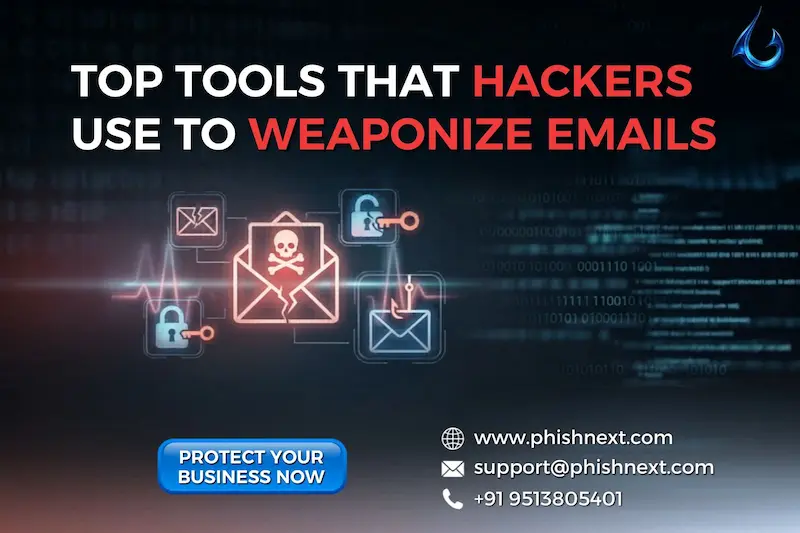
Emails are one of the targets of cybercriminals during a cyberattack, persisting to penetrate the victim’s networks and systems. If a cybercriminal goes through their emails, they won’t be able to secure confidential data from a leak.
Here, we will talk about how these attacks take place and how you can secure your emails against such attacks. What are we waiting for? Let’s get straight to the topic!
What is Weaponizing Emails?
The process of turning a typical digital communication into a vehicle for a cyberattack by inserting malicious links, attachments, or social engineering triggers is known as "email weaponization."
In order to get over security filters and trick receivers into compromising their systems, attackers employ sophisticated technologies to pose as genuine business demands. The final objective is to use email's built-in trust to steal private information, install malware, or intercept multi-factor authentication tokens.
Delivery & Evasion: How They Slip Past the Gatekeepers?
|
S.No. |
Factors |
How? |
|
1. |
HTML and CSS Obfuscation |
Attackers utilize sophisticated scripts to conceal or jumble dangerous source code, causing security scanners to display innocuous language while the user's browser displays a phishing page. |
|
2. |
IP and User-Agent Cloaking |
While only disclosing the true attack to the intended human target, malicious servers verify the visitor's identity and present a phony, "clean" site to security bots and researchers. |
|
3. |
Domain Squatting and Typosquatting |
In order to take advantage of human error and fool consumers into believing a phony website, hackers register visually similar web addresses, such as replacing an "o" with a "0". |
|
4. |
Living off the Land (LotL) |
This method hosts malicious files on reputable cloud services like Dropbox, Google Drive, and SharePoint, making sure that the connections are not detected by common reputation filters. |
|
5. |
Automated URL Rewriting Evasion |
Attackers employ multi-step redirects or "time-bombed" links, which stay safe during the initial email scan but change to a dangerous location only after the email has arrived in the inbox. |
Top 5 Tools That Hackers Use to Weaponize Emails
The following are some tools that hackers use to weaponize emails:
- Adversary-in-the-Middle (AiTM) Proxies: By positioning themselves between a user and a legitimate login page, tools such as Evilginx and Mamba intercept live session cookies, thus circumventing Multi-Factor Authentication (MFA).
- Phishing-as-a-Service (PhaaS) Kits: Attackers can purchase ready-to-use software packages on the dark web that offer pixel-perfect login templates, automatic hosting, and integrated database management.
- Generative AI & "Evil GPTs": Phishing emails with flawless punctuation and context awareness that don't have the usual grammatical "red flags" of conventional fraud are created using specialized AI models like WormGPT or FraudGPT.
- Cloaking and Anti-Bot Frameworks: Sophisticated scripts that, before disclosing the malicious payload, check the visitor's hardware fingerprints and IP reputation to identify and stop security researchers or automated scanners.
- Telegram-Based Command & Control (C2): Attackers can evade conventional server-based detection techniques by using automated Telegram bots to obtain stolen credentials and MFA tokens instantly.
Mitigation: How to Defend Against Email Weaponization?
|
S.No. |
Factors |
How? |
|
1. |
Implement Phishing-Resistant MFA |
Replace SMS or app-based codes with FIDO2-compliant authentication and hardware security keys that are impervious to AiTM proxy tools. |
|
2. |
Enforce Email Authentication Standards |
Set up SPF, DKIM, and DMARC records correctly to confirm sender identity and stop hackers from impersonating your company's domain. |
|
3. |
Deploy AI-Driven Behavioral Analysis |
To identify anomalies, such as an odd login location or an abrupt shift in an executive's writing style, use security technologies that baseline "normal" communication patterns. |
|
4. |
Enable URL Sandboxing and Rewriting |
Put in place a "click-time" security mechanism that encloses each link in a safe layer and only checks the destination for dangers when the user clicks on it. |
|
5. |
Establish a "Human Firewall" with Simulation |
To teach staff members how to recognize the most recent obfuscation and social engineering techniques employed by hackers, conduct frequent, high-fidelity phishing simulations. |
Frequently Asked Questions
About Tools That Hackers Use to Weaponize Emails
- What does "weaponization" mean in a cyber attack?
In order to execute an exploit on a target's machine, an attacker will combine a vulnerability with a malicious payload into a deliverable package, such as a booby-trapped document or a misleading email. This process is known as weaponization.
- How do hackers bypass Multi-Factor Authentication (MFA)?
In the following ways, hackers bypass MFA:
a) Adversary-in-the-Middle (AiTM) Proxies,
b) MFA Fatigue (Prompt Bombing),
c) SIM Swapping,
d) Session Token Theft, and
e) Social Engineering (Vishing).
- What is HTML obfuscation, and why is it used?
The technique known as "HTML obfuscation" involves jumbling a website's source code with intricate scripts or encoding to keep security scanners from identifying harmful information while maintaining the victim's ability to view the page correctly.
- Why do some phishing sites appear to be hosted on Microsoft Azure?
In order to circumvent reputation-based filtering and trick visitors into believing a phony login page is a genuine Microsoft service, hackers host phishing sites on Microsoft Azure. They do this by taking advantage of the "inherited trust" of the windows.net domain and authentic Microsoft SSL certificates.
- Can standard email security stop these weaponized attacks?
Because weaponized emails use dynamic obfuscation, trusted cloud hosting, and real-time proxies to appear completely legitimate, standard email security frequently fails to block these attacks because traditional filters rely on static signatures and known "bad" reputations.
|
Note: To get a stress-free working environment, you can go for a specially designed tool, “PhishNext,” which provides specialized simulations of phishing attacks so that users can get used to such attacks and never become victims of such attacks. |
Trending Blogs
- How to Identify a Phishing Website? | PhishNext
- Top 10 Best Phishing Simulation Tools In 2026
- Corporate Phishing Simulation Solutions in India
- What Is Phishing Simulation? Complete Guide for Businesses
- Time Pressure is the Biggest Email Red Flag: Why?
- How to Identify Fake Websites: A Beginner’s Guide to URL Safety
- Ransomware Infection Incident Disclosed by Washington Hotel in Japan
- Phishing, Vishing, and MFA Attacks Target Enterprise Identity Systems
- Most Cmmon Passwords used in the Whole Year: Report
- Human Risk Management and Security Awareness Training
- What Is Open-Source Intelligence (OSINT)? | PhishNext
- What Is AI Security Posture Management (AI-SPM)?