What Is AI Security Posture Management (AI-SPM)?
Let’s take a look at what amazing thing AI Security Posture Management (AI-SPM) is and how it works! Well, most of you might have gotten an idea of what it is used for. Yes, it is AI Security. Nowadays, AI has fully entered every sector working in the IT Industry.
If you want to protect yourself against AI-embedded attacks, you need to prepare yourself beforehand. What are we waiting for? Let’s get started!
What is AI-SPM?
A specific system called AI Security Posture Management (AI-SPM) was created to identify, evaluate, and secure an organization's AI models, data pipelines, and supporting infrastructure over the course of their whole lifecycle.
In order to guarantee adherence to security regulations, it actively manages risks like model poisoning, prompt injection, and unauthorized data access while offering visibility into "Shadow AI".
AI-SPM bridges the gap between conventional cloud security and the distinct, dynamic dangers presented by large-scale AI deployments by directly integrating these controls into MLSecOps. Let’s take a look at what AI Security Posture Management (AI-SPM) is and how it works for the users!
Steps of AI-SPM
|
S.No. |
Steps |
What? |
|
1. |
Visibility and Discovery |
Identify and catalog all AI models, datasets, and third-party APIs, including unapproved "Shadow AI" instances, by continuously scanning your environment. |
|
2. |
Data Governance |
Enforce stringent controls over the data lifecycle to prevent data leaks during AI interactions and to guarantee that sensitive information is not utilized for training without consent. |
|
3. |
Risk Management |
To reduce possible risks before they are exploited, proactively find and rank vulnerabilities, including prompt injection, model poisoning, and insecure setups. |
Operational Capabilities
The following are some operational capabilities of AI-SPM:
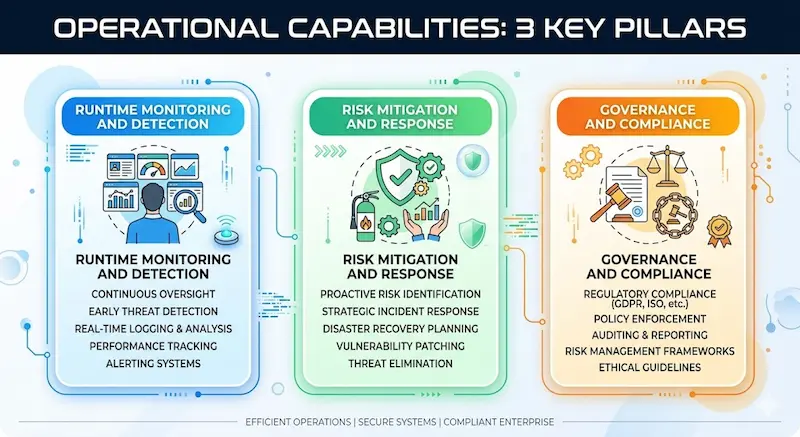
- Runtime Monitoring and Detection: Keep an eye on AI interactions in real time to spot irregularities, illegal data access, or attempts at harmful injection as they happen.
- Risk Mitigation and Response: Immediately neutralize detected threats by using automated or manual measures, such as isolating affected models or preventing suspicious prompts.
- Governance and Compliance: To make sure that all AI usage complies with internal security standards and external regulatory requirements like the EU AI Act, keep thorough audit logs and reporting.
Why Is AI-SPM Important?
For the following reasons, AI-SPM is important:
● Securing the AI Supply Chain: It ensures that flaws or malicious code placed in external components do not jeopardize your entire AI stack by giving you visibility into third-party models, APIs, and open-source datasets.
● Preventing Data Leakage: In order to prevent sensitive intellectual property or personally identifiable information (PII) from unintentionally being incorporated in training data or disclosed through public LLM prompts, AI-SPM maintains tight data control.
● Mitigating Novel AI-Specific Threats: It serves as the main defense against complex assaults that target AI logic instead of code, like data poisoning, prompt injection, and model inversion, which are undetectable by conventional firewalls.
● Eliminating Shadow AI: AI-SPM stops "Shadow AI," or the illicit use of insecure AI apps that get under IT security procedures, by continuously identifying and cataloging every AI tool used within the organization.
● Ensuring Regulatory Compliance: AI-SPM offers the auditing, reporting, and policy enforcement required to demonstrate that your AI systems are being used safely, ethically, and in accordance with the law as governments implement new frameworks like the EU AI Act.
How Does AI-SPM Differ from CSPM?
|
S.No. |
Topics |
Factors |
How? |
|
1. |
AI Security Posture Management (AI-SPM) |
Focuses on AI Logic & Models |
It focuses on AI-specific flaws such as model poisoning, prompt injection, and unsafe model training setups. |
|
Manages AI Data Governance |
In order to prevent data leakage through AI prompts and outputs, it keeps an eye on and limits sensitive data (PII/ IP) utilized in training or inference. |
||
|
Governs AI-Specific Compliance |
By keeping an eye out for bias or inadvertent model behavior, it guarantees that AI deployments comply with AI-centric laws and ethical usage guidelines. |
||
|
2. |
Cloud Security Posture Management (CSPM) |
Focuses on Infrastructure Configs |
It finds setup errors in cloud settings, like unencrypted storage, exposed S3 buckets, and excessively permissive IAM roles. |
|
Monitors Network & Compute Security |
It monitors the condition and security posture of cloud service providers' virtual machines, containers, and network perimeters. |
||
|
Enforces General Regulatory Compliance |
By examining system settings and access logs, it guarantees that cloud infrastructure complies with general compliance frameworks such as SOC2, HIPAA, or ISO 27001. |
AI-SPM Within MLSecOps
The MLSecOps pipeline's crucial governance and continuous monitoring layer, AI-SPM, makes sure that security safeguards are incorporated from the first model design to deployment. It enables teams to preserve security agility without slowing down the iterative development and release cycles typical of contemporary machine learning operations by automating visibility and threat detection.
AI-SPM Vs. DSPM
|
S.No. |
Topics |
Factors |
How? |
|
1. |
AI Security Posture Management (AI-SPM) |
Focuses on AI Interaction |
In order to stop sensitive data from being processed by unapproved or public models, it keeps an eye on the real-time data flow into AI prompts and out of AI responses. |
|
Protects the "AI Stack" |
In particular, it protects the distinct elements of the machine learning lifecycle, including the logic of the model, training pipelines, and the APIs that link AI services. |
||
|
Defends Against Behavioral Risks |
It is intended to identify "live" risks that arise during active AI use, such as prompt injection, model hallucinations, and data poisoning. |
||
|
2. |
Data Security Posture Management (DSPM) |
Focuses on Data Residency |
It continuously finds and maps the locations of databases, cloud buckets, and SaaS apps that contain sensitive data (PII, IP, and financial information). |
|
Manages Static Data Risk |
It finds "data at rest" vulnerabilities, such as data located in the incorrect geographic area, unencrypted storage, or overly exposed permissions. |
||
|
Ensures Data Hygiene |
To lessen the organization's overall attack surface, it places a high priority on cleaning up "dark data" sensitive information that is underused or forgotten. |
Frequently Asked Questions
About AI Security Posture Management (AI-SPM)
- What is grounding AI models, and is it different from training them?
In contrast to training, which teaches a model patterns from a fixed, static dataset during its initial development, grounding an AI model connects it to real-time, external, and reliable data sources to offer a precise, current context for its replies.
- What is model contamination?
When test or evaluation data is unintentionally incorporated into a model's training dataset, it can "memorize" the answers and generate erroneously high performance metrics during evaluation. This is known as model contamination.
- Are CSPM and AI-SPM both required for AI security governance?
Yes, both are necessary since AI-SPM precisely regulates the distinct logic, model behaviors, and immediate security concerns inherent in AI applications, while CSPM protects the fundamental cloud architecture and storage.
- What role do visibility and control play in AI security posture management?
While control offers the means to implement security regulations and immediately reduce recognized threats, visibility enables enterprises to identify and monitor all AI assets and data flows.
- What is an AIBOM?
A thorough, organized inventory of all the parts, datasets, libraries, and third-party models used to construct an AI system is called an AI Bill of Materials (AIBOM), and it offers the transparency required to monitor provenance, security flaws, and license compliance.
- What is explainability?
Explainability, also known as XAI (Explainable AI), describes the strategies and tactics used to make complicated AI models' internal decision-making processes accessible, intelligible, and comprehensible to human users.
- What are notebooks in the AI/ML development workflow?
For quick prototyping, data exploration, and iterative experimentation in the AI/ML workflow, data scientists can integrate live code, visual output, and narrative text into a single document using interactive, web-based computing environments called notebooks (like Jupyter).
- What is the AI supply chain?
The complete lifespan of an AI system, including the training data sources, foundational models, third-party libraries, infrastructure, and deployment tools needed to move an AI application from development to production, is included in the AI supply chain.
- What are common AI attack vectors?
The following are some of the common AI attack vectors:
a) Prompt Injection,
b) Data Poisoning,
c) Model Inversion/Extraction,
d) Adversarial Attacks, and
e) Supply Chain Attacks.
- How do artificial intelligence and machine learning contribute to security blind spots?
In addition to introducing new, automated attack surfaces like malicious prompt injections and data poisoning that conventional, signature-based security tools are not intended to detect or monitor, AI and ML also contribute to security blind spots by producing "black box" systems with opaque internal logic.
|
Note: To get a stress-free working environment, you can go for a specially designed tool, “PhishNext,” which provides specialized simulations of phishing attacks so that users can get used to such attacks and never become victims of such attacks. |
Helpful Resources
- Phishing, Vishing, and MFA Attacks Target Enterprise Identity Systems
- Most Cmmon Passwords used in the Whole Year: Report
- Human Risk Management and Security Awareness Training
- What Is Open-Source Intelligence (OSINT)? | PhishNext
- What Is AI Security Posture Management (AI-SPM)?
- Winner of the AI Arms Race: Threat Actors vs Cybersecurity Defenders
- Phishing Simulation: How It Works to Reduce Risk? | PhishNext
- 50% Rise in Ransomware Attacks Even as Payments Drop
- Top Tools That Hackers Use to Weaponize Emails | PhishNext
- Top Six Key Benefits & Core Features of Endpoint Security | PhishNext