What Is Open-Source Intelligence (OSINT)? | PhishNext
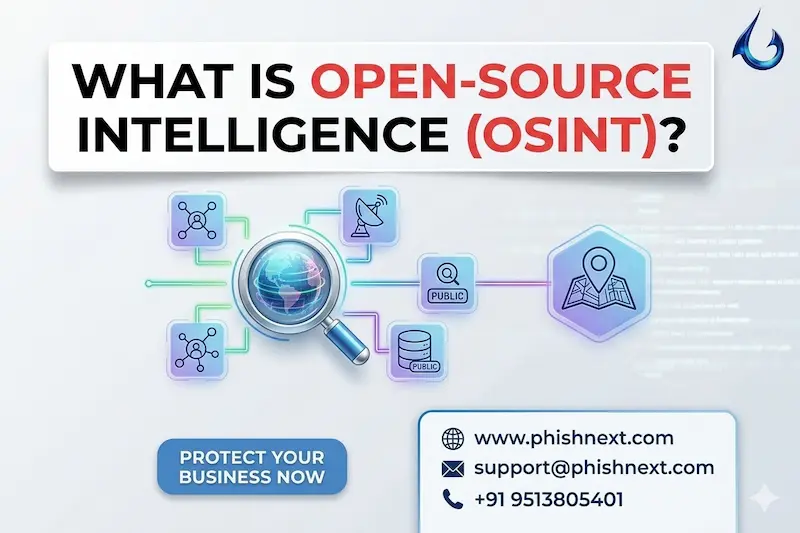
Do you want to know about what OSINT is and its uses? If not, then you are at the right place. Here, we will explore what it is and how it impacts the work performance of the workforce in the IT Industry.
Exploring it will help you understand its nature and reduce the chances of risks related to it. What are we waiting for? Let’s get started!
What is OSINT?
The methodical gathering, analysis, and distribution of data from publicly accessible sources such as social media, domain registrations, and official documents in order to produce actionable insights is known as open-source intelligence, or OSINT.
In a cybersecurity context, it is primarily used during the reconnaissance phase to map an organization's attack surface or to identify personal details of employees for social engineering. Through the synthesis of fragmented data from the "clear web" and "dark web," OSINT enables attackers and defenders to create a high-fidelity profile of a target without ever coming into contact with their internal systems.
Let’s take a look at what OSINT is and how it helps users working in the IT Industry!
Why is OSINT so effective?
|
S.No. |
Factors |
Why? |
|
1. |
Evasion of Detection (Passive Reconnaissance) |
Attackers never come into contact with the target's network and are undetectable by conventional firewalls since they obtain information from external sources like DNS records or LinkedIn. |
|
2. |
Scale and Speed through AI Automation |
High-value targets can be found more quickly than with a manual search thanks to the ability of contemporary LLMs and scrapers to process millions of social media posts and compromised credentials in a matter of seconds. |
|
3. |
The "Human Factor" Vulnerability |
Employee-shared personal information, like vacation photos or office badges, is the ideal "pretext" for extremely convincing spear-phishing and social engineering assaults. |
|
4. |
Visibility into the "Extended" Attack Surface |
OSINT uncovers "forgotten" assets that aren't formally recorded in an organization's inventory, such as shadow IT, outdated development subdomains, and third-party SaaS integrations. |
|
5. |
Leveling the Information Playing Field |
With strong, open-source technologies like Shodan and Maltego, small teams or solitary threat actors can obtain the same high-quality intelligence that was previously only available to nation-states. |
When is OSINT used in the cyber kill chain?
In the following situation, OSINT is used in the cyber kill chain:
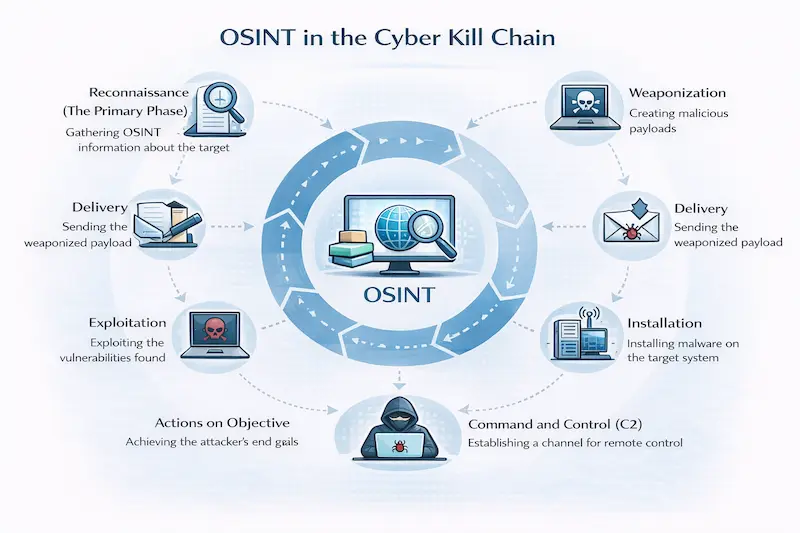 Reconnaissance (The Primary Phase): Attackers use staff emails, social media profiles, and technical metadata to map the target's whole digital and human landscape during this "golden hour" for OSINT.
- Weaponization: In order to ensure that their malware is specifically designed to get over the target's defenses, attackers employ OSINT to determine the target's precise software versions and security patches, or lack thereof.
- Delivery: Highly convincing spear-phishing "lures" that are much more likely to be opened are created using information obtained about a target's professional interests or current corporate happenings.
- Exploitation: Attackers can attempt "credential stuffing" attacks using OSINT on "leaked credentials" from unrelated third-party breaches, frequently obtaining access without the need for technical exploits at all.
- Installation: Attackers can install backdoors that mimic authentic administrative software by investigating the organization's preferred remote-access technologies (such as certain VPNs or RDP installations) through job postings.
- Command and Control (C2): By using OSINT to locate "reputable" yet expired domains or cloud services that the target's firewall already trusts, attackers can conceal their malicious traffic.
- Actions on Objectives: To ensure that they can locate and swiftly exfiltrate data once inside, OSINT assists attackers in identifying the most valuable "crown jewels", such as the particular server containing sensitive intellectual property.
How do attackers use OSINT?
In the following ways, attackers use OSINT:
● Mapping the External Attack Surface: Attackers locate unpatched IoT devices that act as entry points, forgotten subdomains, and exposed cloud buckets (S3) using tools like Shodan and DNSDumpster.
● Crafting Hyper-Targeted Social Engineering: Hackers produce "pretext" emails that are identical to authentic corporate correspondence by searching LinkedIn and Twitter for staff responsibilities, recent promotions, or company events.
● Credential Harvesting via Data Breaches: Actors try to "stuff" employee passwords from unrelated breaches into corporate VPNs or email portals by searching dark web "combo lists" or Have I Been Pwned.
● Identifying the Technical Stack: Attackers identify the precise software versions (e.g., WordPress 5.x) that an organization uses to locate and weaponize existing "Zero-Day" or public exploits by using BuiltWith or examining GitHub changes.
● Physical Security Reconnaissance: Attackers map out CCTV "blind spots" and access control systems for actual site breaches by examining geotagged social media images of office interiors or employee ID badges.
Common OSINT Tools and Data Sources
|
S.No. |
Factors |
What? |
|
1. |
Shodan & Censys |
Testers can identify exposed ports, unpatched software, and incorrectly configured hardware by using specialized search engines that index "Internet of Things" (IoT) devices, servers, and industrial controllers. |
|
2. |
Maltego |
An effective link-analysis tool that maps a target's whole infrastructure and hierarchy by producing visual "graphs" of relationships between individuals, domains, IP addresses, and social media aliases. |
|
3. |
TheHarvester |
A traditional reconnaissance program that automatically gathers hostnames, emails, and subdomains from numerous public sources, including PGP key servers, Google, Bing, and LinkedIn. |
|
4. |
Google Dorking (Advanced Search) |
Using certain search operators (such as filetype:pdf "confidential") to find login portals, "hidden" directories, and sensitive documents that search engines index. |
|
5. |
Have I Been Pwned (HIBP) & Intelligence X |
Important data sources for "Credential Intelligence" are used to determine whether an employee's email has been compromised in prior data breaches, which frequently reveals working passwords for "credential stuffing" assaults. |
The Ethics and Legality of Open-Source Gathering
The following are some of the ethics and legality of Open-Source Gathering:
a) Adherence to Privacy Regulations (GDPR/ CCPA): Gathering and keeping "Personally Identifiable Information" (PII) without a legal basis can result in significant regulatory fines, even if the data is public.
b) The "Passive vs. Active" Legal Line: While utilizing automated "scrapers" or "brute-force" tools against a website's Terms of Service might result in civil or criminal lawsuits, browsing public social media is generally legal.
c) Handling Hacked and Leaked Data: The Computer Fraud and Abuse Act (CFAA) is blatantly violated when "combo lists" obtained through third-party breaches are used to try to log in.
d) Ethical Duty to "Do No Harm": Expert testers must make sure that the information obtained is not utilized to harass, "dox," or harm the reputation of people who are not involved in the security scope.
e) Consent and Authorization (The "Get Out of Jail Free" Card): The only firm legal protection available to a tester conducting OSINT on a particular corporation is a signed "Rules of Engagement" (RoE) document.
What can employees do to protect themselves from OSINT?
Employees can do the following things to protect themselves from OSINT:
- Strict Social Media Privacy: Make sure that office images and professional information are hidden from the public and "friends of friends" by setting all personal profiles to "Private" and routinely checking friend lists.
- Metadata Sanitization: Before submitting images and documents to public websites or corporate portals, use "Exif-stripping" programs to eliminate GPS coordinates, device types, and software versions.
- Avoid "Social Sign-Ons": Avoid using "Login with Google" or "Login with Facebook" on third-party apps because this makes it easy for OSINT tools to map a traceable web of linked accounts.
- Credential Isolation: To avoid "credential stuffing" in the event that one site has a data breach, use a distinct, high-entropy password and a different personal email account for each service.
- Information Minimization (The "Vacation Rule"): Posting "real-time" updates regarding travel, office locations, or high-vis badges should be avoided since they give attackers the ideal opportunity to exploit you both physically and psychologically.
Frequently Asked Questions
About OSINT
- What is OSINT, and how do cybercriminals use it?
To map an organization's attack surface and create extremely convincing, tailored attacks without ever coming into contact with the victim's internal network, hackers use OSINT, which is the lawful collection and analysis of publicly available data ranging from social media to technical DNS records.
- How does OPSEC help defend against OSINT gathering?
In the following ways, OPSEC helps defend against OSINT gathering:
a) Identification of "Critical Information",
b) Analysis of Vulnerabilities,
c) Application of Countermeasures,
d) Pattern Randomization, and
e) Continuous Monitoring (Feedback Loop).
- Why is LinkedIn a popular tool for attackers using OSINT?
Because it offers a verified, structured directory of an organization's hierarchy, employee roles, and particular technical stacks, LinkedIn is the most popular tool for attackers. This enables them to map the "human attack surface" and create highly customized social engineering lures with surgical precision.
- At what stage of the cyber kill chain is OSINT most commonly used?
OSINT is most frequently employed in the Reconnaissance stage, which is the first step in obtaining information on a target's personnel hierarchy, technical infrastructure, and potential weaknesses prior to any direct contact.
- What steps can employees take to reduce their OSINT risk?
Employees can take the following steps to reduce their OSINT risk:
a) Strict Social Media Siloing,
b) Metadata Sanitization,
c) Opt-Out of Data Brokers,
d) Credential & Identity Isolation, and
e) The "Zero-Trust" Sharing Mindset.
|
Note: To get a stress-free working environment, you can go for a specially designed tool, “PhishNext,” which provides specialized simulations of phishing attacks so that users can get used to such attacks and never become victims of such attacks. |
Trending Blogs
- What Is Open-Source Intelligence (OSINT)? | PhishNext
- What Is AI Security Posture Management (AI-SPM)?
- Winner of the AI Arms Race: Threat Actors vs Cybersecurity Defenders
- Phishing Simulation: How It Works to Reduce Risk? | PhishNext
- 50% Rise in Ransomware Attacks Even as Payments Drop
- Top Tools That Hackers Use to Weaponize Emails | PhishNext
- Top Six Key Benefits & Core Features of Endpoint Security | PhishNext
- AI and Vishing Social Engineering Risks Aiming Businesses
- Phishing Scam Targets India AI Impact Summit Attendees: Urgent Security Advisory
- Even After AI Improves Secure Development, Why Cybersecurity Still Matters