What Is Phishing Simulation? Complete Guide for Businesses
 Do you want to know what a Phishing Simulation is? If yes, then you are at the right place. Here, we will explore what phishing simulation is and how it helps individuals to learn the ways cybercriminals use to phish the victims in such attacks, and how they can evade them.
Moreover, we will introduce you to a reliable phishing simulation solution that can offer you real-life experience for phishing attacks and help you secure yourself from future attacks. What are we waiting for? Let’s get started!
What Is Phishing Simulation?
A phishing simulation is a controlled security exercise in which a company tests its employees' abilities to recognize and report online dangers by sending them authentic, fictitious phishing emails.
These simulations offer consumers who engage with the bait a safe "teachable moment" by imitating real-world strategies employed by cybercriminals, such as frantic requests for credentials or harmful attachments.
These initiatives are crucial in 2026 for bolstering the "human firewall" and obtaining data-driven insights into an organization's susceptibility to deepfake and social engineering attacks. Let’s take a look at what a Phishing Simulation is and the benefits!
Types of Phishing Simulations (Email, SMS, Voice & More)
|
S.No. |
Types |
What? |
|
1. |
Email Phishing (Standard Phishing) |
The most popular simulation tests employees' ability to identify fraudulent digital communications by employing phony executive signatures, "urgent" attachments, or misleading emails with malicious links. |
|
2. |
Smishing (SMS Phishing) |
In order to take advantage of customers' high level of trust in their phones, these simulations send phony text messages to mobile devices, frequently disguising them as item arrival alerts or MFA (Multi-Factor Authentication) security warnings. |
|
3. |
Vishing (Voice Phishing) |
These simulations deceive employees into disclosing confidential company information or approving fraudulent wire transfers over the phone by using automated or live voice calls that are increasingly powered by AI-generated voice clones. |
|
4. |
Quishing (QR Code Phishing) |
These simulations, a growing concern in 2026, use malicious QR codes in digital documents or on physical posters that, when scanned, take the user to a website that collects credentials. |
|
5. |
Social Media & Professional Networking Phishing |
By adopting "job offers" or "IT support" identities to get over conventional email filters, these simulations imitate direct messages on websites like LinkedIn or corporate collaboration channels like Slack. |
Why Phishing Attacks Are a Major Threat to Businesses?
Phishing attacks are a major threat to businesses for the following reasons:
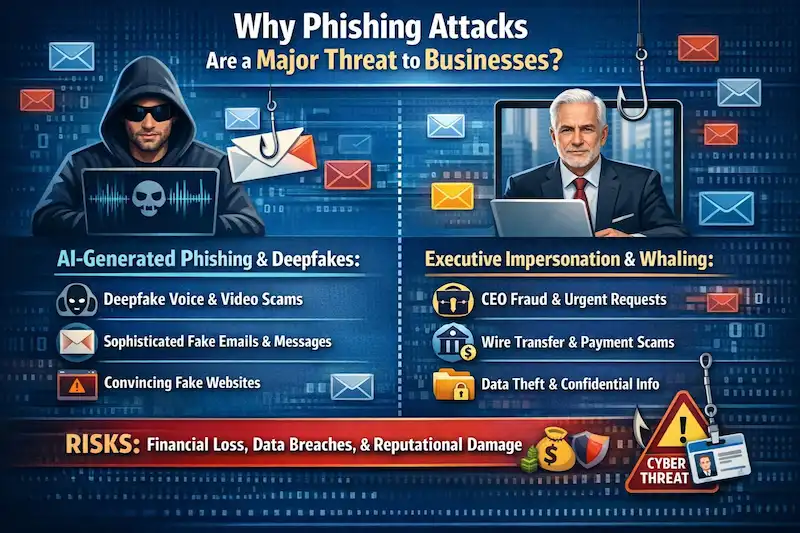
- AI-Generated Phishing & Deepfakes: These days, cybercriminals utilize AI-cloned voices to evade traditional "human" detection signals during fraudulent calls and Large Language Models (LLMs) to create flawless, error-free lures.
- Executive Impersonation & Whaling: With hyper-personalized social engineering, high-value "Whaling" attacks target C-suite executives, causing disastrous financial losses that, on average, exceeded $47 million per incident in late 2025.
How Phishing Simulation Works in Practice?
In the following ways, phishing simulation works in practice:
● Scenario Selection and Customization: Security teams use a template, like a phony "IT Password Reset" or "Unpaid Invoice" notice, and alter the landing page and sender address to resemble the infrastructure of an actual attacker.
● Target Group Segmentation: To make sure the lures are contextually relevant and sufficiently difficult for their particular tasks, the simulation is applied to particular departments or "high-risk" groups (such as Finance or HR).
● Stealthy Delivery and Monitoring: Bypassing internal spam filters, the simulated emails are delivered via a customized platform that tracks in real-time who reads the email, clicks a link, or downloads a "malicious" attachment.
● Point-of-Failure Training: When an employee clicks the lure, they are instantly taken to a "Teachable Moment" site that explains the warning signs they overlooked, giving them rapid feedback while the experience is still new.
● Data Analysis and Remediation: Administrators examine a dashboard of "Click Rates" and "Reporting Rates" to find susceptible users who might need more sophisticated security measures or further required training.
Top Tools and Software for Phishing Simulation in 2026
|
S.No. |
Tools |
What? |
|
1. |
PhishNext (Craw Security) |
A cutting-edge service that specializes in "just-in-time" training teaches users how to recognize complex, AI-enhanced email threats using real-world event data. |
|
2. |
KnowBe4 |
The world's largest collection of more than 25,000 templates and AI-powered "Smart Groups" to automate customized training for high-risk individuals is provided by the industry leader. |
|
3. |
Hoxhunt |
An AI-powered platform that gamifies the experience by sending adaptive, tailored simulations that adjust in difficulty based on each employee's specific historical performance. |
|
4. |
IRONSCALES |
A cloud-native system with special "AI Phishing Simulation Agents" that create highly customized lures for a particular company using actual OSINT data. |
|
5. |
Proofpoint (ZenGuide) |
An enterprise-grade solution that converts real, intercepted phishing assaults into secure, "ThreatFlipped" simulations for staff members by integrating with global threat intelligence. |
Zero-Trust Architecture Integration:
By eliminating the idea of a "trusted" internal network and mandating ongoing, context-aware verification for each access request, Zero-Trust Architecture integrates these seven security categories.
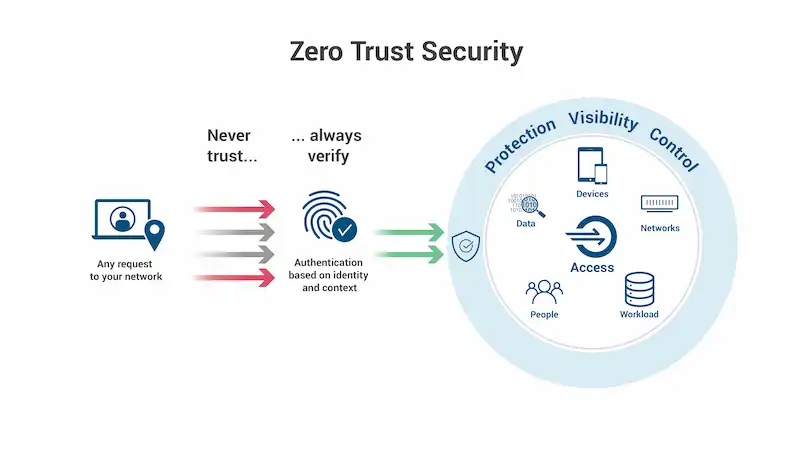
Whether a user is accessing a cloud application, an IoT device, or a local server, it employs granular micro-segmentation and identity-based controls to make sure they are only given the bare minimum of privileges after their identity and device health are rigorously verified.
Best Practices for Running Effective Phishing Simulations
The following are the best practices for running effective phishing simulations:
a) Use Relevant, Context-Aware Lures: To make the test realistic, create simulations like "Project Management Update" or "Benefit Enrollment," which replicate the real software and internal communications your team utilizes daily.
b) Prioritize Positive Reinforcement over Punishment: To promote a cooperative security culture, provide digital badges or public acknowledgment to staff members who click the "Report Phish" button.
c) Implement Just-in-Time Learning: Users who "fail" the simulation should be redirected to a 60-second interactive landing page that underlines the particular warning signs they overlooked while the experience was still fresh in their minds.
d) Vary Simulation Frequency and Difficulty: By launching "micro-campaigns" at random intervals and raising the sophistication of the lures as the team's detection rates increase, you can avoid predictable monthly timetables.
e) Measure the "Reporting Rate," Not Just the "Click Rate": A high reporting rate is a better measure of organizational resilience than a low click rate; thus, concentrate your KPIs on the number of users who successfully reported the threat to the SOC.
Key Benefits of Phishing Simulation for Organizations
|
S.No. |
Benefits |
What? |
|
1. |
Strengthening the "Human Firewall" |
Organizations create subconscious "muscle memory" that enables employees to recognize warning signs in their real inboxes by exposing them to safe, controlled versions of real-world risks. |
|
2. |
Data-Driven Vulnerability Assessment |
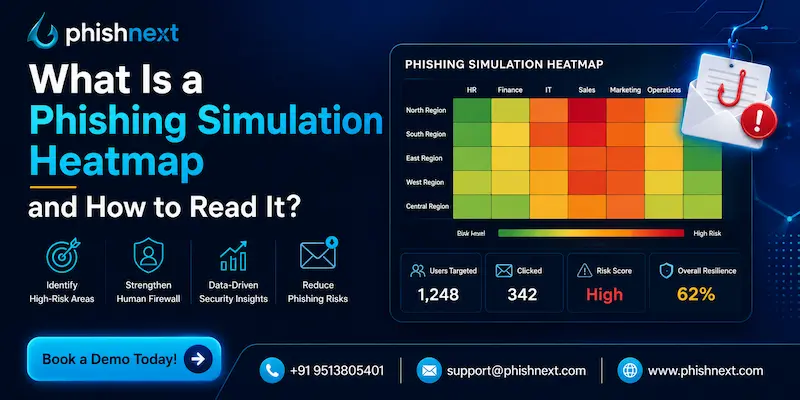
Through the use of tangible measures like "Click Rate" and "Time to Report," simulations enable CISOs to pinpoint particular high-risk departments or persons in need of focused action. |
|
3. |
Compliance and Regulatory Alignment |
In order to maintain accreditation, many contemporary frameworks, including SOC2, ISO 27001, and several 2026 data privacy laws, need documented evidence of continuous security awareness training. |
|
4. |
Reducing the "Attack Surface" of Social Engineering |
Frequent testing greatly reduces the likelihood of a successful breach because knowledgeable employees serve as a distributed sensor network that detects threats before they have a chance to take action. |
|
5. |
Testing Incident Response Procedures |
High-fidelity simulations assess not only the user but also the speed at which the Security Operations Center (SOC) receives, evaluates, and neutralizes a reported danger in a "live-fire" situation. |
Common Mistakes to Avoid in Phishing Training Programs
The following are some of the common mistakes to avoid in phishing training programs:
- Using "Trick" or "Gotcha" Tactics: Employee trust can be destroyed, and a poisonous security culture can result from the use of extremely sensitive themes (such as fictitious "Termination Notices" or "Salary Reductions") or the creation of incredibly challenging lures.
- Focusing Solely on "Click Rates": It is deceptive to use clicks as your sole success statistic; the true objective is to raise the Reporting Rate and transform staff members into active sensors that alert the SOC.
- Irregular or Predictable Training: Instead of developing the everyday habit of skepticism, sending simulations only once every quarter or on a predetermined schedule (e.g., every first Monday) enables users to predict the tests.
- Lack of Immediate Feedback: The psychological impact is lost if the "Teachable Moment" is postponed for hours or days after an employee clicks a link; training works best when it is given at the point of failure.
- Ignoring Non-Email Vectors: In 2026, your company's defense-in-depth approach will be severely compromised if you simply pay attention to email and ignore threats from Smishing (SMS), Vishing (Voice), and QR codes.
How to Measure the Success of Your Phishing Simulation?
In the following ways, you can measure the success of your phishing simulation:
● Reporting Rate (The "Hero" Metric): This gauges the proportion of workers who clicked on the official "Report Phish" button; a high reporting rate is the best proof that your staff is taking preventative actions.
● Click-to-Report Ratio: By contrasting the number of people who fell for the trap with the number of people who flagged it, this gives a clear picture of resilience. The objective is to reach a ratio in 2026 where reports much exceed clicks.
● Mean Time to Report (MTTR): To find out how soon your company can "neutralize" a live campaign before it spreads, monitor the time it takes for the first report to reach the SOC following the launch of a simulation.
● Repeat Offender Rate: Finding the "high-risk" group of workers who routinely fall for several simulations enables the deployment of more stringent technical restrictions (such as hardware security keys) or focused, intensive training for such workers.
● Resilience Rate by Scenario Complexity: By classifying simulations into "Easy," "Medium," and "Advanced" (AI-generated) categories, you may assess whether your team's detection abilities are indeed improving to counter sophisticated contemporary threats.
How to Build a Security-Aware Culture in Your Company?
|
S.No. |
Factors |
How? |
|
1. |
Lead with Executive Buy-in and Modeling |
When C-suite leaders openly take part in phishing simulations and talk about security as a fundamental business value, it communicates to the entire organization that protection is a shared duty. Security begins at the top. |
|
2. |
Gamify the Learning Experience |
Instead of using dull slide shows, replace them with interactive challenges, leaderboards, and digital badges that incentivize staff members to report suspicious activity. This will transform security from a tedious task into an exciting competition. |
|
3. |
Implement "Just-in-Time" Micro-Learning |
Provide concise, pertinent security advice, like a 60-second video about deepfake voice clones, right after a real-world incident or a failed simulation, when the psychological impact and significance are greatest. |
|
4. |
Establish a "No-Blame" Reporting Policy |
Promote openness by making sure staff members may report their own errors (such as clicking on a malicious link) without fear of reprisal, which will enable the SOC to eliminate threats more quickly. |
|
5. |
Appoint Departmental Security Champions |
To serve as local "security advocates" who can offer peer-to-peer advice and put security at the forefront of daily operations, identify and train influential non-IT employees in each department. |
Conclusion
Now that we have talked about Phishing Simulation, you might want to get a dedicated phishing simulation solution. For that, you can go for PhishNext, which is a customized phishing simulation platform that provides similar phishing scenarios to the users, which actually happens when a cybercriminal does phishing.
Moreover, after getting through such scenarios, users will get used to it and will be able to evade such attacks in a better way. What are you waiting for? Contact, Now!
Frequently Asked Questions
About Phishing Simulation
- What is a phishing simulation in cybersecurity?
A phishing simulation is a controlled security exercise that measures an organization's susceptibility to social engineering and teaches staff members how to recognize digital risks by sending them realistic, fictitious, harmful emails.
- Why is phishing simulation important for businesses?
Phishing Simulation is important for businesses for the following reasons:
a) Building Muscle Memory (The Human Firewall),
b) Identifying High-Risk Departments,
c) Reducing the Risk of Costly Breaches,
d) Meeting Compliance and Insurance Requirements, and
e) Validating Incident Response Speed.
- How often should companies run phishing simulations?
Phishing simulations should be carried out at least once a month at random intervals to guarantee that security practices are consistently reinforced without becoming monotonous or overwhelming for employees.
- Is phishing simulation legal and ethical?
When phishing simulations are carried out with prior employee awareness, comply with data protection rules (such as the GDPR or CCPA), and prioritize helpful education above the use of "cruel" lures or punitive measures, they are both legal and ethical.
- What are the most common types of phishing simulations?
The following are the most common types of phishing simulations:
a) Credential Harvesting (Data Entry) Simulations,
b) Malicious Attachment Simulations,
c) Multi-Vector (Omnichannel) Simulations,
d) Business Email Compromise (BEC) & Executive Impersonation, and
e) Quishing (QR Code Phishing) Simulations.
- Can phishing simulations fully prevent cyber attacks?
No, phishing simulators are not a stand-alone defense against advanced technological exploits or zero-day vulnerabilities; rather, they are an essential layer of defense intended to minimize human mistakes.
- What metrics should be tracked in phishing simulations?
The Reporting Rate (% of users who reported the threat) and Mean Time to Report are the most important metrics to monitor in 2026 because they show an organization's proactive defense strength more clearly than click rates.
- What tools are used for phishing simulation?
The following tools are used for phishing simulation:
a) PhishNext (Craw Security),
b) KnowBe4,
c) Hoxhunt,
d) IRONSCALES, and
e) Proofpoint (ZenGuide).
- How do employees typically respond to phishing simulations?
In the following ways, employees typically respond to phishing simulations:
a) Increased Reporting, Not Just Avoiding,
b) The "Just-in-Time" Learning Moment,
c) Gamified Engagement vs. Fatigue,
d) Skepticism Toward AI-Enhanced Lures, and
e) Initial Anxiety Turning to Confidence.
- What is the difference between phishing training and phishing simulation?
Phishing simulation is the real-world application that evaluates those skills using safe, fictitious, harmful emails, whereas phishing training is the instructional material (videos, tests, and modules) that teaches theory.
|
Note: To get a stress-free working environment, you can go for a specially designed tool, “PhishNext,” which provides specialized simulations of phishing attacks so that users can get used to such attacks and never become victims of such attacks. |
Related Security Articles
Top 10 Best Phishing Simulation Tools In 2026
Phishing Simulation: How It Works to Reduce Risk? | PhishNext
What Is Phishing Simulation? Complete Guide for Businesses
How to Identify a Phishing Website? | PhishNext
What Is Open-Source Intelligence (OSINT)? | PhishNext
Time Pressure is the Biggest Email Red Flag: Why?
Phishing on Messaging Apps: How Attackers Use Teams, WhatsApp, SMS, and Slack?
Phishing Attacks Are Imitating City & County Officials: FBI Alerted! | PhishNext
Attackers Using LLMs to Create Phishing Pages in Real Time