Corporate Phishing Simulation Solutions in India
 Do you want to know about some Corporate Phishing Simulation Solutions in India that can provide you with protection against online attacks? If yes, then you are at the right place. Here, we will talk about the best phishing simulation solutions in India.
Moreover, we will find the best features in those solutions and see which one you can choose for better security measures. What are we waiting for? Let’s get straight to the topic!
What Are Corporate Phishing Simulation Solutions?
Comprehensive software systems known as corporate phishing simulation solutions automate the transmission of secure, fictitious "attacks" in order to assess and educate an organization's personnel.
Security teams may discover high-risk departments without the need for manual labor thanks to these enterprise-grade tools' centralized dashboards that track real-time indicators like click rates and reporting speed.
They provide individualized, AI-driven learning that turns workers from potential weaknesses into an active "human firewall" against real attacks by integrating with current identity and email stacks.
Let’s take a look at what Corporate Phishing Simulation Solutions in India are and how they work for a better security solution against future phishing attacks!
Why Indian Businesses Need Phishing Simulation Training?
|
S.No. |
Factors |
Why? |
|
1. |
Massive Increase in Attack Volume |
The attack surface has grown as India's internet population surpasses 100 crore, and in 2025 alone, CERT-In handled about 30 lakh cyber incidents. |
|
2. |
Rise of AI-Powered Deepfakes |
AI voice-cloning and deepfake frauds have targeted nearly half of Indian adults, making simulations necessary to teach staff to confirm high-stakes requests from "synthetic" CEOs. |
|
3. |
Mandatory DPDPA 2023 Compliance |
Businesses are subject to fines of up to ₹200 crore for security lapses under the Digital Personal Data Protection Act, which makes "reasonable safeguards", including staff simulation training, mandatory. |
|
4. |
Targeting of Critical Economic Sectors |
Nearly half of all detections now come from the education, BFSI, and healthcare sectors, necessitating the use of customized lures that imitate industry-specific workflows and regulatory notifications. |
|
5. |
Hyper-Localized Threats |
In order to get over conventional English-centric filters and user suspicion, attackers are increasingly leveraging AI to create grammatically flawless phishing lures in regional Indian languages and through fraud with a UPI theme. |
Key Benefits of Phishing Simulation for Organizations
The following are some of the key benefits of phishing simulation for organizations:
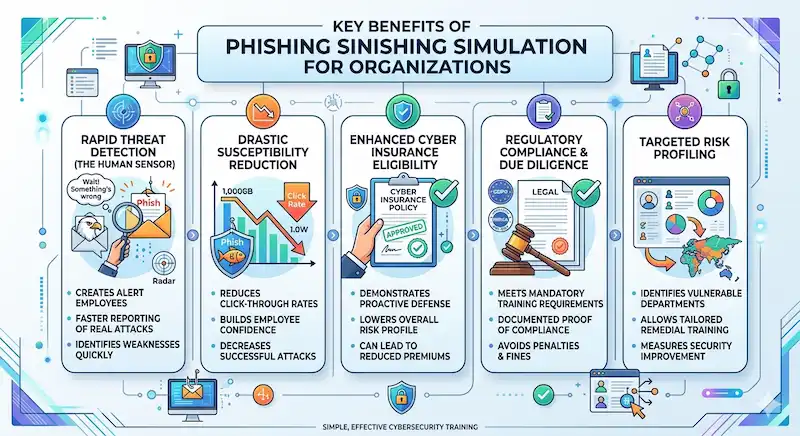
- Rapid Threat Detection (The Human Sensor): Employees are trained to use "Phish Alert" buttons through simulations, transforming thousands of workers into a real-time detection network that detects true zero-day attacks more quickly than many technological filters.
- Drastic Susceptibility Reduction: By fostering skepticism and muscle memory, regular testing usually reduces an organization's "click rate" from an average of 30% to 2-5% during the first 12 months.
- Enhanced Cyber Insurance Eligibility: In order to obtain lower premium rates or to be eligible for coverage in 2026, the majority of insurers will demand documentation of monthly phishing simulations and corrective training.
- Regulatory Compliance & Due Diligence: By demonstrating that the company has taken "reasonable steps" to protect sensitive data, simulations offer the "audit trail" required to comply with SEBI/RBI and DPDPA 2023 regulations.
- Targeted Risk Profiling: Security teams can use granular analytics to pinpoint high-risk departments, such as finance or human resources, and implement sophisticated, role-specific training where it is most needed.
How Phishing Simulation Solutions Work?
In the following ways, phishing simulation solutions work:
● Targeting & Profiling: Create realistic, role-specific attack segments by identifying high-risk groups and synchronizing personnel data.
● Campaign Orchestration: Choose or use AI to create misleading templates, then plan delivery to replicate the time of actual attacks.
● Controlled Execution: Use voice, SMS, or email to send safe, simulated "threats" without jeopardizing the integrity of the real system.
● Interaction Tracking: Get real-time information about who clicked the link, read the message, or reported the threat.
● Just-in-Time Education: While the error is still new, immediately reroute users who "fail" to a quick, interactive learning module.
Features to Look for in Phishing Simulation Tools
|
S.No. |
Features |
What? |
|
1. |
AI-Driven Adaptive Difficulty |
The platform should employ machine learning to automatically modify lure complexity based on a user's prior performance, guaranteeing that astute users remain challenged while struggling users receive basic assistance. |
|
2. |
Multi-Vector Simulation (Omni-Threats) |
To mimic contemporary attacker behavior, look for tools that may mimic coordinated attacks across several channels, such as Smishing (SMS), Vishing (AI-cloned voice calls), and Quishing (malicious QR codes). |
|
3. |
Autonomous "Zero-Touch" Orchestration |
Top-tier products now have "Agentic AI" that creates and schedules hyper-personalized simulations without the need for human IT intervention by scanning your company's public digital footprint (LinkedIn, news, tech stack). |
|
4. |
Integrated "Teachable Moment" Learning |
Instead of a generic 30-minute movie, the application should offer instantaneous, 60-second micro-learning modules that are activated as soon as a user fails an exam, ensuring that the lesson is interesting and pertinent. |
|
5. |
Behavioral Risk Scoring (Human Risk Number) |
The platform should combine training completion, reporting speed, and simulation outcomes into a single, board-ready "Risk Score" that lets you measure the security posture of your company over time. |
Phishing Simulation Use Cases Across Industries in India
The following are the top use cases across industries in India:
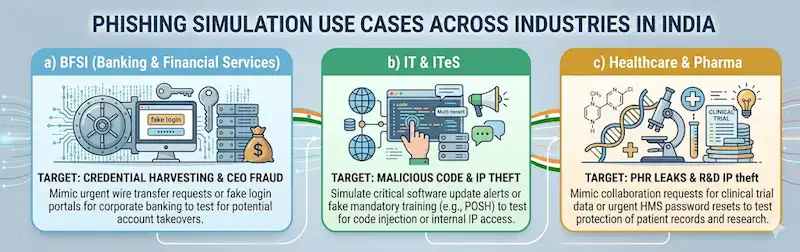
a) BFSI (Banking & Financial Services): To teach staff and clients how to recognize fraudulent push-payment requests before authorizing them, simulations imitate "Collect Request" frauds and fictitious bank KYC alerts in regional languages.
b) IT & ITeS: In order to prevent catastrophic supply chain intrusions, tests concentrate on "Developer Phishing," in which attackers pose as reliable DevOps tools or GitHub warnings in order to gain SSH keys and API tokens.
c) Healthcare & Pharma: To ensure employees adhere to stringent data-handling procedures and avoid the ₹200 crore+ fines required by the new DPDP Act, simulations employ lures relating to "Health ID" upgrades or insurance claims.
Best Practices for Implementing Phishing Simulations
The following are the best practices for implementing phishing simulations:
- Prioritize "Time-to-Report" Over "Click Rate": The only metric that truly prevents an active breach is the speed at which your "Human Sensors" notify the SOC.
- Stagger and Randomize Delivery: To avoid "office chatter" informing colleagues and distorting your results, send simulations in tiny, randomized batches over a few days.
- Implement "Teachable Moments": As soon as a user clicks, while the error is still fresh in their mind, provide instantaneous, interactive feedback, such as a "Spot the Red Flags" overlay.
- Use Context-Aware "Grafted" Lures: To develop functional skepticism, create simulations that imitate real corporate operations, such as fictitious $SaaS$ integration requests or HR policy modifications.
- Maintain Transparency and Trust: To make the program feel more like a cooperative "fire drill" than a "gotcha" trap, inform employees that they will be tested (but not when).
Measuring ROI and Security Awareness Improvement
The Resilience Ratio, which provides a clear statistic for risk reduction by comparing the number of employees who report a threat versus those who click, is used to measure ROI. The Mean Time to Report (MTTR), which shows how fast your "human firewall" can notify the SOC to halt an active breach, is then used to measure the progress in security awareness.
Compliance and Regulatory Considerations in India
The following are some compliance and regulatory considerations in India:
● DPDPA 2023 (Reasonable Security Safeguards): Requires businesses to use "reasonable" behavioral and technical measures, such as phishing simulators, to avoid breaches of personal data, which can now result in fines of up to ₹250 crore.
● RBI Cyber Security Framework (Mandatory Cyber-Drills): Mandates that financial institutions hold frequent, board-approved "cyber-drills" and simulations to make sure employees can quickly identify and report complex financial crime.
● SEBI CSCRF (Evidence-Based Compliance): Requires verifiable evidence of "Cyber Awareness & Training," and as part of their yearly security audits, regulated organizations must provide real simulation data and "Human Risk" indicators.
● CERT-In Vulnerability Reporting: Identifies the lack of social engineering training as a "process vulnerability," forcing businesses to disclose their incident response preparedness and mitigation tactics.
● IRDAI Fraud Risk Management (2026 Guidelines): To tackle the surge in AI-driven insurance and claim scams, insurers are forced to implement a "zero-tolerance" fraud policy that includes required simulation training for partners and staff.
Choosing the Right Phishing Simulation Provider in India
You can choose the right phishing simulation provider in India by considering the following factors:
a) Local Data Residency & DPDPA Compliance: Make that the provider complies with the DPDPA 2023 data localization requirements by hosting all employee PII and simulation data on Indian servers.
b) Hyper-Localized Content & Language Support: Seek out platforms that provide templates in regional languages (Hindi, Tamil, Kannada, etc.) and lures that imitate regional brands such as Indian Income Tax notifications, Keka, or UPI/BHIM.
c) Advanced "Omni-Channel" Simulation (QR & Voice): The fastest-growing attack vectors in the Indian corporate scene are Quishing (QR codes) and Vishing (AI-voice cloning), thus giving preference to providers who can replicate these techniques.
d) CERT-In & Sectoral Regulatory Alignment: Select a service whose reporting directly aligns with the needs of RBI, SEBI, and IRDAI; preferably, this provider should be CERT-In empanelled or adhere to its auditing criteria.
e) Integration with Indian Workflows: For automated user syncing and reporting, the tool should easily interface with the particular productivity stacks utilized in India, such as Google Workspace, Microsoft 365, and HRMS portals.
Frequently Asked Questions
About Corporate Phishing Simulation Solutions in India
- Which is the best phishing simulation service in India?
PhishNext is one of the best phishing simulation services in India, offered by Craw Security.
- Where do 90% of all cyber incidents begin?
More than 90% of cyber incidents start with phishing or social engineering that targets the "human element."
- What is a phishing simulation?
Phishing simulations are controlled security exercises in which a company sends employees safe, simulated "attack" emails to gauge their awareness and teach them how to identify and report actual cyberthreats.
- Is phishing legal in India?
No, phishing is prohibited in India and is considered a serious criminal offense under the Bharatiya Nyaya Sanhita (BNS) and the Information Technology (IT) Act, 2000.
- What are the 4 P's of phishing?
The following are the 4 P’s of phishing:
a) Profit,
b) Panic,
c) Position, and
d) Person.
- What are the 5 methods of phishing?
The following are the 5 methods of phishing:
a) Email Phishing (The Bulk Method),
b) Spear Phishing (The Targeted Method),
c) Vishing (Voice Phishing),
d) Smishing (SMS/ Text Phishing), and
e) Quishing (QR Code Phishing).
- What are corporate phishing tests?
Corporate phishing tests are approved internal simulations in which the IT or security team sends secure, fictitious "attack" emails to staff members in order to assess their capacity to recognize threats and gauge the organization's overall security posture.
|
Note: To get a stress-free working environment, you can go for a specially designed tool, “PhishNext,” which provides specialized simulations of phishing attacks so that users can get used to such attacks and never become victims of such attacks. |
Read More on This Topic
- Top 10 Best Phishing Simulation Tools In 2026
- Phishing Simulation: How It Works to Reduce Risk? | PhishNext
- What Is Phishing Simulation? Complete Guide for Businesses
- How to Identify a Phishing Website? | PhishNext
- What Is Open-Source Intelligence (OSINT)? | PhishNext
- Time Pressure is the Biggest Email Red Flag: Why?
- Phishing on Messaging Apps: How Attackers Use Teams, WhatsApp, SMS, and Slack?
- Phishing Attacks Are Imitating City & County Officials: FBI Alerted! | PhishNext
- Attackers Using LLMs to Create Phishing Pages in Real Time