Top Six Key Benefits & Core Features of Endpoint Security | PhishNext
 Do you want to know about the Six Key Benefits & Core Features of Endpoint Security? If yes, then you are at the right place. Here, we will explore the main use of endpoint security and how it can benefit users for better security purposes.
Moreover, we will talk about an effective solution that can help you enhance the standard of your security measures. What are we waiting for? Let’s get started!
What is Endpoint Security?
The method of preventing malevolent actors and outside threats from taking advantage of end-user devices' entry points, such as laptops, smartphones, and servers, is known as endpoint security.
It entails putting in place centralized security systems that keep an eye on, identify, and stop ransomware and other cyberattacks before they have a chance to damage the larger network. By protecting these distinct "endpoints," companies make sure that each device that connects to their infrastructure acts as a strong gatekeeper instead of a weak backdoor.
Why Does Endpoint Security Matter?
|
S.No. |
Factors |
Why? |
|
1. |
The Rise of Remote Work |
The typical "office perimeter" has disappeared as employees connect from home offices and public Wi-Fi. In order to guarantee that data is safeguarded outside of the corporate firewall, security must now follow the device wherever it goes. |
|
2. |
Preventing "Initial Access" |
The majority of significant data breaches begin at a single endpoint through malware or phishing. By thwarting a threat at the device level, you can stop attackers from getting the traction they need to spread laterally throughout your whole network. |
|
3. |
Protecting Sensitive Data |
Data is really used and stored at endpoints. Endpoint security guarantees that data, whether it be client credit card information or intellectual property, is encrypted and unreadable even in the event that a device is lost or stolen. |
|
4. |
Combatting Sophisticated Malware |
Traditional antivirus software can be circumvented by contemporary threats like fileless malware and zero-day exploits. Behavioral analysis is used by sophisticated endpoint solutions to identify these "silent" dangers in real time before they manifest. |
|
5. |
Compliance and Regulation |
It is legally necessary for several industries, including healthcare and banking, to demonstrate that any devices that access sensitive data are safe. Endpoint security violations can result in hefty fines and severe reputational harm. |
What Are the Key Benefits of Endpoint Security?
The following are the key benefits of Endpoint Security:
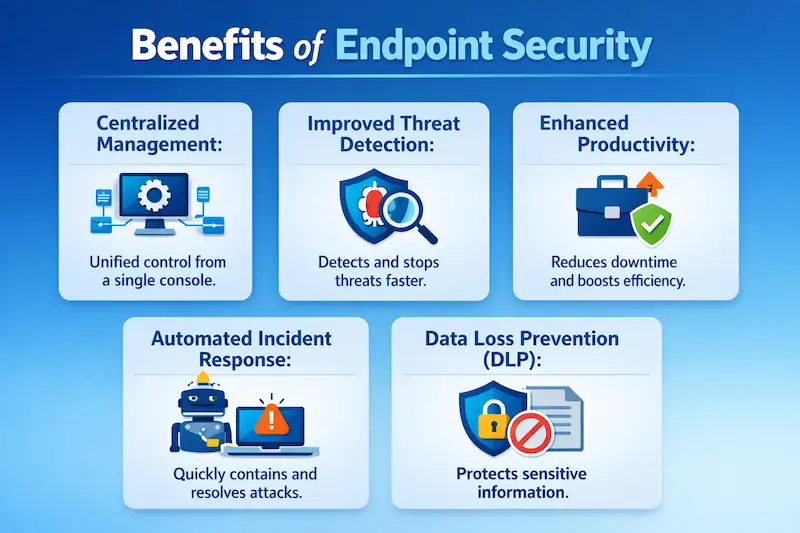
- Centralized Management: Administrators may monitor, update, and patch all linked laptops and mobile devices from a single dashboard rather than handling each one individually, guaranteeing that no "rogue" devices remain susceptible.
- Improved Threat Detection: Even if the particular virus has never been seen before, these systems can use AI and machine learning to spot dangerous patterns, such as a file suddenly attempting to encrypt thousands of documents, and stop them right away.
- Enhanced Productivity: Effective security doesn't consume system resources and operates silently in the background. Additionally, by preventing breaches, it spares the business from the "all-hands-on-deck" pandemonium and significant downtime that follow a cyberattack.
- Automated Incident Response: As soon as a threat is identified, many contemporary solutions can automatically isolate an infected laptop from the rest of the network, limiting the harm without the need for human intervention in the middle of the night.
- Data Loss Prevention (DLP): It stops workers or unauthorized users from unintentionally or purposely sending private information (such as trade secrets or social security numbers) outside the company.
- Cost Savings: Even while there is an initial outlay, it is insignificant compared to the expense of a data breach. A company can save millions of dollars in recovery expenses, legal fees, and lost trust by averting a single ransomware assault.
Industries that need Endpoint Security Facilities
Following industries that need Endpoint Security facilities:
● Healthcare: Highly sensitive Protected Health Information (PHI) is handled by hospitals and clinics. As telemedicine and linked medical devices (IoMT) become more common, it is critical to secure each tablet and monitoring station to avoid HIPAA violations and potentially fatal disruptions.
● Finance and Banking: Fintech companies, banks, and insurance organizations are potential targets for financial gain. In order to safeguard client assets, stop fraudulent transactions, and adhere to strict international banking standards, they need endpoint security.
● Manufacturing and Critical Infrastructure: Industrial Internet of Things (IIoT) devices are used in modern industries to control manufacturing lines. An attacker could be able to alter chemical formulations in a pharmaceutical facility or shut down a power infrastructure with a single endpoint breach.
● Education: Large databases containing research data and students' personal information are managed by schools and universities. Endpoint security is the only method to securely manage that "open" environment when thousands of students link their personal computers (BYOD) to the school network.
● Government and Defense: Classified national security information is handled by these areas. Endpoint security is a fundamental prerequisite for preventing state-sponsored espionage and safeguarding the remote devices used by field agents and government contractors.
● Retail and E-commerce: PCI-DSS requirements must be followed by any company handling credit card information. Point-of-sale (POS) systems and back-office computers are shielded from malware that scrapes client payment information by endpoint protection.
How Is AI Advancing Endpoint Security?
|
S.No. |
Factors |
How? |
|
1. |
Predictive Behavioral Analysis |
Before a breach happens, AI detects malicious intent by identifying minute differences from a user's typical behavior, such as odd data access patterns. |
|
2. |
Automated Incident Response |
The instant a threat is identified, AI systems instantly isolate compromised devices and undo harmful modifications without the need for human intervention. |
|
3. |
Detection of "Fileless" and Zero-Day Malware |
AI detects unseen threats and novel exploits without a known signature by examining code execution in memory as opposed to merely scanning static files. |
|
4. |
Generative AI Security Copilots |
These tools enable analysts to quickly create remediation scripts, summarize large breach reports, and query complex data using natural language. |
|
5. |
Reducing Alert Fatigue |
AI functions as an advanced filter, automatically eliminating thousands of "false positives" so security professionals may concentrate their efforts solely on the most serious, dangerous threats. |
Conclusion
Now that we have talked about the six benefits of endpoint security, you might think that this is the only solution for better security. However, if you reach out to Craw Security, they have something amazing to offer “ShieldXDR.”
This is a security tool to protect your website against hackers with the latest security features, like detecting malware beforehand and eliminating it in a timely manner to protect data. What are you waiting for? Contact, Now!
|
Note: If you want to protect your confidential data against online threats, then you really need a reliable set of techniques and tools to strengthen your database security measures. For that, you can go for Craw Security’s specialized ShieldXDR, which detects and eliminates malicious attempts in a timely manner to secure your data. Go for it! |
Security Learning Resources
- Phishing, Vishing, and MFA Attacks Target Enterprise Identity Systems
- Most Cmmon Passwords used in the Whole Year: Report
- Human Risk Management and Security Awareness Training
- What Is Open-Source Intelligence (OSINT)? | PhishNext
- What Is AI Security Posture Management (AI-SPM)?
- Winner of the AI Arms Race: Threat Actors vs Cybersecurity Defenders
- Phishing Simulation: How It Works to Reduce Risk? | PhishNext
- 50% Rise in Ransomware Attacks Even as Payments Drop
- Top Tools That Hackers Use to Weaponize Emails | PhishNext
- Top Six Key Benefits & Core Features of Endpoint Security | PhishNext