Winner of the AI Arms Race: Threat Actors vs Cybersecurity Defenders

Do you know how AI in Cybersecurity is useful to defend against AI-initiated cyberattacks? If not, then you are at the right place. Here, we will talk about the ways AI helps users to protect their devices against such threats.
Several organizations have already started training their staff for such situations, and normal internet users also need to protect themselves against such attacks. What are we waiting for? Let’s get straight to the topic!
What is AI in Cybersecurity?
In cybersecurity, artificial intelligence (AI) refers to the use of deep learning and machine learning algorithms to automatically identify, anticipate, and eliminate online threats in real time. These systems can automate complex incident responses and stay ahead of new zero-day vulnerabilities by evaluating large datasets to find patterns that depart from typical behavior.
Organizations are able to reduce risks at a scale and pace that human analysts cannot accomplish on their own, thanks to this change from reactive to proactive defense. Let’s take a look at why AI in Cybersecurity is needed!
Types of AI in Cybersecurity
|
S.No. |
Types |
What? |
|
1. |
Machine Learning (ML) |
Identifies unusual network activity and flags any zero-day risks before they become more serious by using statistical models and pattern recognition. |
|
2. |
Generative AI (GenAI) |
Helps developers create secure, hardened code, synthesizes threat knowledge, and automates the development of complex security reports. |
|
3. |
AI-Adjacent Infrastructure Risk |
Focuses on safeguarding the data pipelines and specialized hardware that drive AI against adversarial assaults and model poisoning. |
What Are the Benefits of AI in Cybersecurity?
The following are the benefits of AI in cybersecurity
- Predictive Threat Intelligence: By examining past data and worldwide trends, AI predicts future assaults and finds new vectors before they affect your network.
- Autonomous Incident Response: As soon as a breach is discovered, security systems can immediately isolate vulnerable hosts or block malicious IPs, significantly cutting down on "dwell time."
- High-Fidelity Alert Triage: By removing the noise of thousands of false positives, machine learning enables human analysts to concentrate solely on the most serious, confirmed threats.
- Continuous Behavioral Analytics: AI may identify tiny deviations, such as illicit data exfiltration, that conventional rules might overlook by creating a baseline of typical user behavior.
- Vulnerability Management at Scale: Based on real-world exploitability and business effect, AI-driven scanners automatically rank thousands of software defects.
What Are the Challenges of AI in Cybersecurity?
The following are the challenges of AI in cybersecurity:
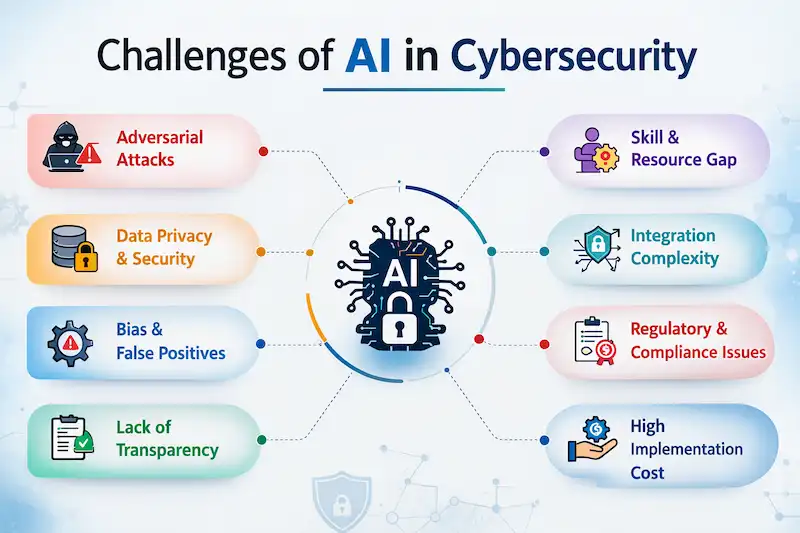
● Adversarial AI and Model Manipulation: By taking advantage of model logic weaknesses, attackers employ AI to create evasive malware and avoid detection.
● Data Poisoning and Integrity Risks: In order to "teach" security models to disregard particular illegal behaviors, malicious actors manipulate training datasets.
● High Rates of False Positives: Security teams may experience alert fatigue as a result of overly sensitive algorithms labeling normal user behavior as a danger.
● Resource and Skill Requirements: Massive processing power and a unique combination of cybersecurity and data science knowledge are needed to implement AI.
● The "Arms Race" Dynamic: Hackers conduct automated, fast attacks as defense AI advances, resulting in a never-ending cycle of increasing complexity.
How Are Security Teams Using AI?
|
S.No. |
Factors |
How? |
|
1. |
Autonomous Investigation & Triage |
By ingesting hundreds of warnings, agentic AI platforms (AI SOCs) reduce the workload for human analysts by deduplicating noise and executing investigation playbooks on their own. |
|
2. |
Hyper-Personalized Phishing Defense |
In order to identify "perfect" AI-generated emails and deepfakes that don't have conventional warning signs, defensive models examine staff communication habits and connection graphs. |
|
3. |
AI Red Teaming & Risk Stress-Testing |
Prior to deployment, security teams "attack" their own AI models using automated adversarial frameworks to find flaws like prompt injection or data poisoning. |
|
4. |
Continuous Behavioral "Pattern of Life" Analysis |
AI creates distinct baselines for each user and device, quickly identifying minute variations as possible insider threats, such as odd API calls or late-night data access. |
|
5. |
Predictive Patch Management |
AI predicts which vulnerabilities are most likely to be weaponized first by analyzing local asset criticality and global exploit trends rather than patching everything. |
How Are Threat Actors Using AI?
In the following ways, threat actors use AI:
a) Hyper-Realistic Social Engineering & Deepfakes: Scammers circumvent conventional trust-based security measures by using "Deepfake-as-a-Service" (DaaS) to mimic executive voices and faces for real-time video call fraud.
b) AI-Driven Reconnaissance & Target Prioritization: Within minutes, autonomous agents can map out susceptible network infrastructures and pinpoint high-value targets by parsing gigabytes of leaked data and social media.
c) Polymorphic and Self-Evolving Malware: Families of sophisticated malware, such as PROMPTFLUX, consult LLMs on an hourly basis to rewrite their own code, creating distinct signatures that avoid detection by static and signature-based methods.
d) Rapid Vulnerability Exploitation: Attackers frequently weaponize recently discovered vulnerabilities (Zero-Days) within 15 minutes of an advisory being released by using AI to automate the "monitor-to-exploit" loop.
e) Adversarial AI (Model Poisoning & Jailbreaking): Hackers employ "Linguistic Payloads" to poison training data or jailbreak corporate LLMs using hidden backdoors (like Basilisk Venom) that only activate under particular circumstances.
How Can Organizations Win the AI Arms Race?
In the following ways, organizations can win the AI Arms Race:
- Implement an "Agentic SOC" with Autonomous Triage: Use AI bots to investigate, correlate, and contain 90% of low-to-medium alarms on their own, freeing up human experts to pursue high-value threats.
- Harden the "Secure ADLC" (AI Development Lifecycle): To avoid quick injection, data leaking, and unsafe model deployments, incorporate security screening into all phases of AI development.
- Adopt AI-Driven Zero Trust & Continuous Authentication: Static passwords should be replaced with models that use location, app activity, and typing patterns to confirm identification every second.
- Engage in Continuous AI Red Teaming: Use automated "adversarial" bots on a regular basis to check your LLMs and defenses for vulnerabilities before actual threat actors discover them.
- Unify Telemetry in a Consolidated Control Plane: To give your security AI a single, high-fidelity view of the whole network, cloud, and endpoint environment, break down data silos.
|
Note: If you want to protect your confidential data against online threats, then you really need a reliable set of techniques and tools to strengthen your database security measures. For that, you can go for Craw Security’s specialized ShieldXDR, which detects and eliminates malicious attempts in a timely manner to secure your data. Go for it! |
Read More Related Topics
- Nation-State Cyber Criminals Using AI to Streamline Targeting
- Stolen Traveler Data Is on Sale at Dark Web, According to Eurail
- Guaranteed Publication in Chrome Web Store with New Malware Kit
- Attackers Using LLMs to Create Phishing Pages in Real Time
- Even After AI Improves Secure Development, Why Cybersecurity Still Matters