AI and Vishing Social Engineering Risks Aiming Businesses
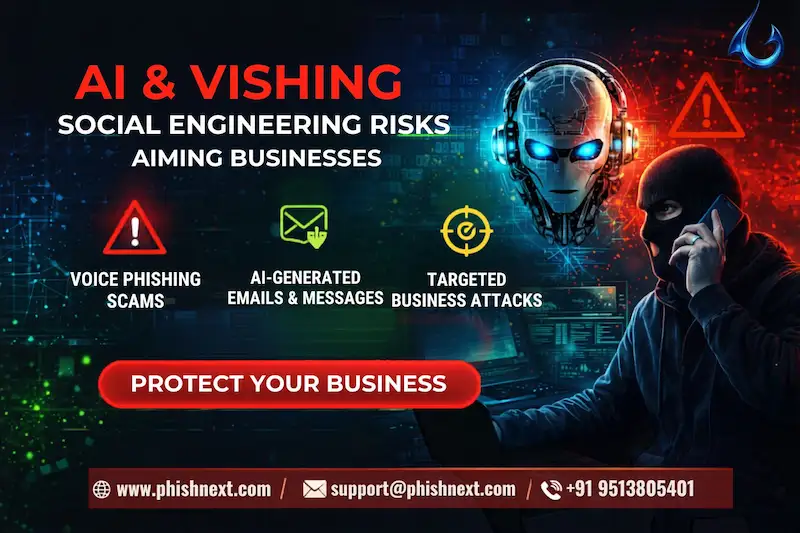 Do you want to know how AI & Vishing Social Engineering risks are attacking businesses in the IT Industry? If yes, then you are at the right place. Here, we will expose the true risks of such engineering techniques.
Moreover, we will explore various ways you can use to protect yourself against such attempts in the easiest way possible. What are we waiting for? Let’s get started!
Broader Threat Landscape: Social Engineering Across 2026
In the "post-grammar" era of social engineering, attackers may now automate highly customized, linguistically flawless deception via email, SMS, and collaboration platforms thanks to generative AI.
This change is typified by the widespread usage of deepfake audio and video to mimic executives, so undermining conventional security measures that depend on identifying typos or dubious sites.
As a result, human manipulation has surpassed technical exploits as the primary first access technique, compelling companies to implement "Zero Trust" authentication mechanisms for all internal communications.
Generative AI & Deepfake Audio Evolution
In order to recreate a person's precise pitch, accent, and emotional nuance, "voice cloning" now requires less than 30 seconds of source audio thanks to advancements in generative AI. By using real-time, interactive deepfake audio instead of static recordings, this technology enables attackers to make live vishing calls that are nearly identical to those made by a reliable executive or colleague.
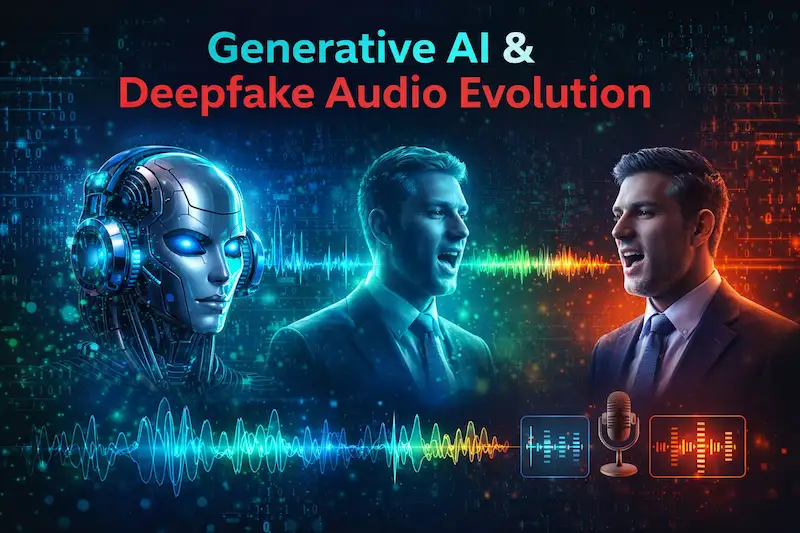
Because of this, companies are forced to regard voice as an unverified data stream that needs secondary, out-of-band authentication, as the "human ear" is no longer a trustworthy security filter.
Regional Cyber Threat Landscape Highlighting Social Engineering in India
The regional cyber threat landscape is highlighting social engineering in India in the following ways:
- Massive Scale of AI-Powered Attacks: The education, healthcare, and manufacturing sectors of India are the main targets of cybercriminals using high-speed automation and generative AI to launch nearly 505 detections every minute.
- Prevalence of Deepfake-Driven Fraud: Deepfake attacks, in which AI-cloned voices or videos are used to get around identity verification and approve fraudulent transactions, have already affected about 65% of Indian organizations.
- Hyper-Personalized "Local" Phishing: Threat actors have progressed from conventional fraud to "Social Engineering 2.0," where they use artificial intelligence (AI) to imitate corporate communication styles, local Indian idioms, and even "too real" WhatsApp messages from senior leadership.
- Credential Theft in Cloud Ecosystems: Credential theft has emerged as the most common attack method (affecting 68% of firms) as Indian businesses quickly adopt cloud-first tactics. This is frequently made possible via vishing calls that deceive staff members into disclosing MFA tokens.
- Hybrid Geopolitical Warfare: "Operation Sindoor" and related initiatives, which combine state-sponsored espionage with hacktivism and use social engineering to breach government and defense networks, are increasingly targeting India's vital infrastructure.
Cyberespionage Campaigns Using Phishing as Initial Access
|
S.No. |
Factors |
Why? |
|
1. |
AI-Enhanced Spearphishing |
Threat actors create perfect, context-aware emails that imitate the tone and writing style of a particular colleague by using Large Language Models to scrub public data. |
|
2. |
Bypassing MFA with AitM |
By positioning themselves between the user and the authentic service, attackers can successfully neutralize multi-factor authentication by using proxy servers to intercept real-time login tokens. |
|
3. |
Recruitment and "Job Offer" Lures |
Before distributing "technical assignments" that are infected with sophisticated malware, groups such as Lazarus create complex phony identities on LinkedIn to establish rapport over the course of several months. |
|
4. |
Omni-Channel Phishing |
Attackers go from email to WhatsApp or SMS (Smishing) to "verify" the malicious link they just gave in order to raise psychological pressure and make the fraud appear more genuine. |
|
5. |
Weaponizing "Trusted" Platforms |
In order to get around conventional email security filters that rely on trustworthy services like Google Drive, GitHub, or Slack, espionage campaigns are increasingly hosting malware payloads on these platforms. |
Incident Response & Zero Trust Authentication
The following are the Incident Response & Zero Trust Authentication:
● Identity as the New Perimeter: Instead of focusing on IP addresses, intrusion detection teams use Conditional Access policies to automatically revoke session tokens as soon as suspicious activity is discovered.
● Micro-Segmentation for Containment: Responders can quarantine a single infected workload or "micro-segment" without taking the entire company offline since the network is divided into isolated zones.
● Continuous Adaptive Authentication: Zero Trust systems employ Risk-Based Authentication (RBA) in place of a one-time login to ask users for additional information if their location, device health, or behavior changes while a session is live.
● Automation and Orchestration (SOAR): By using automation to quickly terminate processes or isolate devices based on predetermined "trust scores," modern IR significantly lowers the Mean Time to Remediate (MTTR).
● Least Privilege Enforcement: Because Zero Trust guarantees that an attacker only has the bare minimum permissions (JIT/JEA) necessary for a particular operation, incident impact is naturally reduced even if they manage to get access.
Conclusion
Now that we have talked about the AI & Vishing Social Engineering Risks Aiming Businesses in 2026, you might want to learn about solutions to keep yourself secure against such attacks. For that, you can go to the phishNext website that offers the Best Simulation Services, provided by Craw Security.
These phishing simulations will help users to be prepared for future phishing attacks. What are you waiting for? Contact, Now!
|
Note: To get a stress-free working environment, you can go for a specially designed tool, “PhishNext,” which provides specialized simulations of phishing attacks so that users can get used to such attacks and never become victims of such attacks. |
Explore Cyber Topics
- What Is Open-Source Intelligence (OSINT)? | PhishNext
- What Is AI Security Posture Management (AI-SPM)?
- Winner of the AI Arms Race: Threat Actors vs Cybersecurity Defenders
- Phishing Simulation: How It Works to Reduce Risk? | PhishNext
- 50% Rise in Ransomware Attacks Even as Payments Drop
- Top Tools That Hackers Use to Weaponize Emails | PhishNext
- Top Six Key Benefits & Core Features of Endpoint Security | PhishNext
- AI and Vishing Social Engineering Risks Aiming Businesses
- Phishing Scam Targets India AI Impact Summit Attendees: Urgent Security Advisory
- Even After AI Improves Secure Development, Why Cybersecurity Still Matters