Whaling Attacks Explained: The Most Dangerous Phishing Scam
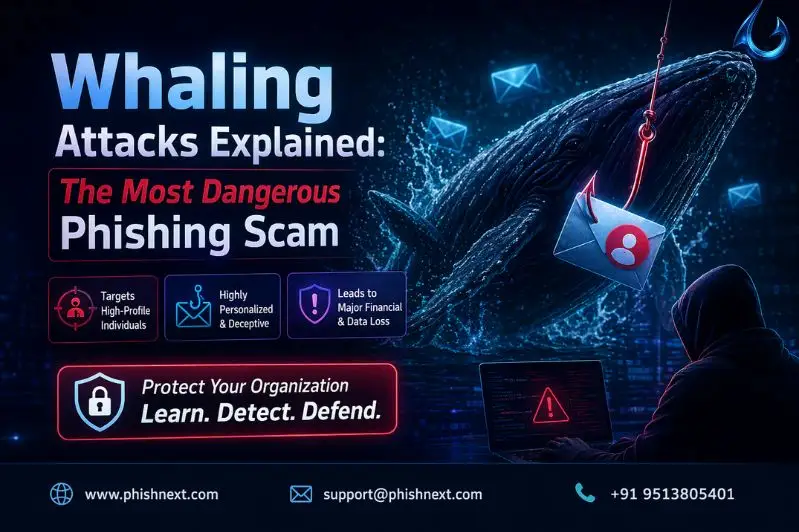
Do you know how severe the damage a Whaling Attack can give you if you’re not prepared beforehand? If not, then it is the time you get to know about it in detail. Here, we will explore what risks it carries and how you can evade it in time.
Moreover, we will introduce you to a reputable VAPT service provider that is offering a dedicated phishing simulation platform. What are we waiting for? Let’s find out!
What Is a Whaling Attack in Cybersecurity?
A whaling attack is a highly focused type of spear phishing that uses sophisticated social engineering and fake communications to specifically trick high-ranking executives, including CEOs or CFOs.
In order to trick the victim into approving large wire transfers or disclosing private information, these attacks frequently pose as urgent legal summons, business litigation, or executive briefings.
Whaling is one of the most harmful and expensive dangers to contemporary organizations due to the high status of the targets and the substantial financial or strategic value of the material involved.
Let’s take a look at what Whaling Attack is, its uses, and how you can protect yourself against such scheming tools!
How Whaling Differs from Traditional Phishing and Spear Phishing?
|
S.No. |
Topics |
Factors |
What? |
|
1. |
Whatling Attacks |
Target Scope |
Focuses only on "big fish," such as the CEO, CFO, or other senior executives with substantial influence and access. |
|
Level of Effort |
Attackers research the executive's speech patterns, travel plans, and business connections in order to craft an impeccable deception that requires a great deal of work and customization. |
||
|
Typical Goal |
Aimed at high-value results, such as obtaining trade secrets or approving wire transfers worth millions of dollars (Business Email Compromise). |
||
|
2. |
Traditional Phishing |
Target Scope |
Sends generic emails to thousands of random recipients at once using a "scattergun" strategy. |
|
Level of Effort |
Requires very little investigation; attackers prioritize quantity over quality in the hopes that a tiny portion of users will click on a malicious link. |
||
|
Typical Goal |
Intended to distribute malware widely or steal popular login credentials, such as those for Netflix or Gmail. |
||
|
3. |
Spear Phishing |
Target Scope |
Aimed at a particular person, group, or organization, in order to establish credibility, the victim's name and job position are frequently used. |
|
Level of Effort |
Uses social media or business websites to conduct moderate research to make the email seem pertinent to the victim's particular function. |
||
|
Typical Goal |
Concentrated on stealing certain department-level data or obtaining internal access to a company's network. |
Why Executives Are Prime Targets for Whaling Attacks?
For the following reasons, executives are prime targets for whaling attacks:
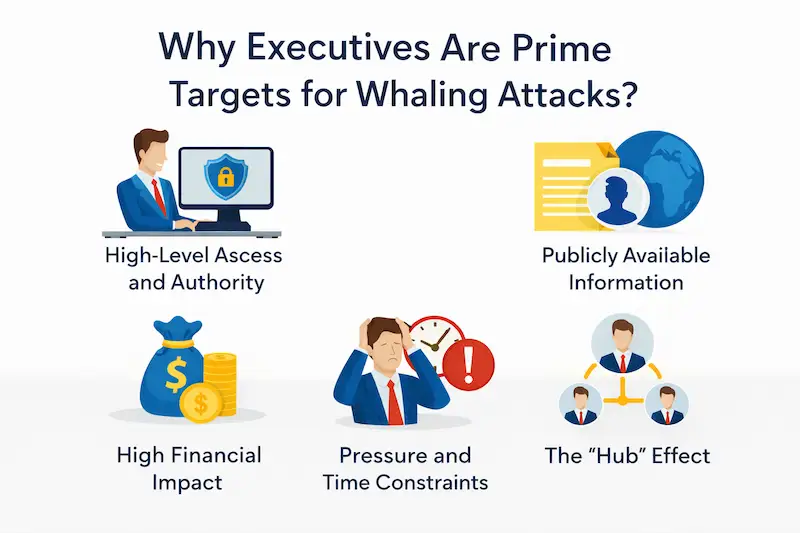
- High-Level Access and Authority: Executives have the authority to approve significant sensitive transactions or data releases without further review, as well as unrestricted administrative privileges.
- Publicly Available Information: Attackers may create very realistic and customized lures because it is easy to find detailed information about leaders on LinkedIn, corporate profiles, and news releases.
- High Financial Impact: Compared to targeting lower-level personnel, a single successful compromise can result in significant, instant cash theft because leaders oversee budgets worth millions of dollars.
- Pressure and Time Constraints: When faced with a "time-sensitive" fictitious emergency, leaders are more inclined to circumvent security procedures because they are frequently overburdened with urgent requests and strict deadlines.
- The "Hub" Effect: An executive's compromised account carries the highest amount of trust because they are key players in the corporation, making it simple to trick everyone else in the hierarchy.
Common Techniques Used in Whaling Scams
The following are some of the common techniques used in whaling scams:
● Deepfake Audio and Video Impersonation: Attackers can successfully authorize fraudulent transactions during high-pressure meetings by using AI-generated voice clones or video calls that imitate an executive's appearance.
● Executive Pretexting & Social Engineering: In order to create a very plausible "pretext" or backstory that makes a fictitious request appear like a reasonable business assignment, criminals spend weeks investigating a target's schedule and professional tone.
● Business Email Compromise (BEC) & Account Takeover: Attackers use the inherent confidence of an internal identity to deliver communications that evade all "external sender" warnings by breaking into a legitimate executive email account.
● Urgent Legal or Regulatory Threats: In order to cause fear and avoid the victim's usual due diligence, whaling emails frequently pose as confidential regulatory investigations or high-stakes court subpoenas.
● Multi-Channel Strategy (The "Follow-up"): Attackers bolster a phony email with a coordinated text message or phone call to boost the success rate, giving the impression of multi-platform legitimacy that is hard to dismiss.
Warning Signs of a Whaling Email
|
S.No. |
Factors |
What? |
|
1. |
Sense of Extreme Urgency or Secrecy |
The email, which is intended to cause fear and deter the CEO from speaking with their team, demands quick action on a "highly confidential" topic. |
|
2. |
Irregular Financial Requests |
The letter requests a change in vendor payment information, an unexpected wire transfer, or the purchase of expensive gift cards that are not part of regular corporate operations. |
|
3. |
Subtle Domain Spoofing (Look-alike Domains) |
Attackers employ phony email addresses that resemble genuine company domains almost exactly, such as substituting a lowercase "l" with a "1" or a ".co" for ".com." |
|
4. |
Anomalous Tone or Language |
The writing style may seem "off," with peculiar syntax, strange greetings, or a degree of formality (or informality) that deviates from the executive's established communication style. |
|
5. |
Request to Bypass Standard Procedures |
To avoid being discovered by accounting departments, the sender specifically requests that internal controls be disregarded, that "skip the paperwork," or that the transaction be kept off the books until a later time. |
Real-World Examples of Whaling Attacks
The following are the real-world examples of whaling attacks:
a) FACC (Aerospace Manufacturer): An employee in the finance department received an email purporting to be from the CEO in a classic "Fake President" scam, seeking €42 million for a covert acquisition project. The money was moved before the deception was discovered.
b) Pathé (Cinema Chain): Using extremely convincing phony email signatures and a "strictly confidential" pretext, attackers pretended to be senior executives from the French headquarters in order to deceive the managing director of the Dutch division into sending over $21 million.
c) Ubiquiti Networks: A whaling attack that targeted the company's finance department resulted in a loss of around $46.7 million. The attackers pretended to be top leadership and outside counsel in order to effectuate several illicit international wire transactions.
The Financial and Reputational Impact of Whaling
Through illegal wire transfers and the ensuing expenses of forensic investigations, legal fees, and regulatory fines, whaling assaults can cause catastrophic financial losses that can exceed tens of millions of dollars.
Beyond the immediate financial loss, these violations cause long-term reputational harm that undermines shareholder confidence, diminishes brand equity, and may result in the resignation of senior executives.
Technical Safeguards
|
S.No. |
Factors |
What? |
|
1. |
DMARC |
In essence, it prevents fake emails from getting to the executive's inbox by acting as a policy layer that instructs receiving servers on how to handle emails that don't pass authentication. |
|
2. |
SPF |
To stop hackers from using your company's name to send fake emails, this DNS record identifies which mail servers are permitted to send emails on behalf of your domain. |
|
3. |
MFA |
In order to prevent an attacker from accessing an executive's account even in the event that their password is stolen, it necessitates a second form of authentication, such as a hardware token or biometric scan. |
How to Prevent Whaling Attacks in Your Organization?
In the following ways, you can prevent whaling attacks in your organization:
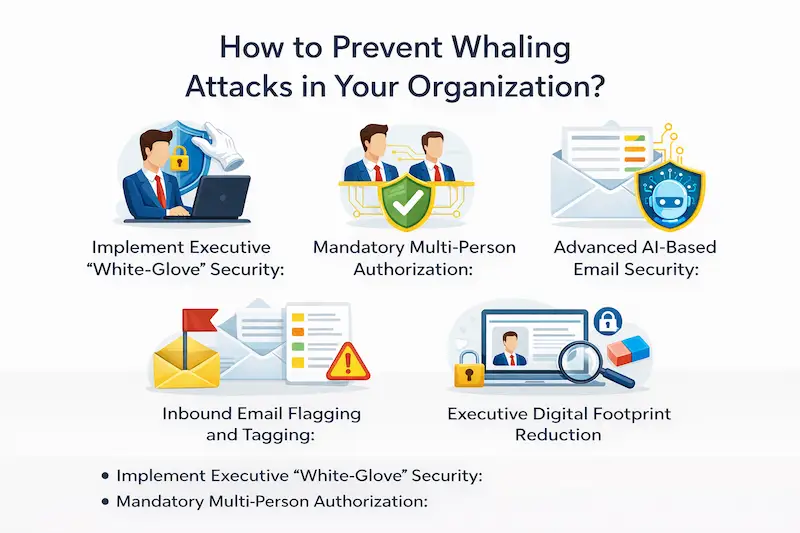
- Implement Executive "White-Glove" Security: Give senior leadership VIP-tier surveillance and specialized, hardened gear so they may identify irregularities in their home and work digital surroundings.
- Mandatory Multi-Person Authorization: Before completing any significant financial transaction, a second authorized officer must provide a voice-confirmed "out-of-band" verification or a physical signature.
- Advanced AI-Based Email Security: Install contemporary security layers that analyze writing style, metadata, and communication patterns in real-time to detect "impersonation" attempts using behavioral modeling.
- Inbound Email Flagging and Tagging: Set up the mail server such that all emails coming from outside the company are clearly labeled with a large banner, making phony "internal" messages immediately noticeable.
- Executive Digital Footprint Reduction: Collaborate with specialized companies to remove private phone numbers, home locations, and family information from public databases and "people search" websites.
Best Practices for Employee Awareness and Training
The following are the best practices for employee awareness and training:
● Conduct Executive-Specific Simulations: Run high-fidelity, personalized whaling simulations that replicate the particular "secret project" narratives and pressure techniques utilized against C-suite executives.
● Establish "Out-of-Band" Verification Protocols: Before acting, teach employees to always validate high-value requests through a second, reliable route, like a direct phone call or an in-person discussion.
● Gamify Threat Reporting: By rewarding staff members who recognize and report suspicious emails via an integrated "Report Phishing" button, you can promote a proactive security culture.
● Review "Social Media Hygiene": Inform executives and staff about how posting vacation images, trip itineraries, or work anniversaries gives scammers the ideal "timing" for fraud.
● Continuous Micro-Learning: Short monthly security briefings on new 2026 risks like deepfake video fraud and AI voice cloning should replace annual training.
What to do if an Executive is Compromised?
|
S.No. |
Factors |
Why? |
|
1. |
Isolate and Revoke Access |
To stop additional lateral movement, immediately end all open sessions, reset global credentials, and isolate the executive's infected devices from the company network. |
|
2. |
Initiate Out-of-Band Verification |
Inform any pertinent department heads and outside partners that the executive's identity is presently untrusted by using a secure, non-email channel, such as a phone call or encrypted messaging app. |
|
3. |
Conduct Immediate Financial Triage |
To try a "kill chain" reversal on any illicit wire transfers started during the hack, notify the bank's fraud department and the FBI's IC3 (Internet Crime Complaint Center). |
|
4. |
Perform Forensic Evidence Collection |
To identify the point of entry and the complete scope of the data exfiltration, save all logs, email headers, and malware samples from the impacted accounts and devices. |
|
5. |
Execute the Communication Plan |
In order to handle disclosure requirements and create a clear statement for stakeholders to minimize long-term reputational harm, notify the legal, PR, and regulatory teams. |
Conclusion
Now that we have talked about Whaling Attack, you might want to know how you can protect yourself against such devious attacks. For that, you can rely on PhishNext, a customized & dedicated phishing simulation platform that gives you various tasks where you confront phishing attacks and will eventually let you experience them to know how to evade them in time.
Such an amazing platform offered by Craw Security can deliver great results for individuals and organizations that frequently face phishing attacks and want a super solution to that. What are we waiting for? Contact, Now!
Frequently Asked Questions
About Whaling Attack
1. What is a whaling phishing attack?
A whaling assault is a high-stakes phishing attempt that targets high-level officials and C-suite executives using sophisticated social engineering in an attempt to steal sensitive company information or large sums of money.
2. What is the most dangerous type of phishing?
Whaling is regarded as the most hazardous kind of phishing since it targets senior executives who have the power to get beyond security measures, leading to enormous data breaches and devastating financial losses.
3. What are the four types of phishing attacks?
The following are the four types of phishing attacks:
a) Standard Phishing (Mass Phishing),
b) Spear Phishing,
c) Whaling, and
d) Vishing & Smishing.
4. What are the 4 P's of phishing?
The following are the 4 P’s of phishing:
a) Persona,
b) Pretext,
c) Platform, and
d) Prize.
5. What are the four types of phishing whaling?
The following are the four types of phishing whaling:
a) Business Email Compromise (BEC),
b) Executive "Pretexting" (Social Engineering),
c) AI-Enhanced Vishing (Voice Whaling), and
d) Legal or Regulatory Baits.
6. What are the 5 key signs of phishing?
The following are the 5 key signs of phishing:
a) Subtle Mismatches in Sender Info,
b) A "Hair-on-Fire" Sense of Urgency,
c) Irregular or "Off" Tone and Language,
d) Suspicious Links or Unexpected Attachments, and
e) Unusual Requests for Sensitive Information.
7. How is whaling different from phishing?
Whaling is a highly advanced, hyper-targeted type of phishing that targets "big fish" like C-suite executives. It uses extreme personalization to either authorize large financial transactions or steal valuable data.
8. What differentiates phishing from whaling attacks?
Whaling is a highly specialized "harpoon" that targets high-level executives in order to take advantage of their special authority and access, whereas ordinary phishing is a wide, low-effort "net" directed at thousands of random users.
9. Is whaling an example of spam?
No, spam is the automatic, mass distribution of unsolicited content to a large audience, while whaling is a highly targeted, manual cyberattack meant for high-value theft.
10. Why is whaling wrong?
Whaling is wrong for the following reasons:
a) Financial Devastation,
b) Betrayal of Human Trust,
c) Severe Psychological Toll,
d) Compromise of Sensitive Data, and
National and Economic Security Risks.
Conclusion
Now that we have talked about Whaling Attack, you might want to know how you can protect yourself against such devious attacks. For that, you can rely on PhishNext, a customized & dedicated phishing simulation platform that gives you various tasks where you confront phishing attacks and will eventually let you experience them to know how to evade them in time.
Such an amazing platform offered by Craw Security can deliver great results for individuals and organizations that frequently face phishing attacks and want a super solution to that. What are we waiting for? Contact, Now!
Recommended Reads
- Phishing, Vishing, and MFA Attacks Target Enterprise Identity Systems
- Most Cmmon Passwords used in the Whole Year: Report
- Human Risk Management and Security Awareness Training
- What Is Open-Source Intelligence (OSINT)? | PhishNext
- What Is AI Security Posture Management (AI-SPM)?
- Winner of the AI Arms Race: Threat Actors vs Cybersecurity Defenders
- Phishing Simulation: How It Works to Reduce Risk? | PhishNext
- 50% Rise in Ransomware Attacks Even as Payments Drop
- Top Six Key Benefits & Core Features of Endpoint Security | PhishNext