What is Business Email Compromise (BEC)? PhishNext
Let’s talk about what Business Email Compromise (BEC) is and how it affects businesses running globally! Why? That’s because it causes high risks to the upper-level management or designated people at higher levels.
Moreover, we will introduce you to a reliable solution that can help you fight against unwanted phishing attacks. What are we waiting for? Let’s explore now!
What is Business Email Compromise (BEC)?
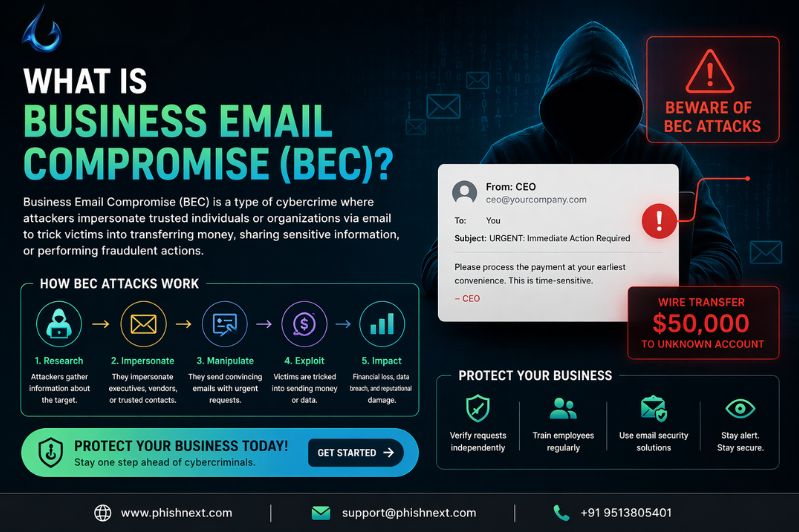
Business Email Compromise (BEC) is a sophisticated cybercrime in which an attacker pretends to be a reliable person, like a CEO or vendor, in order to deceive staff members into sending money or disclosing private company information.
BEC employs social engineering and highly customized strategies to get around conventional security filters and manipulate people's confidence, in contrast to standard phishing, which depends on harmful links.
Because it takes advantage of the legitimacy of regular commercial communication systems, it continues to be one of the most financially devastating types of internet fraud. Let’s take a look at what Business Email Compromise (BEC) is, its uses, and how you can protect yourself against such attacks!
BEC vs. Traditional Phishing Attacks
|
S.No. |
Topics |
Factors |
What? |
|
1. |
Business Email Compromise (BEC) |
Highly Targeted |
BEC uses spear-phishing, in which attackers investigate particular people (such as a CFO) in order to craft a unique, convincing story. |
|
Payload-Free |
Rarely do these attacks employ malware or dubious links; instead, they rely on urgency and plain-text persuasion to get past technical checks. |
||
|
Financial & Data Focus |
Payroll redirection, high-value wire transfer fraud, or the theft of confidential company intellectual property are typically the main objectives. |
||
|
2. |
Traditional Phishing |
Broad & Generic |
Phishing usually uses a "spray and pray" strategy, sending thousands of identical, generic emails to a large number of recipients at once. |
|
Technically Driven |
These emails typically include links or attachments that are malicious and intended to either install ransomware or direct the recipient to a phony login page. |
||
|
Credential Harvesting |
Instead of direct money theft, the primary goal is frequently to obtain a foothold in a network or acquire usernames and passwords. |
Common Types of BEC Scams
The following are some of the common types of BEC Scams:
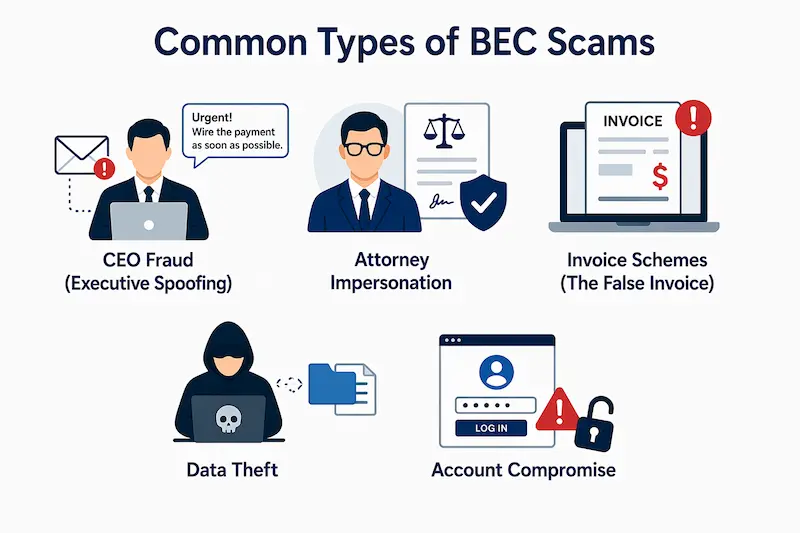
- CEO Fraud (Executive Spoofing): In order to coerce an employee into making an urgent, unlawful wire transfer, attackers pose as senior executives.
- Attorney Impersonation: Under the pretense of private or urgent matters, scammers pretend to be legal counsel in order to demand quick payments or sensitive information.
- Invoice Schemes (The False Invoice): In order to give "updated" bank data and transfer legal payments into their own accounts, fraudsters pose as reputable vendors.
- Data Theft: Instead of stealing cash, this strategy targets HR or finance departments to obtain trade secrets, PII, or tax information.
- Account Compromise: An attacker obtains real login access to an employee's email in order to keep an eye on company operations and initiate timed, genuine-looking fake requests.
Mechanics of BEC Scams
The following are some mechanics of BEC Scams:
● Target Research (Reconnaissance): Attackers use social media, LinkedIn, and corporate websites to find important employees, organizational structures, and vendor ties.
● The Setup (Infrastructure): To make sure the "sender" address appears genuine to the unaided eye, hackers register lookalike domains or breach trustworthy accounts.
● The Hook (Gaining Trust): To build instant credibility, they use the information they have obtained to create a customized message that makes reference to actual projects or colleagues.
● The Psychological Trigger: High-pressure strategies, like fabricated "emergencies" or "strict confidentiality," are used in the email to deter the victim from verifying the information.
● Execution & Exfiltration: Believing they are carrying out a routine work task, the victim completes the required activity, such as delivering data or wire transferring money.
● The Disappearing Act: In order to make the stolen money untraceable, the attacker swiftly transfers it across several "mule" accounts after the transaction is verified.
Typical Content Found in BEC Emails
|
S.No. |
Factors |
What? |
|
1. |
Urgency and Pressure |
Words like "Quick Request," "Immediate Action Required," or "By the end of the day" are used to coerce the victim into making a mistake. |
|
2. |
Confidentiality Requests |
In order to stop the employee from confirming the request through other channels, attackers frequently insist on confidentiality (e.g., "I'm in a meeting, so please don't call"). |
|
3. |
Request for Payment or Sensitive Data |
Typically, the email ends with a request for a wire transfer, a modification to the direct deposit information, or the delivery of W-2 documents. |
|
4. |
Spoofed or Look-alike Sender Addresses |
The "From" column can show a well-known name with an external email address or utilize a domain that is one letter wrong ([email protected] instead of [email protected]). |
|
5. |
Specific Internal Jargon |
Scammers employ project names, company-specific words, or nicknames found during the investigation stage to look genuine. |
|
6. |
Simplified Signature Blocks |
They frequently pretend to be "Sent from my iPhone" or use generic signatures to cover up small mistakes or brevity. |
Social Engineering Tactics
The following are some social engineering tactics:
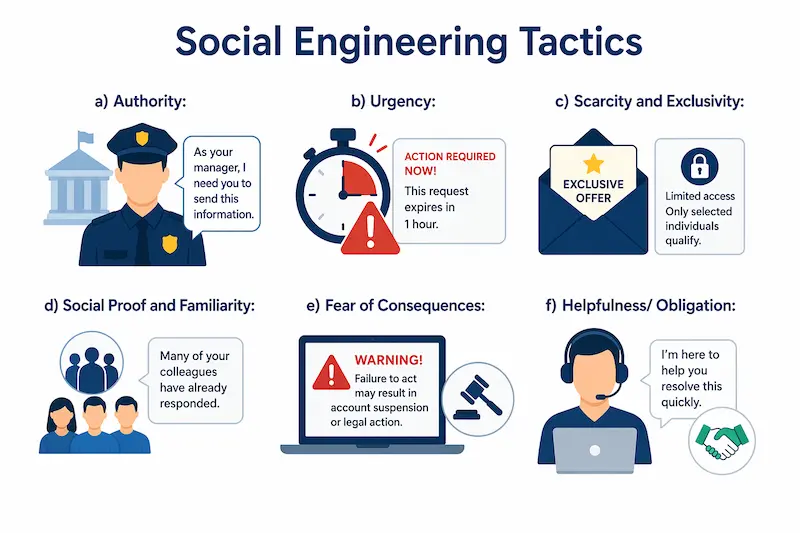
a) Authority: Attackers take advantage of people's innate propensity to obey orders from superiors without questioning them by posing as a CEO, director, or senior executive.
b) Urgency: The victim's ability to adhere to regular verification methods is superseded when a fabricated "crisis" (such as an impending merger or a late payment) is created.
c) Scarcity and Exclusivity: By framing the request as a "confidential project" or a "special assignment," the attacker may gain the employee's trust and discourage them from discussing the email with coworkers.
d) Social Proof and Familiarity: In order to make the conversation seem like a continuation of a genuine connection, scammers use real names, completed projects, or forthcoming business events discovered during the investigation.
e) Fear of Consequences: The victim is sufficiently stressed to put speed ahead of security when it is subtly implied that a delay will result in a lost contract or disciplinary punishment.
f) Helpfulness/ Obligation: Using a "can you do me a quick favor?" strategy takes advantage of an employee's desire to be productive and helpful in their work.
Common Targets of BEC
The following are some common targets of BEC:
- Finance Departments: Because they have direct control over company bank accounts and wire transfers, CFOs, controllers, and accounts payable employees are the main targets.
- Human Resources (HR): Attackers target HR professionals for PII (Personally Identifiable Information) and W-2 forms, which they utilize for tax fraud or identity theft.
- Executive Leadership: High-level directors and CEOs are frequently "whaled" (targeted) because their identities have the power to circumvent established procedures.
- Real Estate Entities: Because they assist big, urgent real estate transactions involving substantial sums of money, title companies and brokers are often targeted.
- Supply Chain & Manufacturing: Businesses with a worldwide network of suppliers are susceptible to invoice schemes, in which hackers eavesdrop on business partner payments.
- Legal Firms: Law companies are popular targets for impersonation and data extortion because they frequently handle sizable escrow accounts and sensitive litigation data.
- IT Administrators: In order to obtain widespread access to the company's email infrastructure for potential future attacks, those with "super-user" privileges are targeted.
Specific Roles Scammers Target
|
S.No. |
Roles |
Why? |
|
1. |
Accounts Payable Professionals |
They are specifically targeted since they have the direct authority to approve and handle payments to outside vendors. |
|
2. |
Chief Financial Officers (CFOs) |
To enable large, high-level wire transactions that evade lower-level inspection, scammers pose as or target CFOs. |
|
3. |
HR Managers and Payroll Administrators |
These positions are used to divert individual salary payments to fake accounts or obtain access to private employee tax records. |
|
4. |
Executive Assistants |
Attackers frequently use assistants to "vouch" for a false request in order to acquire access to a CEO's schedule and communication style. |
|
5. |
Legal Counsel and Paralegals |
Scammers use the confidentiality of legal work to coerce employees into making "urgent" payments for acquisitions or settlements. |
|
6. |
Real Estate Agents and Escrow Officers |
During "closing" times, these professionals are targeted in order to transfer substantial down payments or the proceeds from real estate sales into illicit accounts. |
|
7. |
IT System Administrators |
Attackers look for their login credentials in order to take over the company's email system and send absolutely legitimate internal communications. |
Why are BEC Attacks hard to detect?
For the following reasons, BEC attacks are hard to detect:
● Absence of Malicious Payloads: These emails readily get past conventional antivirus and sandbox security filters because they merely contain text and don't include any "virus-carrying" attachments or links.
● Use of Legitimate Infrastructure: In order to ensure that the email's technical signature appears completely genuine, attackers frequently employ compromised real accounts or reliable email providers (like Gmail or Outlook).
● Perfect Impersonation (Spoofing): Scammers use "display name" spoofing or look-alike domains to make the sender's identity nearly identical to a reliable contact at first glance.
● Social Engineering Sophistication: The communications feel like they belong in a regular business chat since they are customized using corporate knowledge and industry-specific lingo.
● Low-Volume "Quiet" Attacks: In contrast to large spam, BEC uses a single email to target a single person, making it impossible for security systems to recognize the "bulk" characteristics indicative of a widespread attack.
Impact of BEC on Organizations
The following are the impacts of BEC on organizations:
a) Massive Financial Loss: BEC frequently results in the theft of millions of dollars that are rarely retrieved once moved, making it the most expensive cybercrime.
b) Reputational Damage: Attacks that are successful have the potential to undermine the confidence of partners and customers by indicating that a company's data handling procedures and internal controls are weak.
c) Operational Disruption: It takes a lot of time and money to audit systems, freeze accounts, and update security procedures during recovery efforts, which stops regular corporate operations.
d) Legal and Regulatory Penalties: Under legislation like the CCPA and GDPR, organizations that fail to secure sensitive data (such as PII) risk legal action or steep fines.
e) Psychological Toll on Employees: After being tricked into helping a high-value theft, the victims frequently suffer from intense remorse, stress, or even lose their jobs.
Legal and Regulatory Risks
|
S.No. |
Factors |
What? |
|
1. |
Mandatory Disclosure Requirements |
Financial breaches must now be reported right away to law authorities and impacted parties in many areas. |
|
2. |
Data Protection Fines (GDPR/ CCPA) |
If a BEC fraud exposes private information because of "inadequate" security measures, regulators have the authority to impose severe fines. |
|
3. |
Management Personal Liability |
If executives are proven to have disregarded their fiduciary duty to put in place appropriate measures, they may be subject to dismissal or personal litigation. |
|
4. |
Third-Party and Supply Chain Litigation |
If your compromised systems were utilized to enable fraud against them, partners and vendors may file a lawsuit to recover damages. |
|
5. |
Contractual Breaches and Insurance Denials |
Insurance companies may refuse coverage if security procedures were violated, and breach-of-contract claims may result from missing payments or losing data. |
Strategies to Prevent and Detect BEC Attacks
The following are some strategies to prevent and detect BEC Attacks:
- Implement Multi-Factor Authentication (MFA): By adding a second stage of authentication, fraudsters are prevented from taking over legitimate corporate email accounts using stolen passwords.
- Establish Out-of-Band Verification: Make it mandatory for staff members to verify any sensitive requests through a backup channel of communication, like a phone call or a reliable messaging app.
- Deploy Advanced Email Security Tools: Make use of AI-powered security systems that are able to spot unusual activity, phony domains, and linguistic characteristics common to BEC frauds.
- Standardize Internal Approval Workflows: Adopt "dual-control" regulations that require approval from at least two authorized staff members for any modifications to payment information or high-value transfers.
- Conduct Continuous Security Awareness Training: Educate employees on a regular basis using real-world simulations to assist them in identifying the psychological triggers and subtle warning signs of social engineering.
How to Mitigate Business Email Compromise?
In the following ways, you can mitigate business email compromise:
● Enforce Strict Verification Protocols: Requests for sensitive or financial information should always be confirmed by a pre-arranged, non-email channel, such as a face-to-face meeting or direct phone conversation.
● Implement "External" Email Tagging: To avoid "look-alike" domain confusion, enable system-wide banners that highlight any emails coming from outside the company.
● Mandate Multi-Factor Authentication (MFA): To prevent even a stolen password from resulting in a complete account takeover, all business accounts should have strong MFA.
● Adopt "Four-Eyes" Approval: Any new vendor setup or modification to banking instructions must be reviewed and approved by at least two separate authorized staff members.
● Utilize AI-Based Email Filtering: Use contemporary security techniques that examine "intent" and communication patterns to identify suspicious, payload-free messages that get past conventional filters.
Conclusion
Now that we have talked about Business Email Compromise (BEC), you might want to secure your working environment by entrusting a reliable security solution. For that, you can rely on Phish Next, a dedicated phishing simulation platform offered by Craw Security that offers similar visuals to the users, where they can see themselves scammed/ phished by a cybercriminal through phishing attacks.
After the completion of their training, they will be able to evade such situations without any trouble or mistake. What are you waiting for? Contact, Now!
Explore Related Topics
- What Is Open-Source Intelligence (OSINT)? | PhishNext
- What Is AI Security Posture Management (AI-SPM)?
- Winner of the AI Arms Race: Threat Actors vs Cybersecurity Defenders
- Phishing Simulation: How It Works to Reduce Risk? | PhishNext
- 50% Rise in Ransomware Attacks Even as Payments Drop
- Top Six Key Benefits & Core Features of Endpoint Security | PhishNext
- Top Tools That Hackers Use to Weaponize Emails | PhishNext
- Stolen Traveler Data Is on Sale at Dark Web, According to Eurail
- Threat Actors Get Real-Time Access to Attacks via Voice Phishing Kits
- Attackers Using LLMs to Create Phishing Pages in Real Time
- Why Phishing Attacks Are Increasing in 2026?
- Phishing Attacks Are Imitating City & County Officials: FBI Alerted!