Top 10 Impactful Ways to Enhance Cybersecurity Awareness with Behavioural Insights
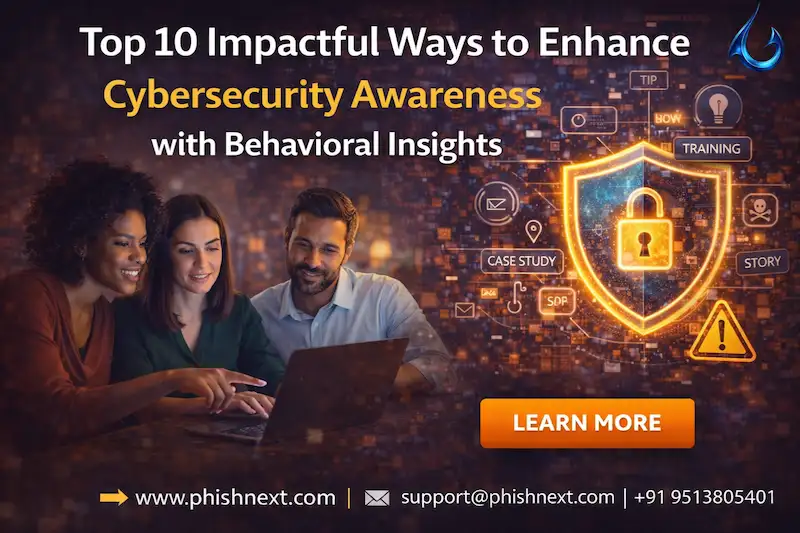
Do you know what the most impactful ways are to improve your cybersecurity awareness? If not, then you really need to know about that. Here, we will have a look at the Top 10 Impactful Ways to Enhance Cybersecurity Awareness among everyone around you.
Moreover, ensuring a secure working environment is really important for the efficiency and productivity of any organization operating in the Industry. What are we waiting for? Let’s get to it!
What is Cybersecurity Awareness?
The continuous process of teaching and enabling people to identify, report, and protect themselves against online dangers such as malware, social engineering, and phishing is known as cybersecurity awareness.
By ensuring that users are aware of the security procedures and moral obligations necessary to safeguard sensitive data, it turns them from potential weaknesses into the first line of protection. It seeks to lessen human error and eliminate the systemic hazards of our hyperconnected digital world in 2026 by promoting a culture of "security-first" thinking.
Let’s take a look at the Top 10 Impactful Ways to Enhance Cybersecurity Awareness and secure your working environment!
Top 10 Impactful Ways to Enhance Cybersecurity Awareness
The following are the Top 10 impactful ways to enhance cybersecurity awareness:
- Reduce and increase friction to shape secure behaviour: Simplify secure pathways by implementing Single Sign-On (SSO) to facilitate login, while purposefully including "speed bumps" such as MFA prompts for behaviors deemed high-risk.
For safety, this directs people to the path of least resistance; for danger, it directs them toward the path of most resistance.
- Use the IKEA effect to create cybersecurityownership: Employees like and defend what they helped make, so let them help establish their own team security manifests or personalized alert settings. As a user "builds" their own protection strategy, they are much more likely to follow it.
- Activate internal influencers and hidden champions: Find naturally tech-savvy non-IT employees and train them to be "Security Ambassadors" who can use informal channels to convince their colleagues.
Peer-to-peer recommendations frequently have greater credibility and weight than an IT department directive.
- Treat branding as part of behaviour change: Get rid of the ominous "warning" aesthetics and give your security program a distinctive brand and personality that fits with your company's culture.
Instead of feeling like a bureaucratic task, a relatable brand transforms security into a shared objective.
- Stack security habits into daily workflows: Include security checks in routines that already exist, such as locking screens before meetings or verifying the VPN status during the daily coffee ritual.
Security becomes a reflexive, unconscious behavior by "stacking" a new habit on top of an existing one.
- Use storytelling to make security memorable: Dramatic, real-life accounts of "near-misses" or well-known hacks that highlight the human consequences of a breach should take the place of dry statistics.
A compelling narrative evokes an emotional reaction that aids in recalling the "why" behind the regulations.
- Leverage temporal landmarks for maximum impact: During "Fresh Start" events, such as the first Monday of the year, the first week of a new hire, or following a business merger, launch significant awareness campaigns.
During these times of transition, people are more willing to modify their behaviors and take on new identities.
- Make learning fun and personalised: Make use of AI-driven training modules and gamified simulations that adjust to a user's particular position, such as phishing tests customized to a recruiter's daily emails.
While competition keeps consumers interested and motivated, personalization guarantees that the material is pertinent.
- Build peer-powered conversations into your culture: Set aside five minutes at the beginning of team meetings for a "Security Shout-out" or a brief period for coworkers to exchange tips.
By normalizing the discussion of digital safety, a collective defense is strengthened, and the stigma associated with seeking assistance is lessened.
- Turn mistakes into learning moments, not punishment: Promote a culture of "Blame-Free" reporting, in which staff members who click on harmful links are commended for reporting them promptly rather than receiving a reprimand.
People become the quickest "human sensors" for identifying imminent dangers when they are not terrified of punishment.
Why is Cybersecurity Awareness Necessary?
Cybersecurity awareness is necessary for the following reasons:
● The "Human Firewall" is the Primary Defense: An informed user is the last and most important layer of any security stack since even the most sophisticated encryption can be circumvented by a single human error.
● Guarding Against AI-Enhanced Social Engineering: In an age of automated deception, awareness is the sole weapon that enables humans to confirm identity and intent in the face of increasingly realistic deepfakes and AI-generated phishing.
● Protecting the Integrated "Smart" Life: A breach poses a physical risk to our privacy, safety, and the gadgets that support our daily activities in an era of connected homes and medical IoT.
● Mitigating the High Cost of Data Breaches: By guaranteeing quick detection and response, awareness effectively lowers the financial and reputational harm of an assault and keeps a small mistake from turning into a disastrous loss.
● Preserving National and Systemic Stability: The vital infrastructure that keeps civilization running, such as banking and electrical grids, is protected from widespread digital sabotage by individual security practices.
|
Note: If you want to protect your confidential data against online threats, then you really need a reliable set of techniques and tools to strengthen your database security measures. For that, you can go for Craw Security’s specialized ShieldXDR, which detects and eliminates malicious attempts in a timely manner to secure your data. Go for it! |
Trending Blogs
- What Is Open-Source Intelligence (OSINT)? | PhishNext
- What Is AI Security Posture Management (AI-SPM)?
- Winner of the AI Arms Race: Threat Actors vs Cybersecurity Defenders
- Phishing Simulation: How It Works to Reduce Risk? | PhishNext
- 50% Rise in Ransomware Attacks Even as Payments Drop
- Top Six Key Benefits & Core Features of Endpoint Security | PhishNext
- Top Tools That Hackers Use to Weaponize Emails | PhishNext
- Stolen Traveler Data Is on Sale at Dark Web, According to Eurail
- Threat Actors Get Real-Time Access to Attacks via Voice Phishing Kits
- Attackers Using LLMs to Create Phishing Pages in Real Time
- Why Phishing Attacks Are Increasing in 2026?