Password Spraying vs Brute Force Attacks: Key Differences Explained
Do you want to know about the differentiation between Password Spraying vs Brute Force Attacks and how you can protect yourself against such attacks? If yes, then you are at the right place. Here, we will explore how these two attacks work.
Moreover, we will introduce you to a dedicated phishing simulation platform offered by a reliable VAPT service provider. What are we waiting for? Let’s get started!
What Is a Brute Force Attack?
A brute force attack is a trial-and-error technique in which an attacker employs automated software to methodically guess all potential character combinations, like encryption keys or passwords, until the right one is discovered.
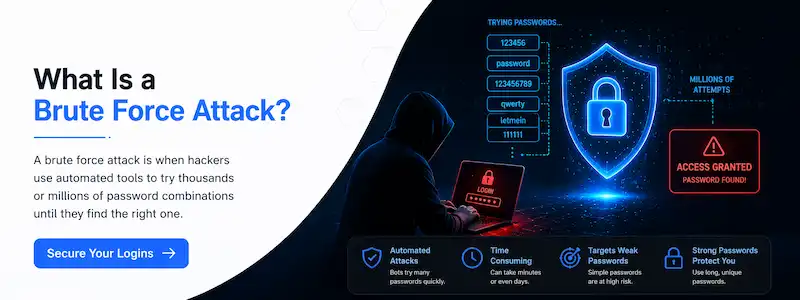
Its success is solely dependent on the target's complexity and the amount of time available to execute the permutations because it relies on pure computational power rather than code exploitation. Let’s take a look at the difference between Password Spraying vs Brute Force Attacks!
What Is a Password Spraying Attack?
A "low and slow" method known as "password spraying" involves an attacker trying one common password, like Password123, against a long list of usernames before going on to the next popular password.
By avoiding the frequent login failures on a single account that usually result in account lockout policies, this technique is especially made to remain undetected by security systems. The attacker increases the likelihood of discovering one vulnerable account without raising an alarm by dispersing the efforts among thousands of users.
Authentication Fundamentals
The following are the authentication fundamentals:
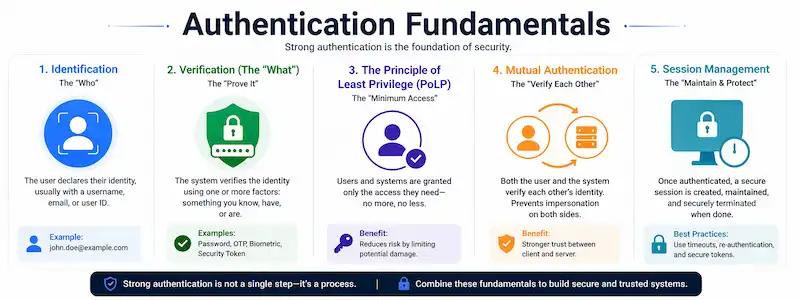
- Identification: In order to identify themselves to the system, a user must first assert their identity, such as by providing their username or email address.
- Verification (The "What"): The process of establishing your identification using one or more factors, which are typically classified as something you are (biometrics), something you possess (token), or something you know (password).
- The Principle of Least Privilege (PoLP): To lower the danger of the account being compromised, a user should only be given the minimal amount of access required to carry out their duties after they have been authenticated.
- Mutual Authentication: To prevent "Man-in-the-Middle" attacks and make sure the user isn't connecting to a phony website, a secure procedure in which the client and the server confirm each other's identities.
- Session Management: In order to save the user from having to re-authenticate for each click, the system issues a temporary "session token" or cookie following a successful login; nevertheless, these must be strictly timed and guarded.
Password Spraying vs Brute Force Attacks: What Is the Main Difference?
|
S.No. |
Topics |
Factors |
What? |
|
1. |
Password Spraying |
Target Ratio |
Employs a many-to-one strategy, "spraying" one or two popular passwords (such as Summer2024!) over thousands of distinct accounts. |
|
Detection Profile |
Because it only makes a few login attempts per account, it is "low and slow" in order to evade security filters and seldom reaches the threshold needed to lock an account. |
||
|
Strategy |
Depends on the statistical likelihood that at least one employee in a big company is using a weak password and human laziness. |
||
|
2. |
Brute Force Attacks |
Target Ratio |
Targets a single account with thousands of distinct password combinations using a one-to-many strategy. |
|
Detection Profile |
The huge number of unsuccessful login attempts on a single user ID promptly sets off automated account lockout procedures, making it extremely noisy and detectable. |
||
|
Strategy |
Uses a lot of variations and processing power to crack complicated passwords or encryption keys. |
Credential Stuffing
Credential stuffing is a specific kind of cyberattack in which hackers obtain illegal access to other unrelated services by using extensive databases of compromised usernames and passwords, usually obtained from prior data breaches.
It is based on the common practice of reusing passwords, presuming that a pair of credentials taken from one website will probably allow access to the user's corporate, email, or banking accounts.
How Password Spraying Attacks Bypass Account Lockout Policies?
In the following ways, password spraying attacks bypass account lockout policies:
● Low Frequency per Account: Attackers stay far below the standard 3-to-5-attempt threshold that initiates an automatic lockout by attempting only one or two passwords per user.
● Time Interleaving: The malicious activity blends in with typical, unsuccessful login noise because login attempts are spaced out over extended periods of time (e.g., once every hour).
● Horizontal Distribution: Instead of concentrating on a single victim, the attack targets thousands of distinct usernames throughout the company, guaranteeing that no specific account is reported for abuse.
● Origin Rotation: Attackers avoid security systems recognizing and preventing the attack based on a single malicious location by employing botnets or proxy servers to alter their originating IP address.
● Exploiting Human Nature: The tactic is based on the high likelihood that many users will utilize seasonal variants or simple passwords like "Welcome2026!" in a huge user base.
Why Brute Force Attacks Are Still a Major Cybersecurity Threat?
|
S.No. |
Factors |
Why? |
|
1. |
Exponential Computing Power |
Even complex passwords can be cracked in record time thanks to modern GPUs and cloud-based clusters that enable attackers to test billions of password permutations per second. |
|
2. |
Leaked Password Databases |
Attackers receive sophisticated "wordlists" from the ongoing flow of large-scale data breaches, which boost the effectiveness of brute force assaults through educated guesswork. |
|
3. |
Persistent Human Behavior |
Despite decades of security warnings, many users still select short, predictable, or dictionary-based passwords, making them simple targets for automated systems. |
|
4. |
Unprotected IoT Devices |
Because millions of smart devices come with default or hardcoded credentials, there is a huge, exposed surface area that is easy to breach via brute force. |
|
5. |
Low Barrier to Entry |
Even inexperienced "script kiddies" may launch high-volume attacks with little effort because of sophisticated, user-friendly hacking tools that are readily accessible online. |
Common Targets of Password Spraying and Brute Force Attacks
The following are the common targets of password spraying and brute force attacks:
a) Cloud Service Portals: Because they include enormous volumes of private company information and internal interactions, platforms like Google Workspace and Microsoft 365 are the main targets.
b) VPN and Remote Access Gateways: In order to get past perimeter protections and into an organization's internal network directly, attackers target these access points.
c) Single Sign-On (SSO) Providers: Because compromising one set of credentials might provide access to dozens of connected applications, services like Okta or Azure AD are high-value targets.
d) Public-Facing Web Applications: Attacks on e-commerce websites and consumer portals to steal financial or personal data from user databases are common.
e) Secure Shell (SSH) and Remote Desktop (RDP): Because they give attackers direct access to servers and workstations, these administration ports are frequently targeted by brute force attacks.
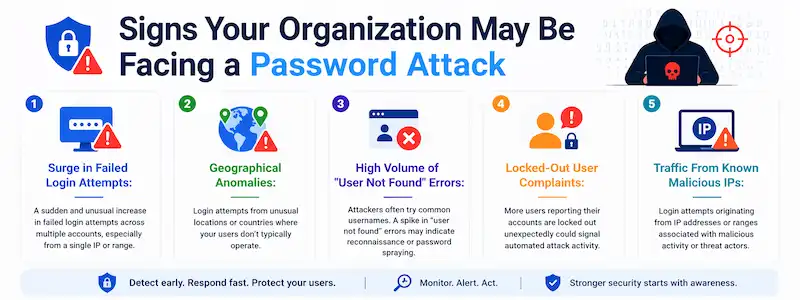
Signs Your Organization May Be Facing a Password Attack
The following are the signs your organization may be facing a password attack:
- Surge in Failed Login Attempts: The most obvious sign of an active attack is a sudden, enormous surge in failed authentication logs across one account or several users.
- Geographical Anomalies: Observing several login attempts for the same user coming from different nations or odd IP addresses in a brief period of time (Impossible Travel).
- High Volume of "User Not Found" Errors: A high percentage of authentication attempts are made against accounts that do not exist in your directory because attackers frequently utilize out-of-date or guessed username lists.
- Locked-Out User Complaints: A high-volume brute force campaign is frequently indicated by a surge of help desk tickets from staff members claiming they have been locked out of their accounts at the same time.
- Traffic From Known Malicious IPs: Security alarms that are sent off by login attempts that come from residential proxy networks that threat actors routinely utilize, Tor exit nodes, or known botnets.
Password Spraying vs Brute Force: Which Attack Is More Dangerous?
|
S.No. |
Topics |
Factors |
What? |
|
1. |
Password Spraying |
Stealth and Persistence |
A password spraying attack might go unnoticed for months because it doesn't result in account lockouts, giving attackers time to carefully and deliberately identify a weak point. |
|
High Success Probability |
The statistical probability of at least one person using a common password (like Company2026!) at a company with thousands of employees is very high. |
||
|
Lower Defensive Visibility |
Because these attacks appear to be single, "normal" failed logins rather than a concentrated assault, standard monitoring tools frequently miss them. |
||
|
2. |
Brute Force |
Targeted Precision |
Brute force is the most straightforward method to completely breach a high-value "VIP" account (such as a CEO or SysAdmin) if MFA is not in place. |
|
Speed of Modern Hardware |
High-end GPUs can crack simple or medium-complexity passwords in a matter of seconds, giving security personnel very little time to intervene. |
||
|
Impact on Availability |
A huge brute force attack can effectively act as a Denial of Service (DoS) attack on employee productivity, locking off hundreds of legitimate users, even if the attacker is unable to get access. |
Indicators of Compromise (IoCs)
Unusual outgoing network traffic, strange registry modifications, or illegal MD5 hashes are examples of forensic artifacts known as indicators of compromise (IoCs), which are digital proof of a possible security breach.
Security teams may proactively detect, track, and eliminate risks before they develop into extensive data exfiltration by keeping an eye on these particular "red flags" in real-time.
Best Practices to Prevent Password Spraying Attacks
The following are the best practices to prevent password spraying attacks:
● Implement Multi-Factor Authentication (MFA): To make stolen passwords useless, require a second verification step.
● Enforce Strong, Unique Passwords: To prevent predictable guesses, utilize complexity criteria and exclude popular phrases.
● Adopt Passwordless Authentication: To completely remove the password as a target, use hardware keys or biometrics.
● Enable Risk-Based/Conditional Access: Stop login attempts coming from high-risk IP addresses or strange places.
● Monitor for "Low and Slow" Patterns: To find individual unsuccessful logins dispersed over numerous accounts, use behavioral analytics.
How to Defend Against Brute Force Login Attempts?
|
S.No. |
Factors |
How? |
|
1. |
Strict Account Lockout Policies |
To prevent automated guessing tools, automatically disable an account for a predetermined amount of time following a predetermined number of unsuccessful login attempts. |
|
2. |
Implement CAPTCHA |
After a few unsuccessful tries to distinguish between high-speed bots and human users, require users to finish an interactive or visual task. |
|
3. |
Progressive Login Delays |
To make a brute force attack statistically impossible, introduce an artificial wait period (e.g., doubling the delay with each failure) between login attempts. |
|
4. |
IP Address Throttling |
Traffic from particular IP addresses that exhibit an unusually high frequency of authentication requests throughout the network should be restricted or blocked. |
|
5. |
Monitor for Unusual Volume |
To notify managers of unexpected increases in unsuccessful authentication traffic, use Security Information and Event Management (SIEM) technologies. |
Multi-Factor Authentication (MFA) & Conditional Access
Conditional Access serves as a gatekeeper by assessing real-time signals like location and device health before allowing access, while Multi-Factor Authentication (MFA) adds additional security levels beyond passwords.
When combined, they guarantee that access is only allowed under trustworthy circumstances, even with the right credentials, greatly lowering the possibility of unwanted breaches.
Frequently Asked Questions
About Password Spraying vs Brute Force Attacks
- What is the difference between a brute force attack and password spraying?
Password spraying targets numerous accounts with a single or two common passwords in order to evade detection, whereas a brute force attack targets a single account with numerous passwords.
- What are the 4 types of passwords?
The following are the 4 types of passwords:
a) Static Passwords,
b) Dynamic (One-Time) Passwords,
c) Passphrases, and
d) Biometric "Passwords".
- What is the 8-4 rule for passwords?
According to the 8-4 rule, passwords should be at least 8 characters long and contain at least 4 different character types: capital and lowercase letters, digits, and special symbols.
- What are the two main types of password attacks?
The following are the two main types of password attacks:
a) Brute Force Attack, and
b) Password Spraying Attack.
- What is another name for a brute force attack?
When employing a predetermined list of plausible terms, a brute force attack is also frequently referred to as an exhaustive key search or dictionary attack.
- What are the risks of password spraying?
The following are the risks of password spraying:
a) Account Takeover and Data Breaches,
b) Bypassing Traditional Detection,
c) Lateral Movement,
d) Mass Organizational Compromise, and
e) Reputational and Financial Damage.
- What are the top 3 types of cyber attacks?
The following are the top 3 types of cyber attacks:
a) AI-Powered Phishing & Social Engineering,
b) Ransomware-as-a-Service (RaaS), and
c) Supply Chain & Third-Party Attacks.
- Can password spraying cause false positives?
In order to replicate the behavior of a widespread login attempt, password spraying can result in false positives when individuals or genuine automated services misconfigure their credentials across numerous platforms.
Conclusion
Now that we have talked about the Password Spraying vs Brute Force Attacks, you might want to know where you can learn more about how you can evade such attacks. For that, you can rely on Phish Next, a dedicated phishing attack simulator offered by Craw Security.
Moreover, you will be able to learn how such phishing attacks take place, and you will be able to evade such attacks in the future. What are you waiting for? Contact, Now!
Expand This Topic
- Huge Ransomware Attacks Rise in October 2025 Globally
- What Is Browser Detection & Response (BDR) in Cybersecurity?
- Guaranteed Publication in Chrome Web Store with New Malware Kit
- AI-Enabled Social Engineering Attacks are on the Rise
- Exposing How Sophisticated a Phishing Campaign is Bypassing M365 MFA
- How to Detect a Scam or Phishing Email in Just 10 Seconds?
- Why Do You Need PhishNext? [2026 Updated]
- Hidden Risks of Non-Compliance: What the Fines Hide?
- Nation-State Cyber Criminals Using AI to Streamline Targeting
- Strong vs Weak Passwords: A Complete Path [2026]