Hidden Risks of Non-Compliance: What the Fines Hide?

Do you know that there are a huge number of Hidden Risks of Non-Compliance with cybersecurity? If not, then this must be the golden hour for you. In recent years, our tech has evolved so far that hours of work can be finished within a couple of minutes.
We will talk about how you can resolve the crisis and evade the consequences with less effort. What are we waiting for? Let’s explore it!
The Trust Deficit: Beyond the Balance Sheet
The Trust Deficit, which frequently costs considerably more than any regulatory consequence, is the breakdown of stakeholder or public confidence that happens when a security breach exposes a lack of expertise or integrity.
Trust is a "soft" asset, unlike financial line items, and when it is damaged, it can cause long-term problems, including decreased citizen involvement, strained relationships, and a permanently damaged brand that may take ten years to restore.
This deficiency has the potential to completely destroy the social contract in the public sector, making it unsafe for the community to share the data required for basic services.
The Taxonomy of Hidden Risks of Non-Compliance
|
S.No. |
Risks |
What? |
|
1. |
Reputational Damage |
A betrayal of confidence that drives away partners and citizens, frequently necessitating years of costly PR campaigns and "rebranding" to mend the social compact. |
|
2. |
Operational Disruption |
A complete loss of productivity and mission delivery results from the required "halt" of digital services during forensic audits and remediation. |
|
3. |
Employee Impact |
An increase in employee turnover and burnout when top performers leave a "toxic" security culture or a place of employment they no longer believe to be secure or stable. |
|
4. |
Legal Exposure |
Years after the first regulatory fine has been settled, the lengthy tail of civil litigation and class-action lawsuits continues. |
|
5. |
Cyber Insurance Invalidation |
The likelihood is that if an inquiry reveals that required compliance controls were disregarded or fabricated, insurers will reject a claim outright. |
Seeing Risk Before It Becomes an Incident
For the following reasons, you need to see risks before it becomes an incident:
- Cost Avoidance vs. Damage Control: Managing a full-scale data breach, forensic investigation, and legal ramifications is far more expensive than fixing a vulnerability.
- Preserving Operational Continuity: Early risk identification enables "hot-fixes" that don't involve halting vital public services or platforms that interact with the public.
- Maintaining Regulatory "Safe Harbor": Numerous 2026 frameworks, such as the EU AI Act and NIS2, grant firms leeway if they can demonstrate that they recognized a risk and were actively addressing it before it became more serious.
- Eliminating the "Silent Breach" Window: Attackers frequently sit in systems for months before taking action; identifying the threat early reduces the amount of time before data exfiltration starts.
- Boosting Stakeholder Confidence: A high "Security Maturity," demonstrated by proactive reporting, reduces insurance costs and boosts the confidence of the people you serve.
The "Human Firewall" Maturity Model
An organization's transition from a "vulnerable" state of passive compliance to a "resilient" culture where staff members proactively identify and mitigate dangers is tracked by the "Human Firewall" Maturity Model.
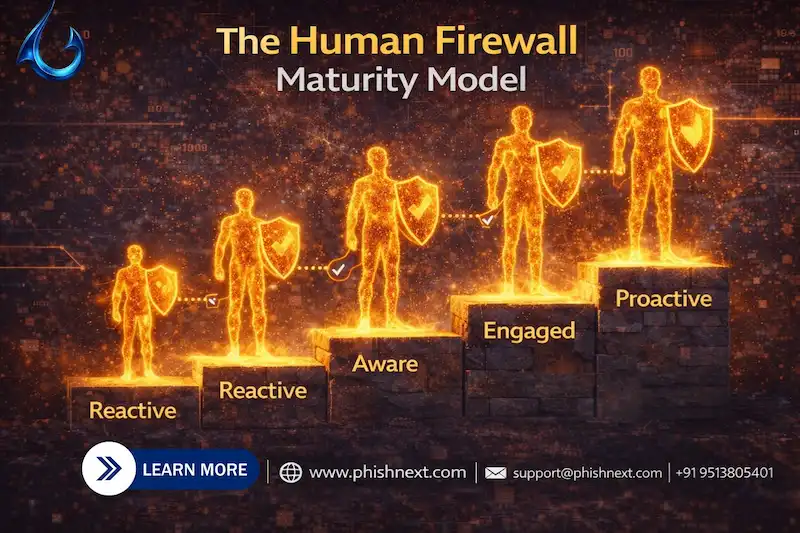
It gauges the transition from rudimentary security awareness to an internalized set of behaviors in which each employee serves as an advanced, real-time sensor for the digital safety of the company.
The Stages of Maturity
|
S.No. |
Stages |
What? |
|
1. |
Level 1 (Reactive) |
Compliance-based training that focuses on "checking the box" rather than changing behavior. |
|
2. |
Level 5 (Resilient) |
A security-first culture that empowers staff members to report phishing attempts and Shadow AI without fear, resulting in a self-healing security loop. |
Frequently Asked Questions
About Hidden Risks of Non-Compliance: What the Fines Hide?
- What is the real cost of non-compliance?
With possible statutory fines of up to ₹250 crore under the Digital Personal Data Protection (DPDP) Act, the actual cost of non-compliance in India has increased to an all-time high of ₹22 crore ($2.51 million) per violation.
- What operational disruptions can occur after a compliance failure?
Following operational disruptions can occur after a compliance failure:
a) Mandatory System Quarantine,
b) Diversion of High-Value Human Capital,
c) Loss of Market Access and Licenses,
d) Third-Party/ Supply Chain De-coupling, and
e) Forensic Audit Fatigue.
- How does non-compliance affect my organisation’s reputation?
In the following ways, non-compliance can affect your organisation’s reputation:
a) The Erosion of the Social Contract,
b) Loss of "Preferred Partner" Status,
c) The "Search Engine" Penalty,
d) Brand Devaluation & "Trust Tax", and
e) Leadership & Talent Brain Drain.
- How are employees impacted by compliance breaches?
In the following ways, employees are impacted by the compliance breaches:
a) The "Crisis Fatigue" Cycle,
b) Personal Privacy Exposure,
c) Professional Stigma & "Resume Tarnish",
d) The Surveillance Backlash, and
e) Moral Injury & Loss of Purpose.
|
Note: If you want to protect your confidential data against online threats, then you really need a reliable set of techniques and tools to strengthen your database security measures. For that, you can go for Craw Security’s specialized ShieldXDR, which detects and eliminates malicious attempts in a timely manner to secure your data. Go for it! |
Trending Blogs
Huge Ransomware Attacks Rise in October 2025 Globally
What Is Browser Detection & Response (BDR) in Cybersecurity?
Guaranteed Publication in Chrome Web Store with New Malware Kit
AI-Enabled Social Engineering Attacks are on the Rise
Exposing How Sophisticated a Phishing Campaign is Bypassing M365 MFA
How to Detect a Scam or Phishing Email in Just 10 Seconds?
Why Do You Need PhishNext? [2026 Updated]
Hidden Risks of Non-Compliance: What the Fines Hide?
Nation-State Cyber Criminals Using AI to Streamline Targeting