Email Phishing Simulation Tools for Employee Training in 2026
Do you want to know about what Email Phishing Simulation Tools are and how professionals use them to train? If yes, then you are at the right place. Here, we will explore what these amazing tools are.
Moreover, we will introduce you to a reliable phishing simulation platform offered by a reputable VAPT service provider. What are we waiting for? Let’s get started!
What Are Email Phishing Simulation Tools?
Email phishing simulation tools are security platforms that test employees' capacity to identify and report cyber risks by sending them controlled, innocuous "fake" phishing emails. To identify high-risk individuals and evaluate an organization's overall exposure to real attacks, these tools offer realistic scenarios that frequently match current social engineering trends.
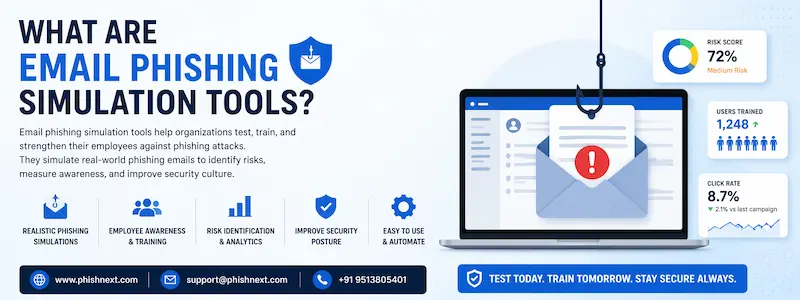
Organizations can provide focused training to promote safe digital practices by monitoring who clicks, inputs data, or reports the mail. Let’s take a look at what Email Phishing Simulation Tools are and how they can offer you better security measures!
Why Employee Training is Critical to Prevent Phishing Attacks?
For the following reasons, employee training is critical to prevent phishing attacks:
- Human-Centric Vulnerability: By addressing the innate psychological triggers that technology filters frequently overlook, it protects the "human firewall."
- Addressing AI-Enhanced Threats: It enables employees to recognize the tiny differences between deepfake social engineering and highly customized, AI-generated lures.
- Reducing the "Success Rate" of Breaches: By encouraging staff to report suspicious activity rather than participate in it, it dramatically reduces the likelihood of a successful incursion.
- Fostering a Culture of Accountability: Employees become active participants who take personal responsibility for the organization's digital safety instead of being passive targets.
- Compliance and Regulatory Standards: It guarantees that the company complies with industry and legislative requirements for continuous security awareness and data protection.
How Phishing Simulation Tools Improve Security Awareness?
In the following ways, phishing simulation tools improve security awareness:
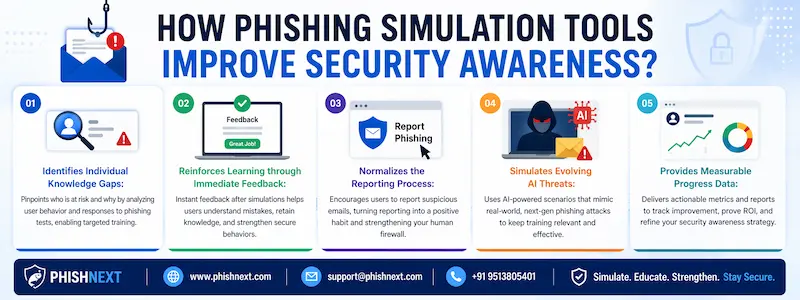
● Identifies Individual Knowledge Gaps: Instead of using a one-size-fits-all strategy, these systems identify precisely which employees have trouble with particular lures, enabling customized training.
● Reinforces Learning through Immediate Feedback: The program links the error to the lesson while the experience is still fresh by offering "teachable moments" the moment a user clicks a simulated link.
● Normalizes the Reporting Process: Frequent simulations ensure that staff members understand exactly how to use the "Report Phishing" button, making the act of flagging questionable emails a subconscious habit.
● Simulates Evolving AI Threats: They prepare employees for the sophistication of 2026-era attacks by exposing them to the high-velocity, hyper-personalized social engineering techniques produced by contemporary AI.
● Provides Measurable Progress Data: By converting subjective "awareness" into concrete measurements like click-through and reporting rates, these platforms demonstrate the security program's measurable return on investment.
Human Risk Management vs. Traditional Compliance
|
S.No. |
Topics |
Factors |
What? |
|
1. |
Human Risk Management |
Dynamic & Continuous |
Operates throughout the clock by keeping an eye on actual behaviors and providing "micro-learning" whenever a dangerous action takes place. |
|
Behavior-Focused (Risk Reduction) |
The real decline in dangerous behavior, such as fewer clicks on simulations and more reports of actual threats, is used to gauge progress. |
||
|
Personalized & Adaptive |
Creates individual risk profiles for each employee using AI, adjusting the kind and level of training based on their function and prior performance. |
||
|
2. |
Traditional Compliance |
Static & Periodic |
Depends on quarterly "refresher" films or yearly training sessions, which frequently use out-of-date material. |
|
Metric-Focused (Completion) |
Determines success by looking at the proportion of staff members who completed a course, regardless of whether they gained any knowledge or not. |
||
|
One-Size-Fits-All |
Ignores the reality that a coder faces distinct risks from a finance manager and instead provides everyone with the same generic content. |
Key Features to Look for in Phishing Simulation Platforms
The following are the key features to look for in phishing simulation platforms:
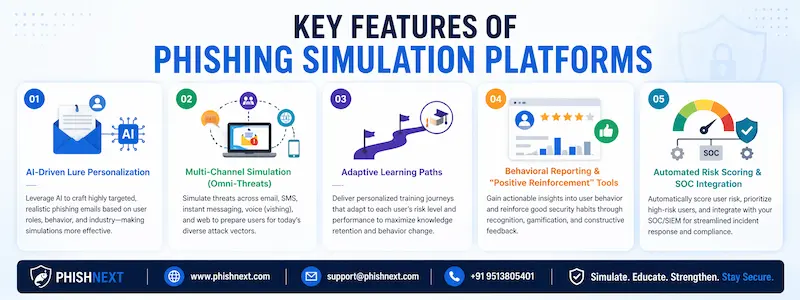
a) AI-Driven Lure Personalization: Creates extremely realistic, context-aware emails using generative AI that imitate an employee's particular function, business jargon, and contemporary social engineering techniques.
b) Multi-Channel Simulation (Omni-Threats): In order to reflect contemporary, cross-platform attack vectors, testing is extended beyond the inbox to include SMS (Smishing), voice calls (Vishing), and QR codes (Quishing).
c) Adaptive Learning Paths: Ensures that high-risk users receive more practice without wearing out resilient ones by automatically modifying the frequency and difficulty of simulations based on an individual's prior performance.
d) Behavioral Reporting & "Positive Reinforcement" Tools: Has a "one-click" report button that makes reporting a habit by offering instantaneous, gamified rewards for accurate identification.
e) Automated Risk Scoring & SOC Integration: Creates real-time "Human Risk Scores" that aid in setting incident response priorities by immediately syncing simulation data with your Security Operations Center (SOC).
AI-Powered Personalization & Automation
AI-powered customization and automation create hyper-realistic, customized phishing lures that imitate true 2026-era attack patterns by using generative algorithms to assess employee roles and behaviors.
The solution guarantees ongoing, hands-free training that adjusts in real-time to each employee's unique risk profile by automating the distribution and difficulty scaling of these campaigns.
Multi-Channel Simulation: Smishing, Vishing, and Quishing
|
S.No. |
Topics |
What? |
|
1. |
Smishing |
Uses urgent lures like "package delivery failures" or "compliance alerts" to mimic malicious SMS or text messages and collect mobile device credentials. |
|
2. |
Vishing |
Impersonates executives or IT support through automated or AI-generated voice conversations, coercing staff to divulge MFA codes or approve fraudulent transfers. |
|
3. |
Quishing |
Uses misleading QR codes in digital documents or on physical posters that, when scanned, get past email filters and direct users to dangerous websites that collect credentials. |
Top Email Phishing Simulation Tools for Employee Training
The following are the Top Email Phishing Simulation Tools for Employee Training:
- Phish Next (Craw Security): With a heavy emphasis on the most recent regional and industry-specific phishing vectors, this high-performance simulation engine is designed for enterprise-grade threat emulation.
- KnowBe4: The world's largest library of security awareness information and the Human Risk Management (HRM+) platform, which can be scaled from small and medium-sized businesses to huge corporations, is provided by the industry leader.
- Hoxhunt: An AI-first platform that drives high engagement and quantifiable gains in real-world danger reporting through gamification and fully automated, customized simulations.
- Proofpoint (ZenGuide): A risk-led solution that provides training based on the real threats targeting your particular users by integrating directly with Proofpoint's top-notch threat data.
- IRONSCALES: A security-focused platform with one-click phishing simulations and integrated email defense that specializes in protecting against Deepfake and Generative AI attacks.
How to Implement a Successful Phishing Simulation Program?
In the following ways, you can implement a successful phishing simulation program:
● Establish Transparent Communication: To foster trust and prevent a "gotcha" attitude, let staff members know the program's objectives.
● Deploy Realistic, Multi-Vector Scenarios: To replicate real 2026 risks, use AI-driven lures in email, SMS, and QR codes.
● Implement Adaptive Difficulty: To maintain training's relevance and difficulty, adjust simulation complexity to each user's ability level.
● Prioritize Reporting Over Clicking: Instead of only focusing on click avoidance, KPIs and incentives should be based on how soon staff identify hazards.
● Integrate Immediate Micro-Learning: As soon as a mistake is made, give succinct, interesting feedback to reinforce safe behaviors.
Benefits of Using Phishing Simulation in Organizations
|
S.No. |
Benefits |
How? |
|
1. |
Measurable Risk Reduction |
After a year of regular, adaptive training, organizations usually witness a decrease in "phish-prone" percentages from over 30% to less than 5%. |
|
2. |
Faster Incident Response (MTTD) |
Employees are trained to use the "Report Phishing" button through simulations, which transforms people into real-time security sensors that frequently identify new threats more quickly than technical filters. |
|
3. |
Immediate "Teachable Moments" |
The technology takes use of a high-retention psychological window by offering micro-learning the moment a user clicks, correcting risky behavior at the precise moment of the error. |
|
4. |
AI-Threat Preparedness |
Staff members are regularly exposed to hyper-realistic "omni-threats" (such as Smishing and Quishing) in order to prevent them from being caught off guard by the sophisticated social engineering techniques employed by contemporary adversaries. |
|
5. |
Compliance and ROI Documentation |
These platforms give board members and insurance companies hard data, such as "Report Rates" and "Time-to-Detect," that demonstrate the real worth of security efforts. |
Common Mistakes to Avoid in Phishing Training Campaigns
The following are the common mistakes to avoid in phishing training campaigns:
a) Using Predictable or Outdated Templates: Staff members are not adequately prepared for the hyper-personalized, AI-generated spear-phishing that will be prevalent in 2026 by relying on basic "You won a gift card" lures.
b) Creating a Punitive "Gotcha" Culture: Instead of fostering the open communication required for a robust security culture, shaming or punishing employees who click results in animosity and hidden threats.
c) Over-Indexing on "Click Rates" Alone: The more important success metric—the number of employees who successfully reported the threat to the SOC is overlooked when concentrating just on clicks.
d) Ignoring Non-Email Attack Vectors: Employees are exposed to the many "omni-channel" strategies employed by contemporary attackers if Smishing, Vishing, or Quishing are not simulated.
e) Executing "Mass-Blast" Simultaneous Sends: Employees can alert one another by sending the same simulation to everyone at once, resulting in "artificial" success rates that conceal real vulnerabilities.
Measuring the Effectiveness of Phishing Simulations
In the following ways, you can measure the effectiveness of phishing simulations:
- The Reporting Rate (The Primary KPI): Determines the proportion of staff members who actively report a simulation, which is the best measure of a proactive and watchful security culture.
- Mean Time to Report (MTTR): Reflects the organization's real-time detection skills by tracking the average speed at which the first employee recognizes a threat.
- The Resilience Ratio: Determines whether the "human firewall" is powerful enough to stop an outbreak by comparing the number of reporters to the number of clickers.
- Repeat Click Rate (Recidivism): Identifies the subset of high-risk "serial clickers" who need specific, intensive coaching to break ingrained digital habits.
- Real-World Threat Conversion: Examines how well employees can recognize and report real, non-simulated phishing attempts using simulation skills.
Future Trends in Phishing Simulation and Security Awareness Training
The transition to "Hyper-Personalized Adaptive Training," in which generative AI generates real-time, user-specific lures that change according to a user's particular behavioral flaws, is where phishing simulations will go in the future.
By 2026, these simulations will be completely integrated with "Autonomous Human Risk Management" platforms that combine mobile threats, deepfake speech, and email into a unified, automated defense-learning environment.
Frequently Asked Questions
About Email Phishing Simulation Tools
- What is a phishing simulation tool?
A phishing simulation tool is a security platform that uses controlled, "fake" phishing assaults to test employees' awareness and teach them how to identify and report actual cyber threats.
- What tools are used to analyze phishing emails?
The following tools are used to analyze phishing emails:
a) Email Header Analyzers,
b) Malware Analysis Sandboxes,
c) URL & Domain Threat Intelligence,
d) Automated Triage & Response (SOAR), and
e) Deobfuscation & Code Analysis Tools.
- What is a phishing email test for employees?
Organizations utilize phishing email tests, which are simulated attacks, to gauge how well staff members can recognize, steer clear of, and report misleading messages before a real cyberthreat enters the network.
- What are the best practices should employees do for an email phishing test?
The following are the best practices that employees follow for an email phishing test:
a) Analyze Before You Act (The "Stop, Look, Think" Rule),
b) Report, Don't Just Delete,
c) Verify via a Second Channel,
d) Embrace the "Teachable Moment", and
e) Practice Healthy Skepticism Across All Devices.
- What are the 4 P's of phishing?
The following are the 4 Ps of phishing:
a) Profit,
b) Pity,
c) Panic, and
d) Pride.
- What are the tools used for phishing?
The following are the tools used for phishing:
a) AI-Powered Phishing Agents (e.g., Hunto AI, WormGPT),
b) Adversary-in-the-Middle (AiTM) Proxies (e.g., Evilginx3, Muraena),
c) Open-Source Frameworks (e.g., Gophish, Social-Engineer Toolkit),
d) Deepfake Voice & Video Suites, and
e) Automated "Phishing-as-a-Service" (PaaS) Kits.
- What are the four types of phishing emails?
The following are the four types of phishing emails:
a) Bulk Phishing (Spray-and-Pray),
b) Spear Phishing,
c) Whaling, and
d) Business Email Compromise (BEC).
- What is the AI tool for phishing?
The main AI tools for phishing in 2026 are Hunto AI or Hoxhunt for authentic, automated security simulations, and illegal generative models like WormGPT and FraudGPT for creating hyper-personalized lures.
- What tool is used to detect phishing?
AI-driven behavioral analysis platforms, such as Microsoft Defender for Office 365, Sublime Security, and Abnormal Security, are the main methods used to detect phishing in 2026.
These platforms identify dangers by examining communication patterns rather than only looking for harmful links
Conclusion
Now that we have talked about what Email Phishing Simulation Tools are, you might want to explore how phishing simulations work. For that, you can get in contact with Craw Security, offering a dedicated phishing simulation platform, “Phish Next.”
This is a dedicated training platform where users can confront real-life scenarios that only relate to Phishing Attacks. What are you waiting for? Contact, Now!
Expand This Topic
- Huge Ransomware Attacks Rise in October 2025 Globally
- What Is Browser Detection & Response (BDR) in Cybersecurity?
- Guaranteed Publication in Chrome Web Store with New Malware Kit
- AI-Enabled Social Engineering Attacks are on the Rise
- Exposing How Sophisticated a Phishing Campaign is Bypassing M365 MFA
- How to Detect a Scam or Phishing Email in Just 10 Seconds?
- Why Do You Need PhishNext? [2026 Updated]
- Hidden Risks of Non-Compliance: What the Fines Hide?
- Nation-State Cyber Criminals Using AI to Streamline Targeting
- Strong vs Weak Passwords: A Complete Path [2026]