Top 10 Benefits of Phishing Awareness Training
Do you know how Phishing Awareness Training can help you fight against future phishing attempts against you? If not, then you are at the right place. Here, we will talk about how it can be helpful for those individuals who want to protect themselves against unknown phishing attacks.
Moreover, we will introduce you to a reliable phishing simulation solution offered by a reputable VAPT service provider. What are we waiting for? Let’s get started!
What is Phishing?
Phishing is a common cyberattack technique in which attackers pose as reputable organizations like banks, coworkers, or well-known businesses in order to fool victims into disclosing private information like passwords or financial information.
These frauds, which are usually distributed through phony emails, texts, or malicious websites, take advantage of human psychology and false urgency to get over technical safeguards. The attacker can steal passwords, install malware, or compromise entire business networks once the victim opens an attachment or clicks a fake link.
Let’s talk about what Phishing Awareness Training is, its features, and its benefits for users in the IT Industry!
Common Types of Phishing Attacks
The following are some common types of phishing attacks:
1. Spear Phishing: Highly focused fraud that deceives a particular person or organization by using specific, well-researched data.
2. Whaling: Spear phishing at the executive level that is intended to deceive prominent business targets, such as CEOs and CFOs, into approving large wire transfers.
3. Vishing (Voice Phishing) and Smishing (SMS Phishing): Deceptive attacks that use urgent texts or phone calls to trick victims into disclosing private information.
4. Clone Phishing: Replicating an authentic, previously sent email with a link or attachment, replacing the secure information with malicious content, and sending it again from a fake address.
5. Business Email Compromise (BEC): High-stakes corporate fraud in which perpetrators use a firm executive's email address to deceive staff members or suppliers into paying fictitious bills.
Why Phishing Awareness Training is Important?
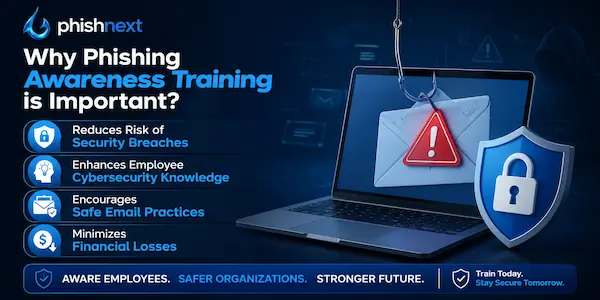
Phishing awareness training is important for the following reasons:
● Reduces Risk of Security Breaches: By strengthening the organization's human perimeter, it significantly reduces the possibility that an attacker will succeed in their initial effort to get access.
● Enhances Employee Cybersecurity Knowledge: Workers become active defenders who are able to identify complex social engineering techniques, instead of passive targets.
● Encourages Safe Email Practices: It teaches employees to regularly examine sender addresses, verify hyperlinks, and refrain from opening unsolicited attachments.
● Minimizes Financial Losses: It stops disastrous financial losses from ransomware payments, fraudulent wire transfers, and post-breach cleanup expenses.
● Protects Sensitive Company Data: It prevents illegal access to important operational assets, employee records, and private intellectual property.
● Strengthens Organizational Reputation: By preventing the business from becoming the next high-profile data breach victim, it safeguards public brand trust.
● Promotes a Security-Conscious Culture: It changes the company's perspective from "security is IT's job" to a shared organizational responsibility by integrating security into everyday routines.
● Improves Incident Response Times: Employees are empowered to immediately report questionable emails, providing security professionals with the early notice necessary to quickly contain risks.
● Supports Compliance with Regulations: It satisfies stringent, legally required data protection regulations (such as GDPR, HIPAA, and PCI-DSS) that call for recorded security awareness initiatives.
● Increases Overall Employee Confidence: It reduces expensive operational hesitancy by substituting clear, practical knowledge for the fear and anxiety associated with clicking links.
How Phishing Affects Individuals and Organizations?
|
S.No. |
Factors |
Why? |
|
1. |
Devastating Financial Loss |
Direct financial theft, ransomware-based extortion, and hefty fines for noncompliance with regulations. |
|
2. |
Severe Operational Disruption |
Requires IT professionals to stop corporate activities and shut down vital networks in order to isolate and clean compromised assets. |
|
3. |
Compromise of Sensitive and Proprietary Data |
Leads to the disastrous theft of critical customer information, employee credentials, and company intellectual property. |
|
4. |
Erosion of Reputation and Brand Trust |
Destroys hard-won consumer trust and lowers the value of the public brand if data negligence is made public. |
|
5. |
Profound Psychological and Emotional Toll |
Causes selected people who become victims of manipulation to experience extreme tension, anxiety, and feelings of violation. |
Conclusion
Now that we have talked about what Phishing Awareness Training is, you might want to get a dedicated phishing training solution. For that, you can go for PhishNext, a dedicated phishing attack simulation platform offered by Craw Security.
With the help of PhishNext, you will be able to confront various types of phishing attack simulations, and at the same time, you will be able to evade such phishing attacks. What are you waiting for? Contact, Now!
Frequently Asked Questions
About Phishing Awareness Training
1. What is phishing, and how does it work?
Phishing is a type of social engineering in which hackers send phony messages posing as reliable organizations in an attempt to fool people into disclosing private information, sending money, or downloading malicious software.
2. Why is phishing awareness training important for employees?
Phishing awareness training is important for employees for the following reasons:
a) Turns the Weakest Link into a Strong Defense,
b) Cultivates a Human Sensor Network,
c) Teaches Detection of Advanced Social Engineering,
d) Reduces Costly Human Error, and
e) Fulfills Strict Regulatory Compliance.
3. What are the most common types of phishing attacks?
The following are the most common types of phishing attacks:
a) Spear Phishing,
b) Whaling,
c) Vishing (Voice Phishing) and Smishing (SMS Phishing),
d) Clone Phishing, and
e) Business Email Compromise (BEC).
4. How can I identify a phishing email?
In the following ways, you can identify a phishing email:
a) Check for High-Pressure and Urgent Language,
b) Scrutinize the Sender's Email Domain,
c) Inspect Links Before Clicking (Hover to Preview),
d) Be Wary of Generic Greetings, and
e) Watch Out for Suspicious or Unexpected Attachments.
5. How often should employees undergo phishing awareness training?
To keep security at the forefront, employees should get phishing awareness training at least once a month using brief, interactive modules and continuous simulated phishing exams.
6. Can phishing attacks really cause financial loss to a company?
Yes, ransomware extortion payouts, illegal wire transfers, fines for non-compliance with regulations, and costly post-breach remediation are all common ways that phishing attacks result in enormous financial losses.
7. What steps should I take if I suspect a phishing attempt?
You should take the following steps if you suspect a phishing attempt:
a) Do Not Click Links or Open Attachments,
b) Report the Email Immediately,
c) Verify Through an Alternate Channel,
d) Isolate Your Device if You Interacted, and
e) Change Exposed Credentials and Notify IT.
8. Does phishing awareness training reduce the risk of data breaches?
Yes, by transforming employees from passive targets into an active "human firewall" that identifies and reports cyber threats, phishing awareness training significantly lowers the chance of data breaches.
9. How can companies measure the effectiveness of phishing training?
By monitoring the consistent decline in employee click rates and a matching rise in reporting rates during unexpected simulated phishing tests, businesses may assess the efficacy of phishing training.
10. Are there tools or software that support phishing awareness training?
Yes, companies frequently utilize specialized tools like Microsoft Defender for Office 365, KnowBe4, Infosec IQ, and Proofpoint Security Awareness to automate phishing campaigns and monitor staff training.