Introduction to Advanced Phishing and Cyber Fraud in 2026
Do you know about what Advanced Phishing is, its uses, targets, and impacts? If not, then you are at the right place. Here, we will talk about advanced phishing attacks in detail and how to evade them with the latest cybersecurity solutions.
Moreover, we will introduce you to a reliable phishing simulation platform offered by a reputable VAPT service provider. What are we waiting for? Let’s get started!
What is Advanced Phishing?
Advanced phishing is the term for extremely complex, focused cyberattacks that combine psychological manipulation with deep technological evasion to get past conventional security measures.
These contemporary tactics use deepfakes, artificial intelligence, and hyper-personalized social engineering to impersonate reliable executives, vendors, or login interfaces in place of bulk email spam.
They successfully plan large-scale data theft and financial fraud by taking advantage of human trust and employing multi-channel strategies across SMS, video, and cloud platforms. Let’s take a look at what Advanced Phishing is, its risks, impacts, and losses for the victims!
Evolution of Phishing Attacks from Traditional to AI-Driven Threats
Conventional phishing depended on widely disseminated, generic emails with malicious URLs and blatant mistakes that were readily stopped by common signature-based gateways. Attacks now take the form of highly customized, AI-powered campaigns that employ real-time deepfakes and automated social engineering to create faultless, context-aware communications that easily evade contemporary security measures.
Rise of AI-Powered Phishing Campaigns and Automation
Cybercrime has been industrialized due to the explosive growth of AI-powered phishing, which allows attackers to automatically collect public data and launch hyper-personalized, error-free fraud at machine speed.
Deepfake voice cloning and sophisticated corporate business email compromise are only two examples of the highly convincing cross-channel tactics that have increased in number as a result of this shift to autonomous automation.
Deepfake-Based Voice and Video Impersonation Scams
In order to influence victims, deepfake-based voice and video impersonation frauds use generative AI to replicate the precise appearance, speech patterns, and tone of trusted people, like family members or business executives.
Attackers can quickly circumvent typical security levels and commit enormous financial fraud and illegal data releases by using these fake identities in live video conferences or real-time phone calls.
Advanced Social Engineering Techniques in Cyber Fraud
|
S.No. |
Techniques |
What? |
|
1. |
Browser-in-the-Browser (BitB) and Fake Login Page Attacks |
Spoofs a flawless, phony Single Sign-On window and address bar using HTML and CSS within a malicious website. |
|
2. |
Adversary-in-the-Middle (AiTM) and MFA Bypass Tactics |
Uses a reverse proxy to completely circumvent multi-factor authentication by stealing live session cookies. |
|
3. |
Multi-Channel Phishing Across Email, SMS, and Social Media |
Creates a false sense of urgency and credibility by coordinating attacks concurrently across several communication platforms. |
|
4. |
QR Code Phishing (Quishing) and Link Masking |
Incorporates harmful URLs into QR codes to induce mobile exploitation and avoid detection by regular email link scanners. |
|
5. |
Cloud Account Takeover and SaaS-Based Phishing Techniques |
Utilizes fraudulent OAuth app permissions to access enterprise cloud suites indefinitely and without a password. |
|
6. |
Synthetic Identity Fraud and Digital Identity Manipulation |
Creates completely fictitious, credit-worthy digital profiles by combining actual and phony personal information. |
|
7. |
Cryptocurrency and Digital Wallet Fraud Schemes |
Use phony help bots and harmful smart contracts to deceive consumers into emptying their cryptocurrency wallets. |
|
8. |
Business Email Compromise (BEC) and Automated Invoice Fraud |
Fraudulent invoices are injected directly into live vendor payment queues using AI and compromised executive emails. |
Role of Artificial Intelligence in Cyber Attack and Defense
The following are the roles of AI in cyber attacks and defense:
1. Automated Reconnaissance vs. Smarter Vulnerability Management: While defenders employ AI to anticipate and fix high-risk vulnerabilities first, hackers utilize AI to map attack surfaces instantaneously.
2. Hyper-Personalized Phishing vs. Behavioral Communication Scanners: While defense AI detects unusual tone, intent, and communication patterns, attackers automate context-aware social engineering frauds.
3. Polymorphic Malware vs. Real-Time Anomaly Detection: Security AI prevents malicious AI from changing code signatures by identifying anomalous behavioral baselines.
4. Brute-Force Credential Stuffing vs. Continuous Identity Authentication: While defenders monitor behavioral biometrics to continuously confirm user identity, AI coordinates huge, human-like login attempts.
5. Industrialized Autonomous Attacks vs. AI-Driven SOC Triage: While defensive AI automatically identifies threats to avoid analyst burnout, self-driving attack frameworks assault at machine speed.
Cybersecurity Measures for Businesses and Organizations
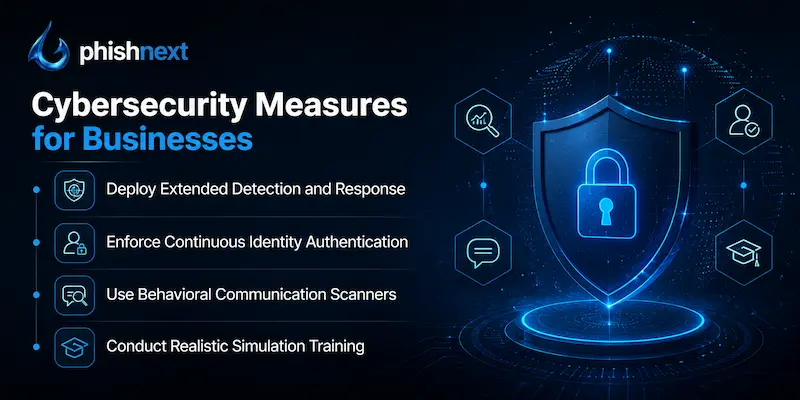
The following are some cybersecurity measures for businesses and organizations:
● Deploy Extended Detection and Response (XDR): Immediately stops multi-stage attacks by automatically combining and correlating threat data from endpoints, networks, and clouds.
● Enforce Continuous Identity Authentication: Rather than depending on a single login event, it continuously verifies user context and behavioral biometrics.
● Use Behavioral Communication Scanners: To stop hyper-personalized, AI-driven phishing frauds, examine email tone, intent, and past relationships.
● Establish Automated Patch Management: Instantly upgrades all devices with essential software to fix vulnerabilities before hackers can take advantage of them.
● Conduct Realistic Simulation Training: Keeps staff members vigilant against complex social engineering and deepfake techniques by using customized, real-world scenario exams.
Future Trends in Phishing and Cyber Fraud Beyond 2026
|
S.No. |
Trends |
What? |
|
1. |
Autonomous Agentic Phishing |
Uses autonomous AI bots that conduct target research, plan talks, and modify lures in real time without the need for human participation. |
|
2. |
Targeting Non-Human Identities (NHIs) |
Focuses on using machine identities, API tokens, and over-privileged service accounts to obtain stealthy, long-term cloud access. |
|
3. |
Exploitation of AI Assistants and Workflows |
Uses malicious prompt injection to fool business AI copilots into making illegal file transfers or disclosing private information. |
|
4. |
Hyper-Realistic, Real-Time Deepfake Hijacking |
Uses generative AI to intercept live audio and video streams during business calls to easily impersonate CEOs and approve fraudulent transactions. |
|
5. |
Sophisticated Multi-Channel Cross-Pollination |
Builds impenetrable, cross-platform credibility by automatically synchronizing assaults across corporate email, WhatsApp, SMS, and LinkedIn. |
Conclusion
Now that we have talked about what Advanced Phishing is, you might want to get a dedicated solution to evade phishing attacks in the future. For that, you can go for PhishNext, a dedicated phishing attack simulator offered by Craw Security.
The amazing PhishNext platform can help users to confront various types of phishing attacks on a single platform while learning the ways to evade them. Thus, you will be able to protect yourself against such phishing attacks. What are you waiting for? Contact, Now!
Frequently Asked Questions
About Advanced Phishing
1. What are advanced phishing attacks in 2026?
The following are some advanced phishing attacks in 2026:
a) GenAI-Perfected Spear Phishing,
b) Real-Time Deepfake Impersonation,
c) AiTM and MFA Bypass Kits,
d) Explosion of Quishing (QR Code Phishing), and
e) CAPTCHA-Gated Evasion.
2. How has phishing evolved with artificial intelligence?
From generic, badly written mass emails, phishing has developed into hyper-personalized, typo-free social engineering tactics and real-time audio/video deepfakes that automate target research and quickly get past conventional filters.
3. What is a deepfake phishing attack, and how does it work?
In order to fool a victim into divulging sensitive information, changing login credentials, or approving fraudulent financial transfers during live calls or digital communications, a deepfake phishing attack uses generative AI to replicate the exact voice, video, or likeness of a trusted individual, such as a CEO or family member.
4. How do QR code phishing (quishing) scams trick users?
QR code phishing scams trick users in the following ways:
a) Exploiting Visual Blind Spots,
b) Bypassing Email Filters,
c) Shifting to Less-Protected Mobile Devices,
d) Creating Urgency with Trusted Contexts, and
e) Obscuring the Destination on Smaller Screens.
5. What is browser-in-the-browser (BitB) phishing?
In order to steal credentials during single sign-on (SSO) logins, an attacker uses HTML and CSS to create a flawless, phony browser pop-up window with a spoofed address bar, SSL padlock icon, and authentic URL. This technique is known as browser-in-the-browser (BitB) phishing.
6. How do attackers use multi-channel phishing strategies?
Attackers use multi-channel phishing strategies in the following ways:
a) Fragmenting the Attack Surface,
b) Building Psychological Credibility,
c) Exploiting Less-Monitored Personal Devices,
d) Creating a False Sense of Urgency, and
e) Bypassing Single-Channel Defense Filters.
7. What is synthetic identity fraud in cybercrime?
In cybercrime, a technique known as "synthetic identity fraud" allows attackers to create a fully new, realistic identity that can be used to open fraudulent accounts and steal money by combining actual, stolen personal information (such as an unused Social Security number) with completely fake data.
8. How can individuals identify modern phishing attempts?
Individuals can identify modern phishing attempts in the following ways:
a) Verify Unusual Requests via an Out-of-Band Channel,
b) Look for Inconsistencies in Deepfake Communication,
c) Inspect the Full URL After Scanning a QR Code,
d) Treat Extreme Urgency or Panic Triggers as Red Flags, and
e) Watch for "Off-Platform" Migrations.
9. What security measures can protect against cyber fraud in 2026?
Following security measures can protect you against cyber fraud in 2026:
a) Implement Phishing-Resistant MFA and Passkeys,
b) Deploy AI-Powered Behavioral Email Security (ICES),
c) Adopt Continuous Identity and Active Call Detection,
d) Establish Real-Time In-Line Deepfake Defenses, and
e) Enforce Automated Exposure and SaaS Governance.
10. What is the future of phishing and cyber fraud techniques?
An industrialized, AI-driven ecosystem where autonomous agents plan hyper-personalized, multi-channel attacks and alter real-time deepfakes at machine speed is at the heart of the future of phishing and cybercrime.