AI-Powered Social Engineering Attacks: The New Cyber Threat
Do you know anything about AI-Powered Social Engineering Attacks? If not, then you are at the right place. Here, we will talk about how these attacks work and victimize the victims with ease. Moreover, we will introduce you to a reliable phishing simulation platform that can offer you various virtual phishing attacks. What are we waiting for? Let’s explore now!
What Are AI-Powered Social Engineering Attacks?
Generative artificial intelligence is used in AI-powered social engineering attacks to automate and improve dishonest strategies, including producing highly tailored phishing emails or hyper-realistic deepfake audio.
Attackers can surgically replicate the tones and behaviors of trusted people on a large scale by using machine learning to evaluate enormous volumes of public data. Because the technology uses sophisticated, real-time modification to go around human intuition and normal security filters, this advancement makes traditional "red flags" more difficult to identify.
Let’s talk about what AI-Powered Social Engineering Attacks are and how you can protect yourself against them!
How Artificial Intelligence Is Transforming Cyber Threats?
|
S.No. |
Factors |
How? |
|
1. |
Hyper-Personalized Social Engineering |
In order to create extremely convincing, customized phishing content that imitates a particular person's distinct writing style and background, AI automates the scraping of public data. |
|
2. |
The Rise of "Agentic" AI Attacks |
Without continuous human guidance, autonomous AI bots are capable of independently scouting networks, pivoting across systems, and making decisions in real time to accomplish a breach. |
|
3. |
Deepfake Identity Fraud |
In order to get beyond biometric protection and control targets during live video calls or voice conversations, generative models produce lifelike audio and video clones. |
|
4. |
Accelerated Technical Exploitation |
LLMs significantly reduce the amount of time defenders have to patch systems by allowing attackers to quickly create functioning exploit code and scan large codebases for vulnerabilities. |
|
5. |
Self-Adapting Malware |
Malicious software powered by AI has the ability to instantly alter its own code signature in order to avoid detection by behavior-based security solutions and conventional antivirus software. |
Why AI Makes Social Engineering More Dangerous Than Ever?
AI is making social engineering more dangerous than ever for the following reasons:
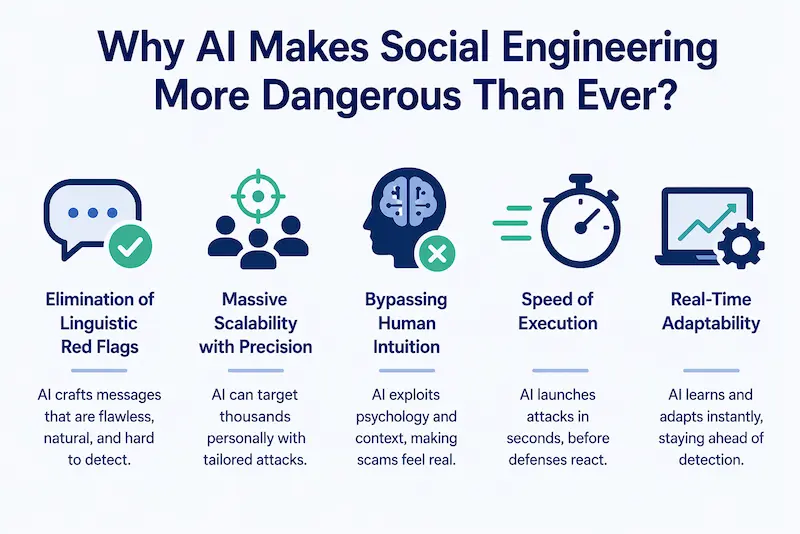
- Elimination of Linguistic Red Flags: AI produces faultless, professional prose that replicates a native speaker or a particular colleague by eliminating obvious signs like bad grammar and inappropriate phrasing.
- Massive Scalability with Precision: Thousands of highly targeted, customized ads can now be launched concurrently by attackers, a feat that previously required labor-intensive manual research for each victim.
- Bypassing Human Intuition: AI takes advantage of the ingrained psychological trust that humans have not evolved to challenge by employing deepfake audio and video to mimic reliable voices and faces.
- Speed of Execution: Security teams have very little time to stop the threat since AI can quickly assess a target's internet presence, create a customized lure, and launch an attack.
- Real-Time Adaptability: In order to guarantee the success of the attack, contemporary AI technologies can quickly modify their conversational strategies in response to a victim's answer.
Deepfake Technology and Its Role in Cybercrime
By using advanced generative models to produce incredibly lifelike synthetic media, deepfake technology enables fraudsters to pose as executives or reliable people by creating perfect audio and video clones.
By enabling convincing "Business Email Compromise" (BEC) schemes and circumventing biometric protection, this capacity effectively turns digital trust into a main attack vector, fueling high-stakes cybercrime.
How Hackers Use AI to Bypass Traditional Security Measures?
|
S.No. |
Factors |
How? |
|
1. |
Automated Evasion of Pattern Recognition |
Hackers can produce "adversarial" malware that appears harmless to conventional signature-based scanners by using AI to examine how security software identifies risks. |
|
2. |
Dynamic Credential Stuffing |
AI bots can successfully get beyond rate-limiting and simple bot-detection filters by imitating human typing cadences and changing IP addresses in real-time. |
|
3. |
Context-Aware Phishing Filters |
Attackers create emails that evade natural language processing (NLP) security filters intended to detect general bad intent by training models on corporate communication habits. |
|
4. |
Real-Time Biometric Spoofing |
Attackers can fool voice recognition and face authentication systems used for identity verification by using artificial intelligence (AI), which creates synthetic voice and facial data in real-time. |
|
5. |
Vulnerability Fuzzing at Scale |
Before security teams can create or implement conventional patches, AI-powered technologies can uncover and attack "zero-day" flaws in software far more quickly than human researchers. |
Key Types of AI-Driven Social Engineering Attacks
Following key types of AI-Driven Social Engineering Attacks:
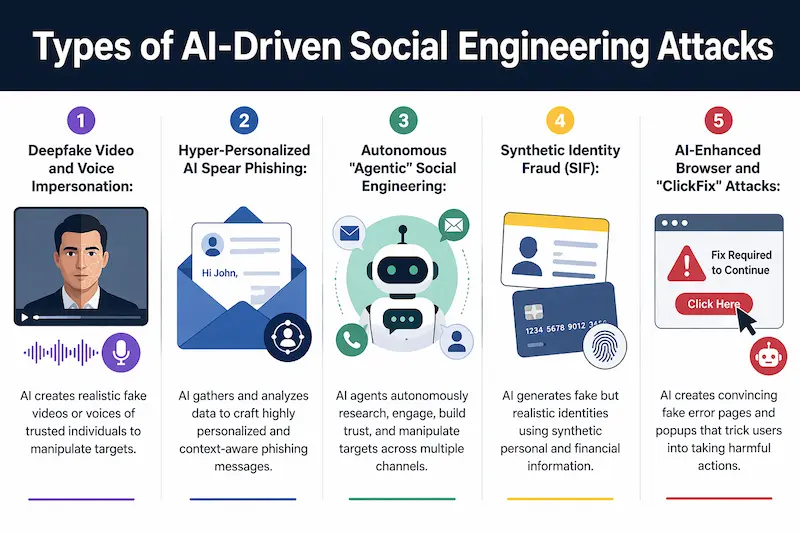
● Deepfake Video and Voice Impersonation: During recorded messages or live calls, AI mimics trustworthy contacts by cloning their voices and faces.
● Hyper-Personalized AI Spear Phishing: AI uses social data analysis to create incredibly precise, flawless lures that reflect the distinct communication style of a target.
● Autonomous "Agentic" Social Engineering: In order to establish rapport and acquire sensitive data without human interference, self-operating bots participate in lengthy, multi-step discussions.
● Synthetic Identity Fraud (SIF): AI creates completely new, convincing digital avatars that can evade identity and credit checks by combining actual and fake data.
● AI-Enhanced Browser and "ClickFix" Attacks: To fool users into granting access or "fixing" nonexistent faults, intelligent malware crafts pixel-perfect phony browser overlays or system prompts.
Psychological Manipulation in the AI Era
AI uses data-driven insights to take advantage of cognitive biases like authority and urgency by producing emotionally compelling and precisely timed messages that reduce a target's inherent skepticism.
By substituting highly convincing encounters that feel really personal for generic lures, attackers can affect human psychology at scale through the "precision engineering" of trust.
Real-World Examples of AI-Based Cyber Attacks
|
S.No. |
Examples |
What? |
|
1. |
The $25 Million Multinational Video Call Scam (2024) |
A financial employee at a multinational company in Hong Kong was duped into sending $25 million in one of the most sophisticated hacks to date after participating in a video conference in which the CFO and all other participants were excellent AI-generated deepfakes. |
|
2. |
The Retool Voice Cloning Breach (2023) |
By convincing an employee to provide an MFA (Multi-Factor Authentication) code over the phone using an AI-cloned voice of an IT administrator, attackers were able to compromise 27 well-known customer accounts at the software company Retool. |
|
3. |
The UK Energy Firm CEO Impersonation (Early Precursor) |
An early but iconic incident was a UK-based energy manager who, after receiving a call from someone who sounded exactly like his German boss, deposited $243,000 to a bogus account. The AI had accurately mimicked the CEO's unique accent, rhythm, and speech patterns. |
Warning Signs of AI-Powered Social Engineering Attempts
The following are the warning signs of AI-powered social engineering attempts:
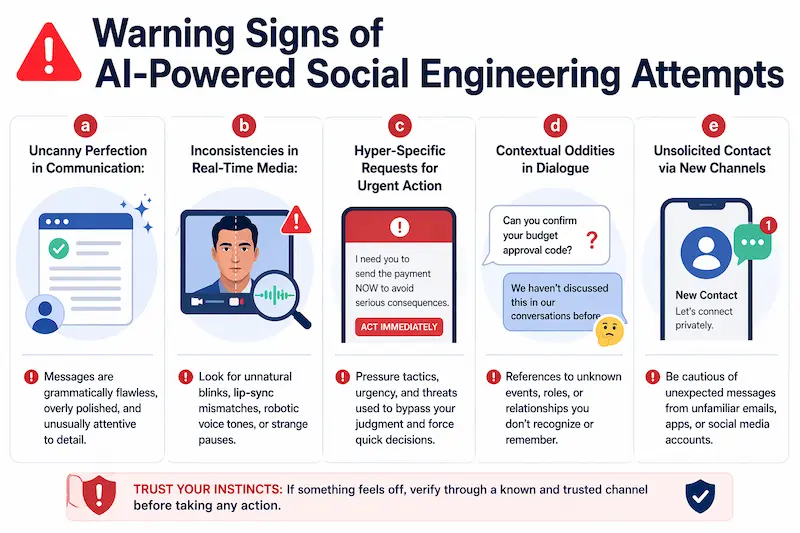
a) Uncanny Perfection in Communication: Emails and texts appear strangely perfect and formal, without the usual typos, slang, or grammatical faults inherent in human writing.
b) Inconsistencies in Real-Time Media: Subtle flaws like unnatural eye blinking, synchronized lip movements, or a robotic "flatness" in vocal tone can be seen in deepfake audio or video.
c) Hyper-Specific Requests for Urgent Action: In order to coerce you into circumventing common security measures, AI-driven lures frequently combine extensive personal knowledge with a fake emergency.
d) Contextual Oddities in Dialogue: AI is convincing, but when asked for "inside" knowledge, it might not be able to recollect certain, unindexed personal memories or provide ambiguous, circular responses.
e) Unsolicited Contact via New Channels: When a familiar acquaintance unexpectedly contacts you via an unfamiliar platform or a recently created "official" account, proceed with caution.
Best Practices to Protect Against AI-Driven Attacks
The following are the best practices against AI-Driven Attacks
- Enforce Phishing-Resistant MFA: To stop AI from intercepting or spoofing conventional SMS and push-notification codes, switch to hardware security keys or FIDO2 standards.
- Establish Out-of-Band (OOB) Verification: Before approving any sensitive data transfers or financial transactions, we need a supplementary confirmation through a prearranged, independent communication channel.
- Deploy AI-Enhanced Behavioral Analytics: Make use of machine learning-based security techniques to identify tiny deviations from accepted standards in user behavior and communication patterns.
- Implement "Human-in-the-Loop" for Critical Workflows: To prevent AI-automated logic from causing catastrophic events on its own, high-risk activities should require manual review and multi-person authorization.
- Upgrade to Scenario-Based Simulation Training: Use immersive simulations instead of generic tests to teach staff members how to spot deepfake audio, video, and hyper-personalized AI lures in real time.
The Future of Cybersecurity in the Age of AI
Cybersecurity will move toward an "AI vs. AI" environment in the future, where automated defensive systems fight emerging autonomous attacks in real-time at the millisecond level. The key to success will be to transition from static defenses to proactive, self-healing networks that put cryptographic trust and verifiable identification ahead of visual or auditory recognition.
Frequently Asked Questions
About AI-Powered Social Engineering Attacks
- What are the 4 types of AI risk?
The following are the 4 types of AI risk:
a) Bias and Fairness Risks,
b) Security and Robustness Risks,
c) Privacy and Data Governance Risks, and
d) Safety and Reliability Risks.
- What is a social engineering attack example?
Phishing emails are a common example, in which an attacker pretends to be a reputable bank or IT department in order to fool a victim into clicking on a malicious link and divulging their login information.
- What are the top 5 major threats to cybersecurity?
The following are the top 5 major threats to cybersecurity:
a) AI-Driven "Agentic" Attacks,
b) Identity and Session Hijacking,
c) Triple-Extortion Ransomware,
d) Software Supply Chain & "Shadow AI" Integrations, and
e) Living-off-the-Cloud (LotC).
- How is AI a threat to cybersecurity?
By automating the development of complex, error-free phishing operations, producing self-mutating malware to avoid detection, and employing deepfakes to impersonate reliable people on a large scale, artificial intelligence (AI) serves as a force multiplier for cybercriminals.
- What are the 7 types of AI?
The following are the 7 types of AI:
a) Artificial Narrow Intelligence (ANI),
b) Artificial General Intelligence (AGI),
c) Artificial Super Intelligence (ASI),
d) Reactive Machines,
e) Limited Memory,
f) Theory of Mind, and
g) Self-Aware AI.
- Which 3 jobs will survive AI?
The following 3 jobs will survive AI:
a) Skilled Trades (The "Real World" Barrier),
b) Healthcare & Mental Health (The "Empathy" Barrier), and
c) Strategic Leadership & Governance (The "Accountability" Barrier).
- What is the most famous social engineering attack?
The most well-known RSA SecurID incident occurred in 2011, when the world's top security company was forced to replace 40 million physical tokens after their encryption keys were exposed due to a single phishing email with a malicious Excel attachment.
- What are the four types of social engineering?
The following are the four types of social engineering:
a) Phishing (Email-Based),
b) Vishing (Voice-Based),
c) Smishing (SMS/Text-Based), and
d) Baiting (Physical or Digital Rewards).
- What are the top 3 types of cyber attacks?
The following are the top 3 types of cyber attacks:
a) AI-Driven Phishing and Social Engineering,
b) Advanced Ransomware (Multi-Extortion), and
c) Identity and Session Hijacking.
Conclusion
Now that we have talked about what AI-Powered Social Engineering Attacks are and how you can protect yourself against them. For that, you can get in contact with Craw Security, offering Phish Next, a dedicated phishing simulation platform.
Moreover, through such phishing attacks, you will be able to be prepared for the future phishing attacks and will be able to evade them in no time. What are you waiting for? Contact, Now!
Explore Related Topics
- Why Phishing Attacks Are Increasing in 2026?
- Phishing Attacks Are Imitating City & County Officials: FBI Alerted! | PhishNext
- Even After AI Improves Secure Development, Why Cybersecurity Still Matters
- Phishing Campaign Aims at WhatsApp Accounts
- How Phishing Attacks Work on Mobile Devices? - PhishNext
- Phishing Campaign Attacking Executives on LinkedIn: Alert!
- Huge Ransomware Attacks Rise in October 2025 Globally
- What Is Browser Detection & Response (BDR) in Cybersecurity?
- Guaranteed Publication in Chrome Web Store with New Malware Kit
- AI-Enabled Social Engineering Attacks are on the Rise
- Exposing How Sophisticated a Phishing Campaign is Bypassing M365 MFA
- How to Detect a Scam or Phishing Email in Just 10 Seconds?
- Why Do You Need PhishNext? [2026 Updated]
- Hidden Risks of Non-Compliance: What the Fines Hide?