Shadow AI Risks and How Leaders Can Build a Safe AI Use Culture

“AI” surely become a part of our lives and adjusted very well; however, sometimes, humans need to rethink about cohabitation with AI. Do you want to know why with an example? If yes, then you have come to the right place.
Here, we will explore how the cooperation with AI can ease our tasks, as well as create certain issues that may not be settled, and how you can prepare for that.
What is Shadow AI?
The term "shadow AI" describes the unapproved use of artificial intelligence tools and massive language models by staff members of a company without the IT department's express knowledge or consent.
In contrast to traditional software, it frequently entails integrating private company data into public AI systems in order to automate processes or boost productivity. This poses serious problems with regard to data privacy, intellectual property leakage, and regulatory compliance.
This "shadow" adoption typically happens as a result of employees looking for quick efficiency improvements that are not yet possible with official corporate technologies.
Is Shadow AI growing too quickly?
Yes, enterprise traffic to AI applications has increased by around 600% in the past year alone, indicating that Shadow AI is expanding at a never-before-seen pace. Eight out of ten office workers currently use unapproved AI technologies on a daily basis, according to recent statistics from 2026.
This creates a "productivity-security gap" where use of these tools surpasses organizational governance by a ratio of almost five to one.
The Scale of Growth (2025–2026)
Because it circumvents conventional protection layers, the "speed" of this growth is especially risky:
- The Stealth Factor: Nowadays, 70% of AI interactions take place through capabilities built into already-existing software, which makes it practically invisible to routine IT monitoring.
- The Policy Gap: Only around 30% of firms have official AI use standards in place, despite the fact that 98% of them report unsanctioned use, leaving the rest of the workforce "flying blind."
What are the risks of Shadow AI?
The following are the risks of shadow AI:
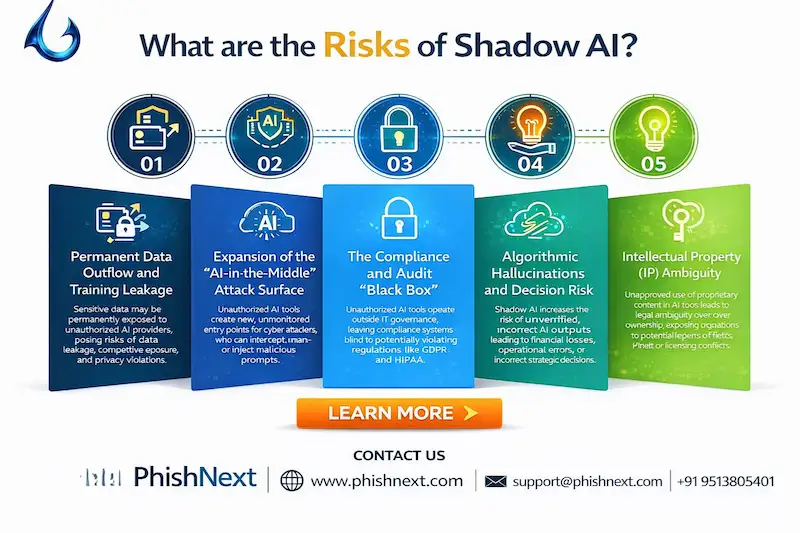
● Permanent Data Outflow and Training Leakage: Public models incorporate private company data into their permanent training set, which could reveal trade secrets to rivals.
● Expansion of the "AI-in-the-Middle" Attack Surface: Unverified AI browser plugins and extensions open up new, unguarded entry points for hackers to obtain private session information.
● The Compliance and Audit "Black Box": It is impossible to trace data lineage when using unapproved AI, which results in serious infractions of the CCPA, GDPR, and industry-specific privacy regulations.
● Algorithmic Hallucinations and Decision Risk: Workers might base important reports on trustworthy but erroneous AI-generated data, which could result in poor strategic choices and harm to the company's reputation.
● Intellectual Property (IP) Ambiguity: Unauthorized AI-generated content frequently lacks obvious legal ownership, which makes it a "legal minefield" for copyrights, patents, and business agreements.
Data Sovereignty and IP Leakage
|
S.No. |
Topics |
Factors |
What? |
|
1. |
Data Sovereignty |
Extraterritorial Data Traps |
Sensitive data is frequently handled in other jurisdictions when employees use public LLMs, exposing your company to the U.S. CLOUD Act or other international regulations that circumvent local privacy rules. |
|
Compliance Fragmentation |
Unauthorized AI use creates a "black box" that disrupts the chain of custody mandated by the EU AI Act, GDPR, and NIS2, making it impossible to verify who has access to or where data is stored. |
||
|
Training Set "Residency" |
Data effectively loses its residence once it is incorporated into the training set of a public model; it can no longer be "deleted" or localized, leading to a permanent violation of sovereignty. |
||
|
2. |
IP Leakage |
Prompt-Based Secret Exposure |
Giving an AI secret code, product roadmaps, or legal strategies to "summarize" could unintentionally teach the model to recommend the same fixes to your rivals. |
|
Loss of Copyright Eligibility |
Your "new" intellectual property may be legally unprotected and open to copying in many 2026 jurisdictions since AI-generated work is not protected by human authorship laws. |
||
|
Model Inversion Attacks |
Cybercriminals can explicitly query public models using "inversion" techniques to retrieve "memorized" trade secrets or private information that your employees have previously supplied as prompts. |
How is governing Shadow AI different from Shadow IT?
Shadow AI is different from Shadow IT in the following ways:
a) Data Persistency vs. Installation: Shadow AI is about sensitive data being permanently included in a public model's training set, whereas Shadow IT is about an unauthorized "app" sitting on a drive.
b) Predictability vs. Probability: While Shadow AI generates probabilistic outputs that may "hallucinate" or yield inconsistent results, Shadow IT technologies adhere to established, deterministic logic that is simple to audit.
c) Static Risk vs. Evolving Surface: After the software is deployed, Shadow IT dangers remain constant, but Shadow AI hazards change every day as new "agentic" features are added without user permission or models are updated.
d) Access Control vs. Prompt Governance: Shadow IT governance is concerned with "who can log in," whereas Shadow AI needs to control "what is being said," keeping an eye on the real prompts and shared data context.
e) Technical Users vs. Universal Adoption: While "power users" looking for specialized tools have historically pushed Shadow IT, Shadow AI's zero-barrier conversational interface has led to its widespread adoption across all departments.
Why is trying to stop Shadow AI unrealistic?
Trying to stop shadow AI is unrealistic for the following reasons:
- The Productivity Paradox: Workers with growing workloads will always pick AI's effectiveness over an IT "no," considering unapproved tools necessary to fulfill public service obligations.
- The "Invisible" Feature Creep: A complete prohibition is theoretically unattainable without turning off basic work software because AI is being natively incorporated into everyday tools like word processors and spreadsheets.
- The "Underground" Effect: Strict prohibitions prevent workers from seeking advice, which encourages them to handle sensitive data on personal devices and accounts where the company has no visibility.
- The Barrier to Competitive Talent: AI prohibitions are a significant barrier to hiring and retaining top digital talent in 2026, since they will not work for companies that "handcuff" them with antiquated technology.
- The Enforcement Gap: A level of surveillance that is both unaffordable and detrimental to culture is needed to keep an eye on every prompt and interaction among a varied municipal workforce.
The Innovation vs. Security Paradox
|
S.No. |
Topics |
Factors |
What? |
|
1. |
The Innovation Drive |
Operational Hyper-Efficiency |
AI frees up human workers for high-value public service duties by automating administrative tasks in understaffed departments. |
|
Citizen-Centric Service Delivery |
AI-powered solutions provide people with individualized assistance and round-the-clock accessibility, raising the bar for contemporary government responsiveness. |
||
|
Data-Driven Policy Making |
Leaders can see patterns and allocate resources (like emergency services or transit) with never-before-seen accuracy thanks to the quick analysis of large datasets. |
||
|
2. |
The Security Constraint |
Risk of "Black Box" Governance |
Public officials may find it challenging to defend or explain AI-driven results to the public due to the lack of transparency in automated decision-making. |
|
The Zero-Trust Mandate |
Verifying each contact is necessary for public sector security, which naturally slows down the "instant" deployment of experimental AI solutions. |
||
|
Long-Term Liability vs. Short-Term Gain |
The possibility of a persistent data breach presents a long-term liability that might plague a town for decades, even though a tool might save time today. |
A people-first approach to governing Shadow AI
The following are the people-first approaches to govern shadow AI:
● Define responsible use guardrails: Provide staff with explicit, uncomplicated "Rules of the Road" that outline which data kinds are safe for AI and which must remain completely offline.
● Increase visibility into usage: Determine which AI apps are most popular using open surveys and discovery tools. Use this information as a guide to determine what technologies the company genuinely needs.
● Approve and provision trusted AI tools: Provide formal, enterprise-grade AI platforms that are as fast as open-source technologies but maintain stringent data protection to do away with the need for "Shadow" behavior.
● AI-focused awareness and training: Go beyond simple "don't click" alerts and teach employees AI literacy by demonstrating to them how to create secure prompts and check the veracity of AI outputs.
Psychological Safety in AI Adoption
The corporate environment where employees feel comfortable revealing their use of unapproved AI tools without worrying about repercussions or mockery is known as psychological safety in AI adoption.
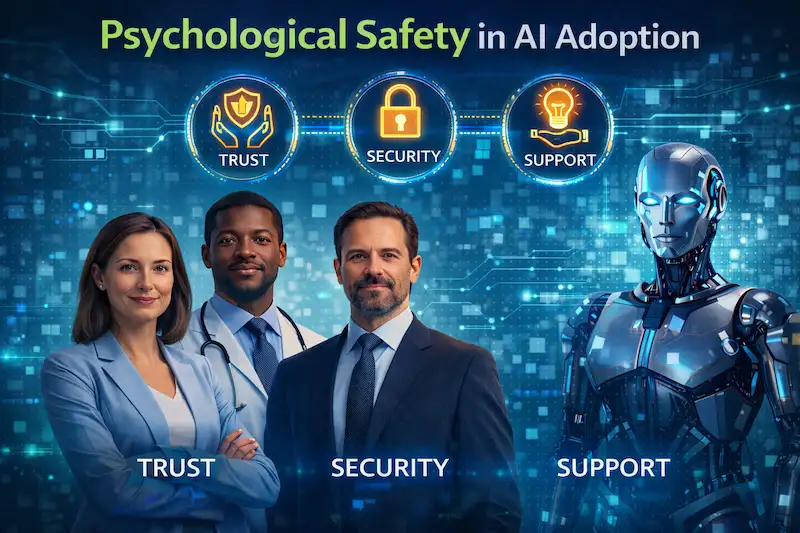
Instead of pushing usage deeper underground, leaders who cultivate this trust turn "hidden" hazards into opportunities for collaboration, enabling the business to offer advice on safe prompting and data handling.
Why Human-centred risk needs human-focused controls?
Human-centred risk needs human-focused controls for the following reasons:
a) Intent Outpaces Infrastructure: Productive workers will always come up with innovative ways to get over technical obstacles, so their buy-in is more powerful than any firewall.
b) The "Invisible" Nature of Prompts: Real-time governance can only be provided by a skilled and willing user because AI risk exists in the context of a discussion rather than just a file upload.
c) Adaptability Over Rigidity: A human-centered strategy develops a workforce that can critically evaluate new risks as they arise, while static technology safeguards are ineffective against quickly changing AI models.
d) Transparency as a Security Sensor: Every employee becomes a "security sensor" in a psychologically safe workplace, confidently reporting a possible data breach before it becomes widespread.
e) Trust is the Only Scalable Solution: You cannot keep an eye on every screen in a decentralized workplace; instead, you must rely on a foundation of shared principles and trust to safeguard organizational data.
|
Note: If you want to protect your confidential data against online threats, then you really need a reliable set of techniques and tools to strengthen your database security measures. For that, you can go for Craw Security’s specialized ShieldXDR, which detects and eliminates malicious attempts in a timely manner to secure your data. Go for it! |
Helpful Resources
- Guaranteed Publication in Chrome Web Store with New Malware Kit
- AI-Enabled Social Engineering Attacks are on the Rise
- Exposing How Sophisticated a Phishing Campaign is Bypassing M365 MFA
- How to Detect a Scam or Phishing Email in Just 10 Seconds?
- Why Do You Need PhishNext? [2026 Updated]
- Hidden Risks of Non-Compliance: What the Fines Hide?
- Nation-State Cyber Criminals Using AI to Streamline Targeting
- Strong vs Weak Passwords: A Complete Path [2026]