Account Takeover (ATO) Fraud Explained: Causes, Risks & Prevention
Do you know how heinous Account Takeover (ATO) Fraud is and how you can protect yourself against it? If not, then you are at the right place. Here, we will explore what this ATO does to the working staff.
Moreover, we will introduce you to a reliable phishing simulation platform where you can train yourself and fight against such attacks. What are we waiting for? Let’s find out!
What is Account Takeover (ATO) Fraud?
Account Takeover (ATO) fraud is a serious type of identity theft in which a malevolent actor uses social engineering or stolen credentials to obtain unauthorized access to a victim's online accounts, including banking, e-commerce, and email.
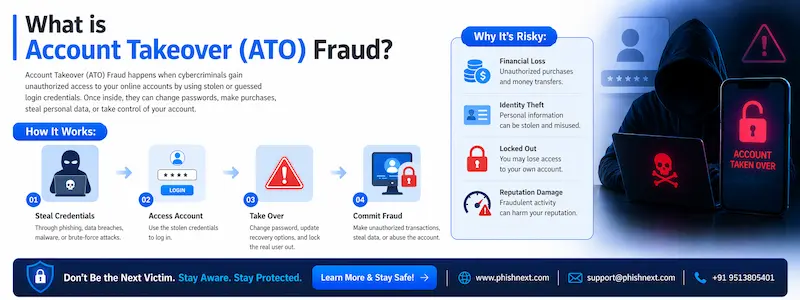
Once inside, the attacker can alter security settings, embezzle money, or steal private information, frequently preventing the rightful owner from accessing their own profile. Because it takes advantage of the trust that is built between a platform and a confirmed user identity, it poses a serious risk to digital security.
Let’s talk about what Account Takeover (ATO) Fraud is and how you can protect yourself against such attacks!
How Account Takeover Attacks Work Step-by-Step?
|
S.No. |
Steps |
What? |
|
1. |
Data Collection & Reconnaissance |
Attackers use social engineering, phishing, and dark web data breaches to obtain login passwords and personal information. |
|
2. |
Credential Testing |
Bots employ automated tools to carry out brute-force attacks or credential stuffing in order to determine which combinations are effective on particular sites. |
|
3. |
Initial Entry & Validation |
After gaining access to the account, the attacker searches for valuable assets like credit card savings, loyalty points, or private information. |
|
4. |
Account Hardening (The Takeover) |
The attacker modifies the recovery email, phone number, and password to keep the true owner from getting back in. |
|
5. |
Exploitation |
The hacked account is used to transfer money, make illegal transactions, or initiate other phishing attempts against the victim's connections. |
Types of Account Takeover Attacks You Should Know
The following are the types of Account takeover attacks you should know:
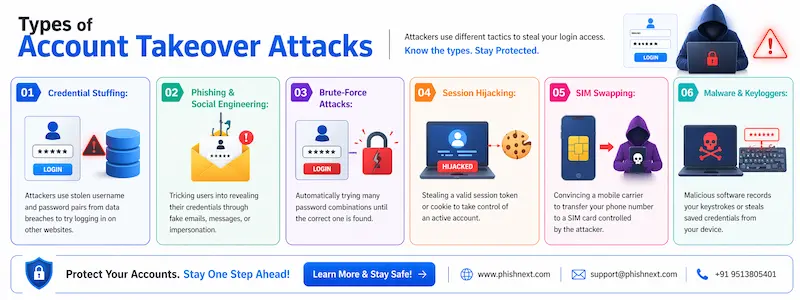
- Credential Stuffing: Attempting to log in on other sites using extensive databases of usernames and passwords that were compromised in one attack.
- Phishing & Social Engineering: Tricking people into disclosing their login credentials by using phony websites, misleading emails, or coercive phone calls.
- Brute-Force Attacks: Using automated tools to methodically guess passwords by attempting millions of different combinations until the right one is discovered.
- Session Hijacking: Stealing active "session cookies" to take control of a user's current authenticated online session and completely avoid the login process.
- SIM Swapping: Convincing a cell provider to move a victim's number to a different SIM card to intercept two-factor authentication (2FA) codes.
- Malware & Keyloggers: Installing malicious software on a device that logs all keystrokes and captures passwords and usernames as they are entered.
Common Causes of ATO Fraud in 2026
The following are some common causes of ATO Fraud in 2026:
● Agentic AI & Industrialized Deception: Real-time voice cloning and highly customized phishing attempts are now automated on a large scale by sophisticated AI agents.
● Widespread Credential Recycling: Because users continue to reuse passwords on several sites, an attacker can gain access to a complete digital footprint through a single breach.
● Bypassing Legacy Multi-Factor Authentication (MFA): To intercept one-time codes and session tokens in real time, modern attackers use proxy-based phishing websites and "MFA fatigue" assaults.
● Expansion of Info-Stealer Malware: Specialized malware is now more widely available and surreptitiously collects active session cookies and browser-stored credentials from compromised computers.
● API Vulnerabilities & Synthetic Identities: Attackers can get beyond typical front-end security barriers and build "sleeper" accounts for future takeovers by using AI-generated phony identities and insecure backend APIs.
Real-World Examples of ATO Fraud Incidents
|
S.No. |
Examples |
What? |
|
1. |
Financial Services Exploitation |
In a significant 2026 incident, hackers gained access to high-net-worth bank accounts and started unlawful wire transfers by using AI-powered speech cloning to get over biometric phone verification. |
|
2. |
Retail & Loyalty Program Breaches |
In a large credential stuffing assault, hackers acquired control of millions of user profiles at a major international e-commerce company in order to utilize saved credit cards to make transactions and deplete accrued loyalty points. |
|
3. |
Social Media & Identity Theft |
Attackers were able to publish bogus cryptocurrency scams and deliver malicious phishing links to millions of followers by using session hijacking to infiltrate high-profile social media accounts. |
Key Risks and Impacts of Account Takeover Attacks
The following are some of the key risks and impacts of account takeover attacks:
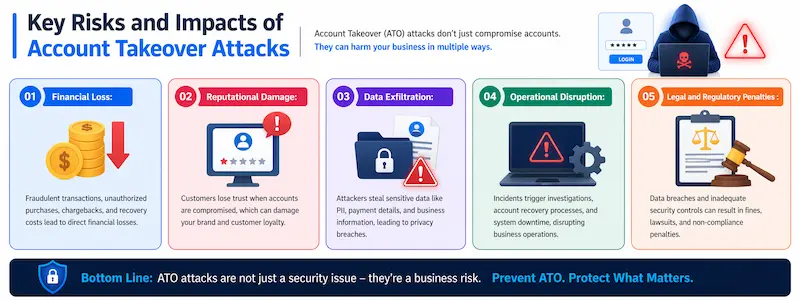
a) Financial Loss: Unauthorized transactions made with credit cards that have been saved, direct bank account theft, or the depletion of important loyalty and reward points.
b) Reputational Damage: A successful ATO wave damages a company's reputation and undermines consumer trust; for individuals, hacked accounts can be used to distribute offensive or fraudulent content to their contacts.
c) Data Exfiltration: Sensitive personal information (PII) is obtained by attackers and can be sold on the dark web or utilized for long-term fraud and additional identity theft.
d) Operational Disruption: Victims lose a lot of time and money trying to get back into their accounts, while businesses have to deal with higher customer service and legal costs.
e) Legal and Regulatory Penalties: Under data protection rules like the CCPA or GDPR, organizations that fail to secure user data may be subject to severe fines.
Warning Signs of a Compromised Account
The following are the warning signs of a Compromised Account:
- Unexplained Security Notifications: Getting notifications by email or SMS about new login locations, password changes, or two-factor authentication (2FA) requests that you didn't start.
- Locked Out of Account: Discovering that your recovery email address or phone number has been altered without your consent and that your login credentials are no longer valid.
- Unfamiliar Account Activity: Seeing friend requests and follow requests that you did not authorize, posts that you did not share, and sent messages that you did not write.
- Strange Financial Transactions: Unauthorized bank transfers, unanticipated credit card payments, or disappearing gift card balances and loyalty points.
- Suspicious Device List: Looking at your account settings and discovering "authorized devices" or active sessions that you do not own or recognize.
Account Takeover Detection vs. Prevention Strategies
|
S.No. |
Topics |
Factors |
What? |
|
1. |
Account Takeover Detection Strategies |
User Behavior Analytics (UBA) |
Keeping an eye out for irregularities in typical user behavior, like a quick change in account settings at three in the morning or an unexpected login from a different nation. |
|
Velocity & Impossible Travel Checks |
Flagging accounts that display attempts to log in from two distinct locations during a period of time that would be impractical for travel. |
||
|
Dark Web Monitoring |
Using automated techniques to search underground forums and leak sites for compromised domain credentials before they are utilized in an attack. |
||
|
2. |
Account Takeover Prevention Strategies |
Phishing-Resistant MFA |
To reduce the possibility of one-time passwords or intercepted SMS codes, use hardware security keys or FIDO2-compliant authentication. |
|
Device Fingerprinting |
Examining IP addresses, browser settings, and hardware characteristics to make sure that only approved and reliable devices are permitted to access the account. |
||
|
Strict Password Policies & Vaults |
Encourage enterprise-grade password managers to prevent credential recycling across platforms and enforce the usage of distinct, complicated passwords. |
Best Security Tools and Technologies to Stop ATO Attacks
The following are the best security tools and technologies to stop ATO Attacks:
● Adaptive Authentication & Risk-Based MFA: Simply increases security requirements in cases where login signals seem dubious or dangerous.
● Biometric Verification: Makes use of distinctive physical indicators, such as fingerprints or face recognition, to verify that the individual is the true owner.
● Behavioral Biometrics: Detects automated bots or impostors by analyzing subtle user behaviors, such as mouse movements and typing rhythm.
● Bot Management & Mitigation Platforms: Distinguishes between fraudulent credential-stuffing scripts and legitimate users, preventing widespread automated attacks.
● Threat Intelligence Feeds: Allows for the proactive blocking of known threats by providing real-time data on compromised credentials and new attack trends.
How to Prevent Account Takeover (ATO) Fraud Effectively?
In the following ways, you can prevent account takeover fraud effectively:
a) Enable Robust Multi-Factor Authentication (MFA): Give phishing-resistant techniques such as authenticator applications or hardware security keys (FIDO2) priority over susceptible SMS-based codes.
b) Monitor Account Activity Regularly: To quickly identify unauthorized changes, set up real-time alerts for successful logins, password resets, and contact information changes.
c) Implement Behavioral Analytics: To identify irregularities that point to a non-human or unauthorized user, utilize security tools that monitor common user behaviors like typing speed and mouse movements.
d) Practice Strong Password Hygiene: To effectively eliminate the possibility of credential stuffing, create complicated, one-of-a-kind passwords for each service using a dedicated password manager.
e) Educate Users on Social Engineering: Provide frequent training to assist people in recognizing advanced phishing attempts, voice cloning, and dishonest "MFA fatigue" techniques employed by contemporary attackers.
Compliance and Legal Requirements for Data Protection
|
S.No. |
Factors |
What? |
|
1. |
GDPR (General Data Protection Regulation) |
Requires users in the EU to comply with stringent data security and breach notification regulations. |
|
2. |
CCPA/ CPRA (California Consumer Privacy Act) |
Gives Californians the ability to manage their personal information and mandates that companies put in place appropriate security measures. |
|
3. |
PCI DSS (Payment Card Industry Data Security Standard) |
Establishes international standards for safeguarding cardholder information to stop account takeovers connected to payments. |
|
4. |
HIPAA (Health Insurance Portability and Accountability Act) |
Creates national guidelines for protecting private patient health data in the US. |
|
5. |
DORA (Digital Operational Resilience Act) |
Compels EU financial institutions to report major ICT-related incidents and bolster their digital defenses. |
Future Trends in ATO Fraud and Cybersecurity Defense
The following are the future trends in ATO Fraud and Cybersecurity Defense:
- Generative AI Weaponization: Attackers automate incredibly convincing, customized takeover attempts at scale using LLM-driven social engineering and real-time deepfakes.
- Passkey Adoption & Passwordless Security: By linking authentication to actual objects, the move toward FIDO2 passkeys seeks to do away with standard passwords and make phishing almost impossible.
- Autonomous Security Operations (ASOC): AI agents will be used by defensive systems more frequently to anticipate, identify, and stop ATO attempts in milliseconds without the need for human interaction.
- Decentralized Identity (DID): By enabling users to manage their own credentials, blockchain-based identification solutions lessen the dependence on centralized databases that are vulnerable to widespread breaches.
- Zero Trust Continuous Authentication: The goal of security frameworks is "never trust, always verify," which involves continuously re-validating user identity based on behavioral indications during a session.
Frequently Asked Questions
About Account Takeover (ATO) Fraud
- What is Account Takeover (ATO) fraud?
Account Takeover (ATO) fraud is a type of identity theft in which an unauthorized person obtains access to a valid account in order to steal money, personal information, or carry out additional cybercrimes.
- How do hackers perform ATO attacks?
In the following ways, hackers perform ATO attacks:
a) Phishing and Social Engineering,
b) Credential Stuffing,
c) Brute-Force Attacks,
d) Session Hijacking, and
e) SIM Swapping.
- What are the common targets of ATO fraud?
The following are the common targets of ATO fraud:
a) Financial Institutions,
b) E-commerce and Retail Accounts,
c) Social Media Profiles,
d) Enterprise and Work Emails, and
e) Healthcare and Government Portals.
- What is credential stuffing in ATO attacks?
Credential stuffing is an automated attack in which hackers obtain unauthorized access to other unrelated accounts by using large databases of compromised usernames and passwords from one breach.
- How can I know if my account is compromised?
In the following ways, you will know if your account is compromised:
a) Unsolicited Password Reset Emails,
b) Failed Login Attempts,
c) Unfamiliar Login Activity,
d) Unexplained Account Changes, and
e) Suspicious Financial or Social Activity.
- Why is ATO fraud dangerous?
ATO fraud is dangerous for the following reasons:
a) Immediate Financial Depletion,
b) Identity Theft & Synthesis,
c) Reputational & Social Damage,
d) Loss of Digital Legacy, and
e) Corporate Data Breaches.
- How can I prevent Account Takeover attacks?
In the following ways, you can prevent Account Takeover attacks:
a) Enable Phishing-Resistant MFA,
b) Use a Password Manager,
c) Monitor for Breaches,
d) Set Up Account Alerts, and
e) Secure Your Recovery Methods.
- What role does multi-factor authentication (MFA) play in ATO prevention?
Even if an attacker has stolen your login credentials, MFA acts as a crucial additional barrier by requiring a new kind of authentication in addition to a password.
Conclusion
Now that we have talked about Account Takeover (ATO) Fraud, you might be wondering what kind of phishing simulation platform we are going to introduce you to. We are introducing Phish Next, a dedicated real-life phishing simulation platform where you will confront various phishing attack situations.
After training yourself with those attacks, you will be able to identify unknown phishing attempts and will be able to evade them in time. What are you waiting for? Contact, Now!
Discover Similar Content
- How Phishing Attacks Work on Mobile Devices? - PhishNext
- Phishing Campaign Attacking Executives on LinkedIn: Alert!
- Huge Ransomware Attacks Rise in October 2025 Globally
- What Is Browser Detection & Response (BDR) in Cybersecurity?
- Guaranteed Publication in Chrome Web Store with New Malware Kit
- AI-Enabled Social Engineering Attacks are on the Rise
- Exposing How Sophisticated a Phishing Campaign is Bypassing M365 MFA
- How to Detect a Scam or Phishing Email in Just 10 Seconds?