Top 15 OSINT Tools for Expert Intelligence Gathering In 2026
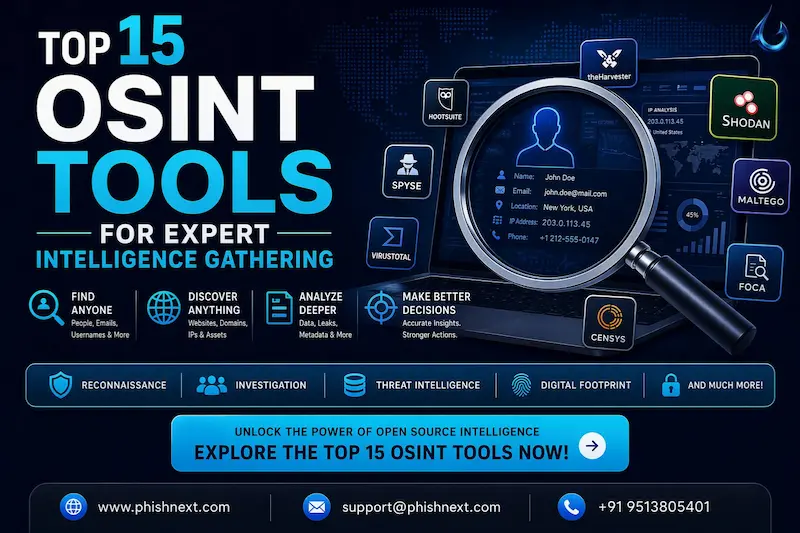
Let’s talk about what OSINT Tools are and how those works! Why? It’s one of the most used tools preferred by ethical hackers around the world. We will explore the work of the top 15 OSINT Tools in detail.
Moreover, we will talk about the legal and ethical boundaries of using these tools and information gathering. What are we waiting for? Let’s get straight to the topic!
What are OSINT Tools?
Software programs called OSINT (Open Source Intelligence) tools are made to compile and examine information from publicly accessible sources, including social media, public records, and the dark web, in order to find security flaws or obtain intelligence.
By automating the process of "connecting the dots" between diverse bits of information, these tools enable security experts to see what an external attacker may learn about a company. Let’s take a look at what OSINT Tools are and how they help experts gather data!
Digital Footprinting in the Modern Era
Thanks to the vast aggregation of IoT data, social media presence, and AI-driven behavioral tracking, digital footprinting has developed into a constant, high-resolution portrait of a person's life in 2026.
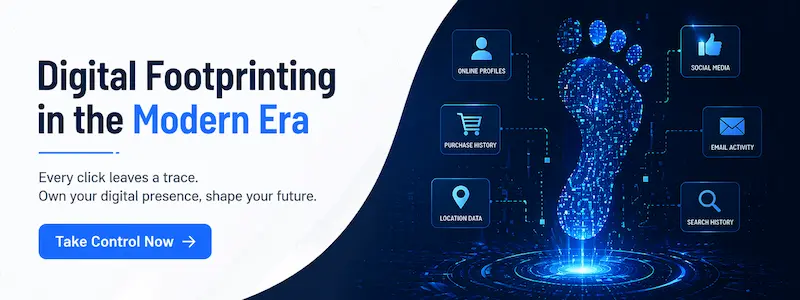
Both marketers and cybercriminals use this vast trail as their main source of intelligence. They use artificial intelligence (AI) to examine even the smallest digital footprints to forecast future activities or create highly focused social engineering assaults.
Legal and Ethical Boundaries in Intelligence Gathering
The following are some of the legal and ethical boundaries in Intellihence gathering:
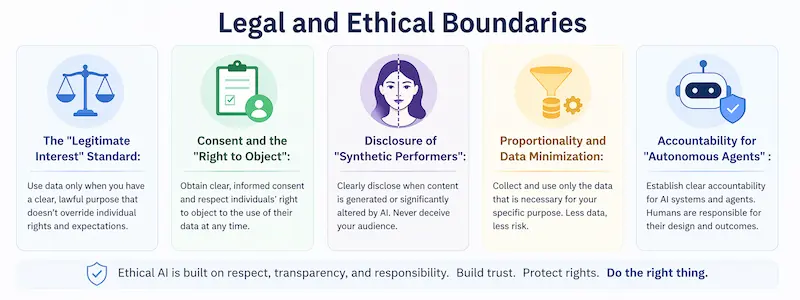
- The "Legitimate Interest" Standard: Companies must demonstrate that gathering data fulfills a specific, essential function that takes precedence over an individual's basic right to privacy.
- Consent and the "Right to Object": People are still able to legally object to data processing and request that their personal data be immediately removed from intelligence databases.
- Disclosure of "Synthetic Performers": In order to prevent fraudulent manipulation, ethical norms require that any AI-generated persona or "deepfake" utilized in data collecting be clearly labeled.
- Proportionality and Data Minimization: The "collect everything" strategy common to early big data must be prohibited, and intelligence gathering must be restricted to the bare minimum of information needed.
- Accountability for "Autonomous Agents": Regardless of the degree of autonomy of the system, human operators are nonetheless legally responsible for the behavior and moral transgressions of the AI technologies they use.
Top 15 OSINT Tools for Expert Intelligence Gathering
The following are the top 15 OSINT tools for expert intelligence gathering:
● OSINT Framework: An extensive online directory that classifies hundreds of tools and resources for different kinds of data exploration.
● Google Dorks: Advanced operators are used in specialized search queries to find hidden files or sensitive information that Google's spiders have indexed.
● theHarvester: A Python-based program that collects emails, hosts, subdomains, and employee names from several public data sources.
● SecurityTrails API: An industry-standard interface for examining IP addresses, domain ownership information, and DNS records from the past and present.
● BGPView: An organization's network infrastructure and IP prefixes can be mapped out using this specialized search engine for Border Gateway Protocol data.
● Recorded Future's Vulnerability Database: A real-time intelligence hub that links actual exploit usage in the wild with CVEs (Common Vulnerabilities and Exposures).
● Triage Malware Sandbox: A tool for high-volume analysis that enables researchers to safely run dubious files and track their network activity.
● Mitaka: An add-on for browsers that makes searching for IP addresses, domains, and hashes across dozens of search engines at once easier.
● Recorded Future's Browser Extension: A tool that instantly offers context for security information on any technical sign discovered when perusing a website.
● Have I Been Pwned?: The best database for determining whether a phone number or email address has been exposed in a known data breach.
● BuiltWith: A profiling tool that shows the complete stack of servers and analytics that power a particular website.
● Shodan: Referred to as the "search engine for the Internet of Things," it enables users to locate routers, servers, and webcams that are linked to the Internet.
● SpiderFoot: An automation program that conducts extensive intelligence collection on a single target by integrating with more than 100 data sources.
● Maltego: An effective link-analysis tool that shows the connections between individuals, organizations, domains, and infrastructure.
● Nmap: In order to create a "map" of the digital landscape, a fabled network mapper was used to identify hosts and services on a computer network.
Passive vs. Active Reconnaissance Techniques
|
S.No. |
Topics |
Factors |
What? |
|
1. |
Passive Reconnaissance |
OSINT Harvesting |
Mapping out personnel hierarchies and infrastructure by gathering public data from social media, WHOIS records, and business filings using programs like Maltego or SpiderFoot. |
|
Search Engine Discovery |
Using Shodan or Google Dorks to locate critical subdomains that have already been indexed by third-party crawlers, exposed servers, or compromised data. |
||
|
Traffic Analysis |
Software versions and potential vulnerabilities can be found without sending a single packet to the target by keeping an eye on publicly accessible network metadata or using "leaked" information from data breaches (such as Have I Been Pwned?). |
||
|
2. |
Active Reconnaissance |
Port Scanning & Service Discovery |
By sending packets to particular IP addresses using Nmap, one can determine which ports are open and the precise version of the services (such as "Apache 2.4.50") that are operating on those addresses. |
|
Vulnerability Scanning |
Using automated tools to aggressively search systems for known vulnerabilities, including unpatched software or incorrectly configured APIs, by mimicking "mini-attacks." |
||
|
Network Mapping & Enumeration |
To create a real-time, internal map of the network architecture, directly query the target's DNS servers for zone transfers or brute-force subdomains. |
Advanced Search Operators and Dorking Strategies
The following are some advanced search operators and dorking strategies:
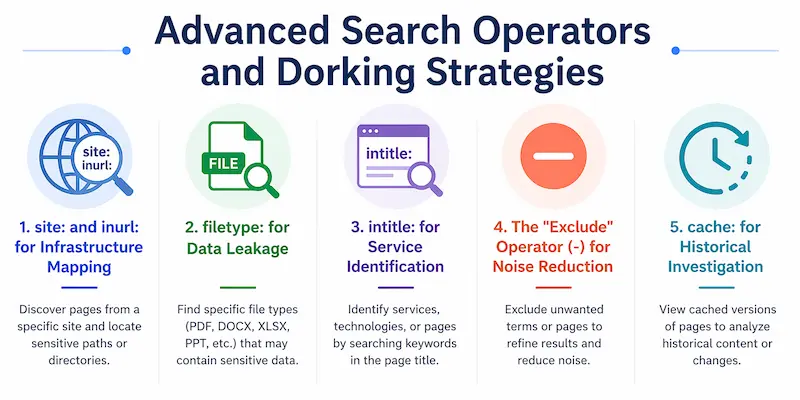
a) site: and inurl: for Infrastructure Mapping: It is possible to find secret login portals or exposed backend interfaces that aren't connected on the main webpage by using site:target.com in conjunction with inurl: admin or inurl:api.
b) filetype: for Data Leakage: Searching for filetype: Keywords like "confidential," "internal only," or "budget" combined with pdf or filetype:xlsx can reveal private papers that search engines have inadvertently searched.
c) intitle: for Service Identification: Using intitle: "index of /" displays open directories where web servers are publicly showing files, frequently revealing configuration information, backup files, or source code.
d) The "Exclude" Operator (-) for Noise Reduction: Removing the obvious is known as "strategic dorking." For instance, site:target.com -www compels the search engine to display only subdomains, such as dev.target.com or test.target.com, which are frequently less secure.
e) cache: for Historical Investigation: The cache: URL operator may frequently get the "snapshot" of the page as it was before it was removed, offering a view into destroyed intelligence, if a target realizes they have released data and deletes the page.
6 Real-Life Examples of How to Use OSINT Tools for Practical Applications
The following are the 6 real-life examples of how to use OSINT Tools for practical applications:
- Advanced Search Engines for Public Information Gathering: To stop illegal access before an exploit happens, use Shodan to find unpatched industrial control systems that are linked to the internet.
- Using Social Media for OSINT: Mapping company hierarchies and identifying particular software versions mentioned in job advertisements by examining a target's LinkedIn and X (Twitter) footprints.
- Exploring Public Records and Databases: Tracing "shell company" ownership arrangements with OpenCorporates to identify a global business's real beneficial owners.
- Integrating Data Analytics in OSINT: Generating a unified risk profile of an organization's attack surface by using SpiderFoot to correlate hundreds of data points from IP blocks to compromised credentials.
- Digital Profiling with OSINT Technologies: Using Maltego to graphically map the connections between an alias, the email addresses that belong with it, and their activity on several dark web forums.
- Code and Development Insights Through OSINT Apps: Using tools like TruffleHog to scan GitHub and GitLab for hardcoded passwords or sensitive API credentials that were inadvertently published to public repositories.
Operational Security (OPSEC) for the Investigator
For an investigator, operational security (OPSEC) is methodically safeguarding one's identity and digital footprint in order to keep a target from becoming aware that they are being observed. The investigator makes sure that their questions don't unintentionally alert the subject or connect the investigation to their personal or professional life by using techniques like non-attributable virtual machines, strong VPNs, and "sock puppet" accounts.
Frequently Asked Questions
About OSINT Tools
- What is an open source intelligence tool?
A software program that automatically gathers and analyzes publicly accessible data from the internet, social media, and public documents to produce actionable insights or security information is known as an open source intelligence (OSINT) tool.
- How can social media be used for OSINT?
In the following ways, social media can be used for OSINT:
a) Mapping Corporate Hierarchies,
b) Geolocation and Physical Security,
c) Technical Intelligence (Tech Stack),
d) Identifying "Soft Targets" for Phishing, and
e) Username and Email Correlation.
- How can legal compliance be ensured in OSINT practices?
In the following ways, legal compliance can be ensured in OSINT practices:
a) Establishing a "Lawful Basis" for Processing,
b) Adhering to Data Minimization,
c) Respecting Platform Terms of Service (ToS),
d) Conducting Data Protection Impact Assessments (DPIA), and
e) Maintaining Transparency and "Right to Redress".
Conclusion
Now that we have talked about OSINT Tools, you might want to learn how these tools work for their best use. For that, there are various sources where you can learn how these tools actually benefit the users.
Moreover, organizations use these tools to get a better understanding of a dataset after gathering data from the internet and keeping only the useful information. What are you waiting for? Learn, Research, and Innovate!
Discover Similar Content
- Stolen Traveler Data Is on Sale at Dark Web, According to Eurail
- Threat Actors Get Real-Time Access to Attacks via Voice Phishing Kits
- Attackers Using LLMs to Create Phishing Pages in Real Time
- Why Phishing Attacks Are Increasing in 2026?
- Phishing Attacks Are Imitating City & County Officials: FBI Alerted! | PhishNext
- Even After AI Improves Secure Development, Why Cybersecurity Still Matters
- Phishing Campaign Aims at WhatsApp Accounts
- How Phishing Attacks Work on Mobile Devices? - PhishNext
- Phishing Campaign Attacking Executives on LinkedIn: Alert!
- Huge Ransomware Attacks Rise in October 2025 Globally
- What Is Browser Detection & Response (BDR) in Cybersecurity?
- Guaranteed Publication in Chrome Web Store with New Malware Kit