How PhishNext AI Shield Protects Your AI Agents in Real Time?
Let’s explore the details of PhishNext AI Shield in detail and find out if it works for you in this fast-changing cyber world! Various companies are finding reliable solutions for cyber phishing attacks in the IT Industry.
Thus, here, we will talk about one of the most amazing phishing AI security tools offered by a reputed VAPT service provider. What are we waiting for? Let’s get straight to the topic!
Why PhishNext AI Shield Matters?
|
S.No. |
Factors |
Why? |
|
1. |
Advanced Phishing Detection |
AI quickly thwarts identity spoofing and complex business email breach threats. |
|
2. |
Real-Time URL and Link Scanning |
In order to prevent hidden risks, it rewrites and verifies URLs at the precise moment of clicking. |
|
3. |
Proactive Protection Against Zero-Day Exploits |
Heuristic analysis eliminates novel, undiscovered phishing techniques prior to the existence of signatures. |
|
4. |
Continuous Security Awareness and Simulation |
Your employees are trained to recognize real-world phishing lures through automated simulation attacks. |
|
5. |
Unified Integration with ShieldXDR |
It provides full cross-domain visibility by feeding email threat data straight into your central dashboard. |
The Rising Threat of AI-Powered Phishing Attacks
The following are some of the reasons for the rising threat of AI-powered phishing attacks:
1. Social Engineering: AI is used by attackers to examine public profiles and quickly create faultless, highly customized phishing emails on a large scale.
2. Deepfakes: To pose as CEOs and fool staff into approving urgent wire transfers, cybercriminals create incredibly lifelike cloned voices and movies.
3. LLM Jailbreaking: In order to get around security measures and quickly create complex, difficult-to-detect malware and exploit code, malicious actors use commercial AI models.
What is PhishNext AI Shield?
PhishNext AI Shield is a cutting-edge, AI-powered email security solution that can instantly identify and stop complex phishing, corporate email compromise (BEC), and deepfake-driven social engineering attacks.
It effortlessly integrates into the larger ShieldXDR ecosystem and stops malicious emails at the gateway by using machine learning, proactive URL rewriting, and zero-day threat analysis.
Key Security Capabilities of PhishNext AI Shield
|
S.No. |
Factors |
What? |
|
1. |
Intent-Based Threat Detection |
It blocks hidden social engineering cues and analyzes email context using language models. |
|
2. |
Hyper-Realistic Attack Mimicry |
The technology creates unique phishing simulations that closely resemble the strategies used by actual attackers. |
|
3. |
Just-in-Time (JIT) Micro-Training |
As soon as an employee makes a mistake and clicks, it instantly provides brief security training. |
|
4. |
Real-Time Browser Detection & Response |
Malicious URL redirection and active credential theft are immediately detected by advanced tracking. |
|
5. |
Advanced Behavioral Risk Analytics |
In order to identify high-risk individuals and monitor organizational vulnerability trends, the system tracks user patterns. |
How AI Shield Stops Phishing Before User Impact?
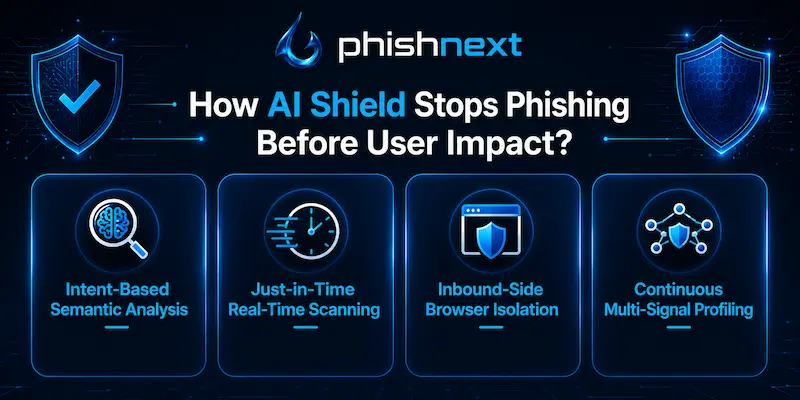
AI shield stops phishing before user impact in the following ways:
● Intent-Based Semantic Analysis: To identify small social engineering indications before delivery, natural language models examine the context of incoming emails.
● Just-in-Time Real-Time Scanning: To identify delayed malicious redirections, every link is rewritten and inspected at the precise moment of the click.
● Inbound-Side Browser Isolation: To prevent malware from running on the user's device, dubious links are opened in a safe, isolated cloud environment.
● Continuous Multi-Signal Profiling: In order to prevent zero-day spoofing attempts, the system quickly cross-references sender behavior, domain age, and email structures.
● Proactive Micro-Training Feedback: Real-time user interventions offer immediate, context-specific security training while preventing unintentional credential entry.
Benefits for Enterprises Using AI Shield
The following are the benefits of enterprises using AI Shield:
a) Neutralization of Human-Risk Vulnerabilities: With real-time, automated security interventions, it rapidly turns workers from passive targets into an active line of defense.
b) Significant Reduction in Successful Breaches: The system prevents ransomware connections, sophisticated credential harvesting, and zero-day social engineering from ever reaching your network.
c) Granular Visibility into Workforce Risk Profiles: Executives get lucid, data-driven insights that identify high-risk divisions and monitor general trends in company security knowledge.
d) Maximized ROI Through Rapid Automation: For security teams, time-consuming human triage is eliminated via automated scanning, URL rewriting, and incident response protocols.
e) A Unified, Cross-Domain Defense Posture: To organize a coordinated response across endpoints, networks, and cloud environments, email threat intelligence is directly integrated into your larger XDR ecosystem.
Why Real-Time AI Protection is the Future of Cybersecurity?
|
S.No. |
Factors |
Why? |
|
1. |
Instant Mitigation of Machine-Speed Attacks |
Before humans can react, AI stops automated, fast-moving cyberattacks in milliseconds. |
|
2. |
Neutralization of Polymorphic and Zero-Day Threats |
New, shape-shifting malware that can readily evade conventional, signature-based defenses is stopped via behavioral analysis. |
|
3. |
Adaptive Defense Against Generative AI Attacks |
In order to identify and stop AI-generated phishing emails and hyper-realistic deepfakes, clever algorithms are always evolving. |
|
4. |
Radical Reduction in Alert Fatigue |
By removing background noise, machine learning creates a single, highly reliable incident chronology from thousands of dispersed notifications. |
|
5. |
Continuous, Dynamic Risk Profiling |
In order to quickly modify access limits and security regulations, the system continuously tracks user and device behavior in real time. |
Conclusion: Moving from Detection to Prevention with AI Shield
Now that we have talked about what PhishNext AI Shield is, you might want to be the first one to get your hands on it. For that, you can get in contact with Craw Security, offering PhishNext AI Shield, a dedicated phishing AI shield that can help you with dealing with suspicious emails tricking you into lending access to unknown/ unauthorized users without your consent.
Moreover, this tool is one of the best in its category, which is strictly handled, updated, and maintained by a reliable professional team. What are you waiting for? Contact, Now!
Frequently Asked Questions
About PhishNext AI Shield
1. What is PhishNext AI Shield, and how does it work?
PhishNext AI Shield is an AI-powered email security system that uses natural language models for intent analysis and automatically rewrites and scans URLs at the precise moment of a click to identify and stop complex phishing and social engineering attempts in real time.
2. How does AI Shield detect phishing attacks in real time?
AI shield can detect phishing attacks in real time in the following ways:
a) Intent-Based Semantic Analysis,
b) Just-in-Time (JIT) URL Scanning,
c) Continuous Multi-Signal Profiling,
d) Inbound-Side Browser Isolation, and
e) Heuristic Zero-Day Detection.
3. Does PhishNext AI Shield protect against zero-day phishing threats?
Yes, PhishNext AI Shield uses natural language processing and behavioral heuristics to analyze email intent and webpage architecture in real time rather than depending on antiquated blacklists or signature files to defend against zero-day phishing attempts.
4. How does browser-level protection improve security?
Browser-level protection can improve security in the following ways:
a) Prevents Credential Harvesting,
b) Isolates Malicious Code Execution,
c) Mitigates Post-Delivery Weaponization,
d) Blocks Malicious Extensions and Scripts, and
e) Provides Immediate Contextual Feedback.
5. Can AI Shield stop credential theft attempts before data is entered?
Yes, AI Shield prevents credential theft by automatically freezing browser input to prevent users from inputting data on phony websites and evaluating webpage login fields in real time.
6. What types of phishing attacks can AI Shield detect and block?
AI Shield can detect and block the following types of Phishing attacks:
a) Business Email Compromise (BEC): It stops executive impersonation and urgent financial fraud by analyzing language patterns, even when no malicious links or attachments are present.
b) Credential Harvesting,
c) Spear-Phishing,
d) Polymorphic and Zero-Day Phishing, and
e) Deepfake and Social Engineering Lures.
7. Does PhishNext AI Shield require manual intervention to stop threats?
No, PhishNext AI Shield operates entirely on its own, utilizing automated playbooks and real-time machine learning to quickly identify, alter, and stop threats without the need for security teams' manual participation.
8. How does AI Shield use AI to analyze suspicious websites?
AI Shield uses AI to analyze suspicious websites in the following ways:
a) Visual Layout and Brand Verification,
b) Document Object Model (DOM) Analysis,
c) Client-Side Behavioral Tracking,
d) Mismatched Credential Field Interception, and
e) Dynamic Redirect and Navigation Auditing.
9. Can PhishNext AI Shield integrate with existing enterprise security tools?
Yes, PhishNext AI Shield feeds real-time email threat data straight into your central ShieldXDR platform, SIEM, and SOAR systems by effortlessly integrating with your current enterprise security architecture via native APIs and open connections.
10. What industries benefit most from using PhishNext AI Shield?
The following industries benefit most from using PhishNext AI Shield:
a) Banking, Financial Services, and Insurance (BFSI),
b) Healthcare and Pharmaceuticals,
c) Information Technology and ITeS/SaaS Firms,
d) Manufacturing, Supply Chain, and Logistics, and
e) Government and Enterprise Teams.
Read More:
How Phishing Simulation Reduces Data Breach Risks in India Organizations?