What Is Smishing? How SMS Phishing Attacks Work in 2026
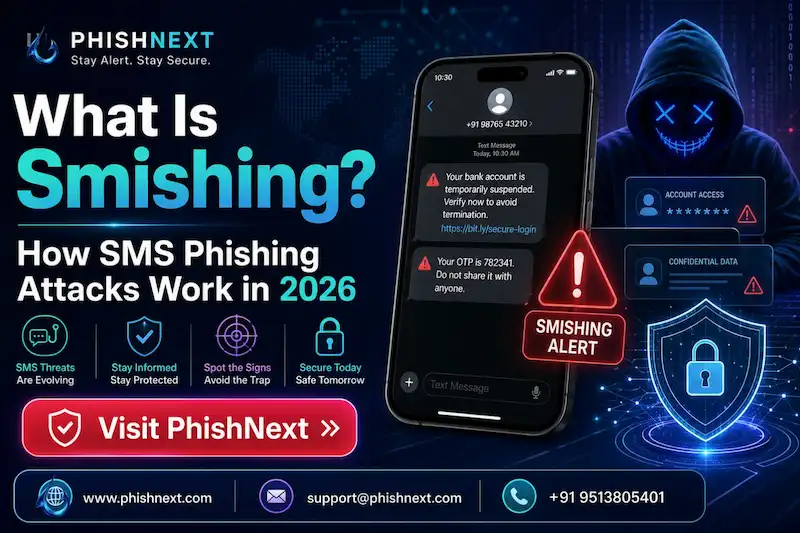
Do you know what SMS Phishing Attacks are and how they implicate smooth working atmosphere? If not, then you are at the right place. Here, we will talk about Smishing in detail for a better security solution.
Moreover, we will introduce you to a reliable phishing simulation platform offered by a reputable VAPT service provider. What are we waiting for? Let’s get straight to the topic!
What Is Smishing (SMS Phishing Explained)?
Smishing, also known as SMS phishing, is a type of social engineering assault in which fraudsters send phony texts to trick recipients into divulging private information, including passwords, bank account information, or personal identity details.
In order to trick the recipient into clicking a harmful link or downloading malware onto their mobile device, these messages frequently use a sense of urgency, terror, or fictitious curiosity. Attackers try to get over conventional email filters and take advantage of the greater degree of trust people usually have in mobile communications by posing as reputable organizations like banks, delivery services, or government institutions.
Let’s take a look at what are SMS Phishing Attacks and see how you can secure yourself against them!
The Anatomy of a Smishing Attack in 2026
|
S.No. |
Factors |
What? |
|
1. |
Lure Crafting (Contextual AI Personalization) |
AI maximizes deceit by creating incredibly convincing, customized communications. |
|
2. |
Message Delivery (Cross-Channel Exploitation) |
To guarantee interaction, malicious links are promoted on several message platforms. |
|
3. |
Victim Interaction (Credential and MFA Harvesting) |
Real-time multi-factor authentication tokens and login information are stolen by dishonest websites. |
|
4. |
Data Exfiltration (Immediate Abuse) |
Unauthorized access or automated financial theft are two immediate uses for stolen data. |
|
5. |
Post-Compromise Activity (Lateral Movement) |
Attackers further infect the victim's contacts by using the hacked account. |
Why Smishing Is Increasing Rapidly in 2026?
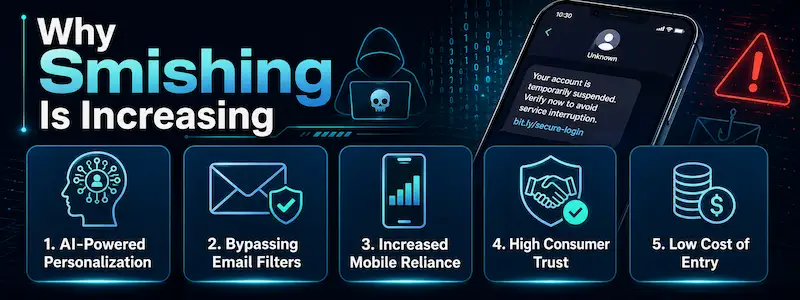
Smishing is increasing rapidly in 2026 for the following reasons:
- AI-Powered Personalization: Attackers create very convincing, tailored messages by using generative AI to collect public data and social media.
- Bypassing Email Filters: Smishing takes advantage of mobile channels that don't have the strong, enterprise-level phishing and spam defenses seen in corporate email systems.
- Increased Mobile Reliance: People are more likely to respond hastily and impulsively to signals that sound important since they are continuously multitasking on smartphones.
- High Consumer Trust: Users are more inclined to click on links from "trusted" delivery or banking alerts because they trust SMS and mobile messaging more than email.
- Low Cost of Entry: Even inexperienced attackers can initiate large-scale, automated smishing campaigns thanks to the widespread availability of "phishing-as-a-service" tools.
Common Types of Smishing Attacks You Should Know
The following are the most common types of smishing attacks you should know about:
● Bank Impersonation: To deceive you into clicking URLs that collect your banking information, attackers pretend to be financial organizations and notify you of suspicious account activity.
● Package Delivery Scams: Texts requesting a minor "redelivery fee" or claiming a delivery problem are used to acquire credit card numbers and personal information.
● Government Agency Fraud: Messages posing as government agencies, such as tax offices, threaten fines or legal action unless you divulge private information to settle a fictitious "delinquency."
● Customer Support Scams: Scammers pretend to be representatives of well-known companies and ask you to click on a link or give a fictitious number in order to fix a "billing issue."
● Fake Prize/ Reward Scams: These messages entice recipients with promises of prizes or gift cards, but in order to receive them, they must "verify their identity" on a malicious website.
● Wrong Number/ Pig Butchering: Attackers initiate a cordial, long-term discussion by sending a "mistaken" text, which ultimately leads to financial exploitation or fraudulent investment schemes.
Key Signs to Identify a Smishing Message
|
S.No. |
Signs |
What? |
|
1. |
Extreme Urgency or Threats |
In order to compel a quick reaction, the message either demands immediate action or threatens unfavorable outcomes, such as account suspension or legal action. |
|
2. |
Suspicious Links |
An abbreviated or misspelled URL that does not correspond to the official domain of the organization it purports to represent is included in the text. |
|
3. |
Generic or Unprofessional Tone |
Even with personalization, the message could have odd wording that deviates from a brand's typical communication style, bad syntax, or spelling mistakes. |
|
4. |
Unsolicited Requests for Sensitive Data |
Seldom do reputable businesses send you texts requesting full credit card information, passwords, or login credentials via a link. |
|
5. |
Unexpected Context |
A phishing lure is characterized by the alert's reference to a transaction, delivery, or account status that you are unaware of or did not initiate. |
Impact of Smishing Attacks on Individuals and Businesses
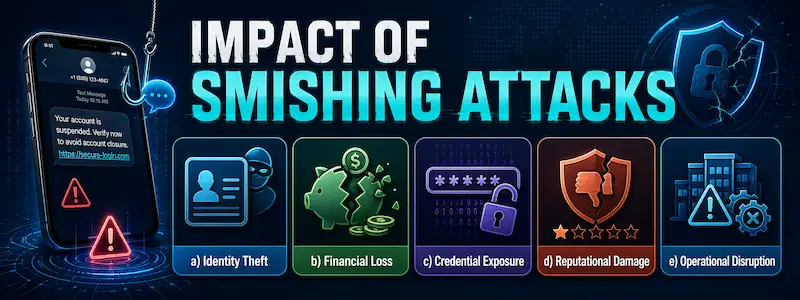
The following are the impacts of smishing attacks on individuals and businesses:
a) Identity Theft: Victims suffer from personal information theft, which can result in long-term legal issues as well as unlawful usage of their digital identities.
b) Financial Loss: Unauthorized bank transfers, empty digital wallets, and fraudulent transactions performed with stolen credit card information are examples of immediate theft.
c) Credential Exposure: When employees fall for smishing, businesses run serious risks because stolen corporate credentials provide hackers access to internal networks.
d) Reputational Damage: When an organization's name is used by hackers to defraud their own user base, they lose the trust of their customers and risk having their brand damaged.
e) Operational Disruption: Organizations may be forced to stop operations in order to address successful breaches, which could result in lost productivity, recovery expenses, and possible fines from the authorities.
How to Protect Yourself from Smishing Attacks?
In the following ways, you can protect yourself from smishing attacks:
- Verify the Sender: Instead of opening links or phoning numbers in dubious texts, always get in touch with the organization directly via their official website or app.
- Enable Multi-Factor Authentication (MFA): To stop hackers from accessing accounts even if they manage to get your credentials, use hardware-based or app-based MFA instead of SMS-based codes.
- Inspect URLs Carefully: Make sure the domain is correct and not a spoof that is meant to look like a genuine service before clicking the link.
- Maintain Privacy: Reduce the amount of personal information you provide on social media since hackers can create convincing, customized smishing lures using this information.
- Use Security Software: Install mobile security apps that can automatically identify, prevent, or alert you to phishing attempts and known bad sites.
Best Tools and Practices to Prevent SMS Phishing in 2026
|
S.No. |
Tools |
What? |
|
1. |
Phishing-Resistant MFA |
To reduce the possibility of credential interception, use hardware security keys or passkeys rather than SMS-based codes. |
|
2. |
URL Inspection Tools |
Make use of mobile security apps that check URLs in real time and alert you before you visit fake or malicious websites. |
|
3. |
Password Managers |
To prevent a single compromised credential from causing a larger account takeover, store complicated, one-of-a-kind passwords in an encrypted manager. |
|
4. |
Device-Level Security |
Implement automated OS updates to fix security holes that phishing kits use to infect your mobile device with malware. |
|
5. |
Continuous Awareness Training |
Participate in phishing simulations on a regular basis to enhance your capacity to identify and report questionable messages as they appear. |
What to Do If You Become a Victim?
If you become a victim, you can do the following tasks:
● Secure Affected Accounts: Change passwords and activate strong multi-factor authentication on all compromised accounts right away by logging in from a reliable device.
● Notify Financial Institutions: To report unauthorized activities, freeze accounts, and obtain new account numbers if needed, get in touch with your bank and credit card companies.
● Document Evidence: Before removing the malicious messages and any phony landing pages, take pictures of them because they are essential for reporting and investigation.
● Report the Incident: To help prevent the attack, forward the phishing details to the appropriate authorities, such as the organization being impersonated or your local cybercrime section.
● Scan for Malware: Make sure no harmful software or configuration profiles were installed during the contact by running a thorough scan using a reliable mobile security application.
Conclusion
Now that we have talked about SMS Phishing Attacks, you might want to protect yourself & your colleagues against such attacks. For that, you can go for the amazing “Phish Next,” a dedicated phishing simulation platform offered by Craw Security.
Moreover, by practicing on this platform, you and your colleagues can train yourself with real-like phishing attacks, and with time, you will be able to create techniques to evade them. What are you waiting for? Contact, Now!
Frequently Asked Questions
About SMS Phishing Attacks
- What do you mean by smishing?
Smishing is a type of cyberattack in which people are tricked into installing malware or disclosing private information by use of misleading text messages.
- What is the difference between smishing and phishing?
Smishing particularly refers to attacks carried out by SMS or mobile text messaging, whereas phishing often refers to attacks delivered via email.
- What happens if you click on a smishing text?
Usually, clicking the link takes you to a bogus website where malicious software is installed on your device or your login credentials and personal information are stolen.
- How do I stop smishing text messages?
By turning on your phone's built-in spam filter, banning unfamiliar numbers, and avoiding interacting with dubious texts, you may stop these messages from marking your number as "active" for additional attacks.
- What is a real-life example of smishing?
An urgent text message stating that a product delivery was unsuccessful, followed by a link to a fraudulent website requesting a minor "rescheduling fee" in order to steal your credit card information, is a typical example.
- What are the 4 P's of phishing?
The following are the 4 Ps of phishing:
a) Pretexting,
b) Personalization,
c) Pressure, and
d) Payload.
- What is ghost tapping?
A security flaw or attack known as "ghost tapping" occurs when a device records illegal screen touches or actions, possibly brought on by malicious software or defective hardware, in order to get around human interaction requirements.
- What is an example of a smishing text?
"Alert: Your [Bank Name] account has been flagged for suspicious activity; please verify your identity immediately at [https://www.google.com/search?q=suspicious-link.com] to prevent permanent suspension."
- What are the 10 most common cyberattacks?
The following are the 10 most common cyberattacks:
a) Phishing,
b) Ransomware,
c) AI-Powered Attacks,
d) Credential Stuffing/Theft,
e) Supply Chain Attacks,
f) Denial of Service (DoS/DDoS),
g) Man-in-the-Middle (MitM),
h) SQL Injection,
i) Zero-Day Exploits, and
j) Business Email Compromise (BEC).
- Can I reply to smishing?
No, you should never respond to a smishing text because doing so verifies that your number is active and encourages hackers to send more complex and frequent lures.
- What is a famous example of phishing?
The 2016 phishing attack on John Podesta, the chairman of Hillary Clinton's presidential campaign, is a well-known example. Attackers gained access to Podesta's personal Gmail account by sending a phony "password reset" email.