What is Human Risk Management In 2026?
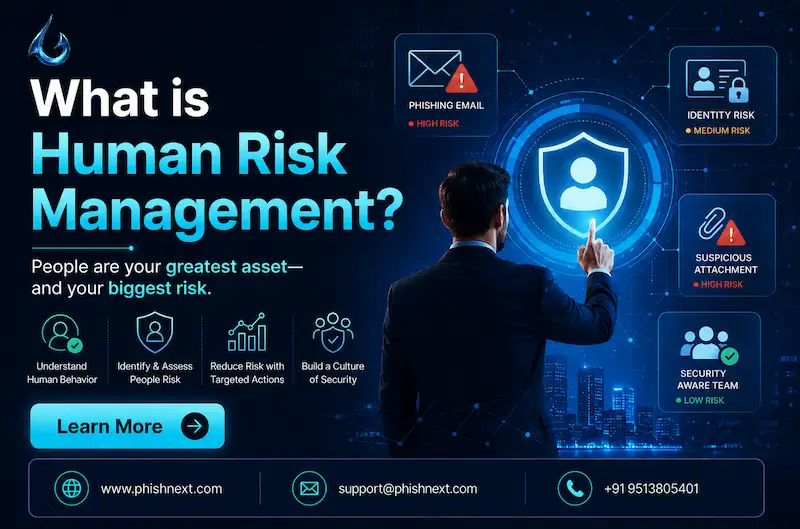
Do you know what Human Risk Management is, its benefits, and how it can be helpful for organizations running in the IT Industry? If not, then you are at the right place. Here, we will talk about what HRM is and how it can help your business to fight scams/ phishing attacks.
Moreover, we will introduce you to a reliable phishing simulation platform offered by a reputed VAPT service provider. What are we waiting for? Let’s get straight to the topic!
What is Human Risk Management?
Human Risk Management (HRM) is a strategic security method that actively measures, monitors, and influences human actions that result in cyber hazards, going beyond basic awareness training.
It effectively turns employees from a vulnerability into a proactive layer of defense by combining data from security technologies with behavioral science to identify high-risk individuals and deliver tailored solutions.
Let’s take a look at what Human Risk Management is and how it can help organizations to protect themselves against online threats!
The Importance of Human Risk Management
|
S.No. |
Factors |
What? |
|
1. |
Addresses the "Human Element" |
By tackling human error, carelessness, and inadvertent insider threats, it addresses the underlying causes of more than 90% of data breaches. |
|
2. |
Reduces the Success of Social Engineering |
It builds a "human firewall" against phishing, baiting, and pretexting assaults by teaching users to spot psychological manipulation. |
|
3. |
Moves from Compliance to Behavior |
The emphasis is now on developing long-lasting, secure habits in everyday digital interactions rather than just "checking a box" in an annual training video. |
|
4. |
Provides Data-Driven Insights |
It determines which people or departments require additional assistance and resources using real-world measures like click rates and password strength. |
|
5. |
Fosters a Security-First Culture |
It encourages employees to report suspicious conduct without fear of retaliation, empowering them to assume personal responsibility for organizational safety. |
Why Companies Are Adopting This Framework?
Companies are adopting this framework in the following ways:
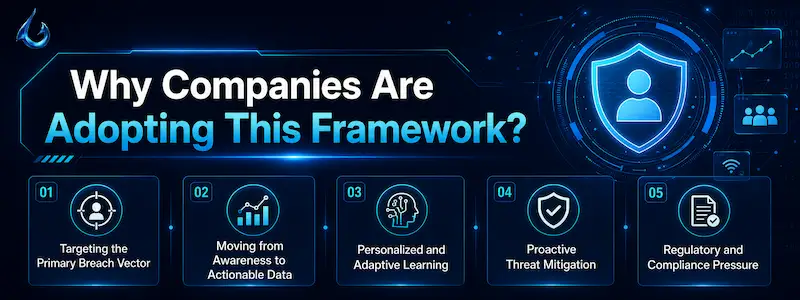
- Targeting the Primary Breach Vector: It directly addresses psychological manipulation and human error, which continue to be the key reasons for successful company security breaches.
- Moving from Awareness to Actionable Data: Businesses are moving away from general training and toward quantifiable indicators that identify the precise locations of security threats in their staff.
- Personalized and Adaptive Learning: Based on a person's unique role, risk profile, and historical habits, this paradigm enables organizations to offer customized coaching.
- Proactive Threat Mitigation: Instead of just responding to an incident, teams can intervene early by detecting high-risk behaviors prior to a breach.
- Regulatory and Compliance Pressure: Evidence of an efficient security culture and behavioral risk management is becoming more and more required by contemporary standards like NIS2 and ISO 27001.
The Human Risk Lifecycle: Identify, Assess, and Mitigate
The following is the human risk lifecycle:
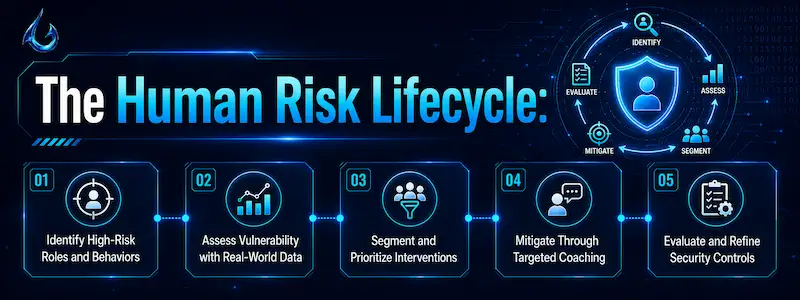
● Identify High-Risk Roles and Behaviors: Determine which staff members have access to private information, and keep tabs on frequent mistakes like phishing clicks and password reuse.
● Assess Vulnerability with Real-World Data: To gauge how vulnerable various groups are to real threats, use security telemetry and simulated attacks.
● Segment and Prioritize Interventions: To provide resources to the most vulnerable or high-access persons first, group your staff according to risk levels.
● Mitigate Through Targeted Coaching: Provide targeted, "just-in-time" training that targets the precise errors a user is making in their regular work.
● Evaluate and Refine Security Controls: To continuously reduce the human risk score, track the outcomes of your interventions, and modify technical settings or policies.
Challenges of Human Risk Management
|
S.No. |
Challenges |
What? |
|
1. |
Balancing Privacy and Monitoring |
Companies have to walk a tightrope between monitoring dangerous activity and honoring workers' demands for digital privacy. |
|
2. |
Overcoming "Security Fatigue" |
Employees may get desensitized and disregard important security warnings as a result of frequent notifications and training. |
|
3. |
Measuring Intangible Cultural Shifts |
A shift in "mindset" is harder to measure than technical measures like patch percentages or firewall logs. |
|
4. |
Integrating Disparate Data Sources |
It is technically difficult to combine information from identity providers, emails, and physical security into a single risk score. |
|
5. |
Avoiding a "Blame Culture" |
Instead of penalizing staff for errors, which may result in a suppression of reporting, the framework should emphasize assistance and instruction. |
Key Metrics: How to Measure Human Risk?
In the following ways, you can measure human risk:
a) Phishing Simulation Fail Rate: To determine baseline vulnerability, monitor the proportion of staff members who submit credentials or click on malicious URLs during controlled tests.
b) Mean Time to Report (MTTR): Faster reporting significantly reduces the "dwell time" of an attack, so track how soon staff members report questionable emails to the security team.
c) Credential Strength and Hygiene: Keep an eye on the frequency of weak or reused passwords across the organization's identification systems, as well as the usage of multi-factor authentication.
d) Security Policy Violation Frequency: To spot trends in behavior, keep track of instances of unapproved software downloads, data exfiltration efforts, and ignored device upgrades.
e) Knowledge Retention Over Time: To find out if security training is truly being retained or if it needs to be reinforced, use follow-up tests or microlearning evaluations.
How to Create an Effective Human Risk Management Programme?
In the following ways, you can create an effective human risk management programme:
- Secure Executive Buy-In and Budget: To secure long-term funding and leadership support, present human risk as an operational and financial priority.
- Establish a Behavioral Baseline: Before starting new projects, determine the present risk levels using audit logs and initial phishing simulations.
- Implement "Just-in-Time" Training: To optimize learning impact, provide brief, pertinent security advice as soon as a user commits a mistake.
- Automate Data Integration: Create a uniform, real-time human risk profile by integrating your identity providers, email gateways, and HR applications.
- Gamify and Reward Positive Behavior: To encourage reporting and promote a healthy security culture, use leaderboards and public acknowledgment.
How Phish Next Can Help?
|
S.No. |
Factors |
How? |
|
1. |
Realistic Attack Simulations |
It uses extremely lifelike phishing, smishing, and QR-code-based campaigns that imitate modern hacker techniques, including invoicing schemes and CEO fraud. |
|
2. |
Automated Awareness Training |
When an employee clicks a link and "fails" a simulation, the platform automatically enrolls them in specific micro-learning courses to instantly remediate the behavior. |
|
3. |
Data-Driven Risk Analytics |
By monitoring indicators like click rates, credential submissions, and reporting speed, it offers detailed insights into which departments or positions are most at risk. |
|
4. |
Proactive Threat Reporting |
By rewarding staff members who utilize the one-click reporting feature to flag questionable emails, the platform promotes a "Security-First" attitude. |
|
5. |
Compliance and ROI Mapping |
For standards like ISO 27001, GDPR, and SOC 2, it produces ready-to-use reports that demonstrate to stakeholders that human risk is being actively reduced. |
Conclusion
Now that we have talked about what Human Risk Management is, you might want to get the best solution to ensure utmost awareness and safety against phishing attacks. For that, you can go for “Phish Next,” a dedicated phishing simulation platform offered by Craw Security.
This platform offers amazing phishing simulations to the users/ practitioners so that they can get trained against phishing attacks, and with time, they will be able to identify & evade such attacks. What are you waiting for? Contact, Now!
Frequently Asked Questions
About What is Human Risk Management?
- What is the definition of human risk?
In cybersecurity, human risk refers to the likelihood that an individual would either purposefully or inadvertently carry out an activity that jeopardizes an organization's security, such as clicking on a malicious link, reusing a password, or improperly handling data.
- What are the 6 risk factors?
The following are the 6 risk factors:
a) Distraction,
b) Urgency,
c) Authority,
d) Technical Proficiency,
e) Curiosity, and
f) Complacency.
- What are the 4 fundamentals of risk management?
The following are the 4 fundamentals of risk management:
a) Risk Identification,
b) Risk Assessment,
c) Risk Mitigation (Treatment), and
d) Risk Monitoring and Review.
- What are the 4 concepts of risk management?
The following are the 4 concepts of risk management:
a) Tolerate (Acceptance),
b) Treat (Mitigation),
c) Transfer (Sharing), and
d) Terminate (Avoidance).
- What is the first step in risk management?
Risk identification, the initial stage of risk management, is methodically identifying, characterizing, and recording each possible danger that can affect an organization's resources or goals.
- What are the 4 types of risk control?
The following are the 4 types of risk control:
a) Directive Controls,
b) Preventive Controls,
c) Detective Controls, and
d) Corrective Controls.
- What are the 4 pillars of risk management?
The following are the 4 pillars of risk management:
a) Risk Strategy and Governance,
b) Risk Identification and Assessment,
c) Risk Mitigation and Control, and
d) Risk Reporting and Communication.
- What are the 5 principles of risk management?
The following are the 5 principles of risk management:
a) Integrate with Organizational Processes,
b) Be Systematic and Structured,
c) Be Based on the Best Available Information,
d) Account for Human and Cultural Factors, and
e) Be Dynamic and Iterative.
- What is a risk matrix?
A risk matrix is a visual aid used in risk assessment that plots the probability of a risk's occurrence against the severity of its impact to determine the risk's level.
- What are the four ways to handle risk?
The following are the 4 ways to handle risk:
a) Treat (Mitigation),
b) Transfer (Sharing),
c) Tolerate (Acceptance),
d) Terminate (Avoidance).