What Is Crimeware-as-a-Service (CaaS)? Complete Guide for 2026
Do you know what Crimeware-as-a-Service (CaaS) is, its impacts, and how you can prevent yourself from becoming a victim of such attacks? If not, then you are at the right place. Here, we will talk about CaaS in detail.
Moreover, we will introduce you to a reliable phishing simulation platform offered by a reputable VAPT service provider. What are we waiting for? Let’s get started!
What Is Crimeware?
A specific class of harmful software known as "crimeware" is specifically created to support illicit acts for financial benefit, such as extortion, identity theft, and improper financial transactions. It serves as the fundamental toolkit for cybercriminals, giving them the infrastructure they need to break into networks, steal confidential information, or take over resources.

Crimeware is now the main mechanism driving the contemporary, industrialized cybercrime economy by making it possible for non-technical actors to execute sophisticated attacks through user-friendly interfaces.
Let’s take a look at what Crimeware-as-a-Service (CaaS) is, its impacts, and how you can protect yourself against it!
How Does Crimeware Work?
|
S.No. |
Factors |
How? |
|
1. |
Infiltration (Delivery) |
Phishing emails, hacked websites, or malicious attachments that take advantage of software flaws to obtain initial access are some of the ways that criminals spread malware. |
|
2. |
Execution and Persistence |
Once inside, the program installs itself in the background and adjusts system settings so that it keeps running even after a reboot. |
|
3. |
Command and Control (C2) |
In order to send commands and receive updates covertly, the malware creates a covert connection to a distant server under the attacker's control. |
|
4. |
Resource Hijacking or Data Exfiltration |
The malware either silently copies private files, financial records, and sensitive credentials to the attacker's repository or uses system processing power for illegal activities. |
|
5. |
Monetization |
In order to turn their illegal behavior into profit, attackers utilize encrypted files for ransom demands, sell the stolen material on dark web markets, or empty accounts. |
What is Crimeware-as-a-Service (CaaS) Model?
Cybercriminals sell or lease advanced malware, infrastructure, and technical assistance to other actors through the Crimeware-as-a-Service (CaaS) model, a professionalized subscription-based ecosystem.
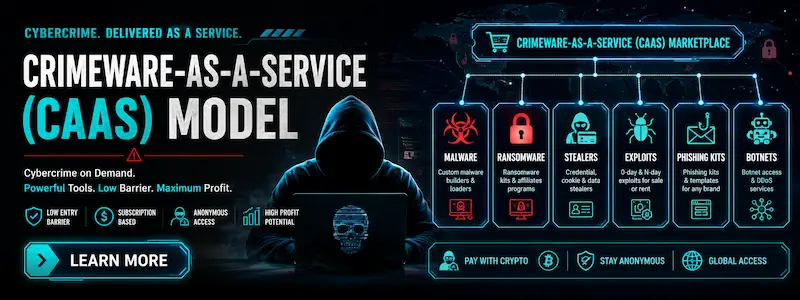
By allowing people without significant coding skills to launch sophisticated, large-scale cyberattacks in exchange for fees or a portion of the illicit earnings, this "business" structure reduces the barrier to entry.
How CaaS Works in the Modern Cybercrime Ecosystem?
In the following ways, CaaS works in the modern cybercrime ecosystem:
- Development and R&D: Skilled programmers constantly refine harmful code to get around security software updates and guarantee high success rates for their "products."
- Infrastructure Provisioning: By managing anonymization networks, C2 servers, and bulletproof hosting, providers enable affiliates to execute assaults without requiring their own technological backend.
- Affiliate Programs: Often using revenue-sharing schemes in which affiliates receive a portion of each successful ransom or fraud payment, operators enlist a network of users to spread the virus.
- Customer Support and User Experience: Professional "help desks," user guides, and web-based dashboards are provided by CaaS providers, making sophisticated hacking tools just as manageable as genuine commercial software.
- The Monetization Pipeline: Through automated smart contracts or escrow services, criminal proceeds are immediately processed and disbursed, guaranteeing that payments are shared instantly between the affiliate and the developer.
Different Types of Crimeware
|
S.No. |
Types |
What? |
|
1. |
Ransomware |
Critical files or systems are encrypted by this malicious software, which then requests payment, usually in cryptocurrency, in exchange for the decryption key. |
|
2. |
Banking Trojans |
Intended to enable fraudulent transactions by intercepting and recording private financial information and login passwords, particularly from online banking sessions. |
|
3. |
Infostealers |
These programs stealthily collect a variety of information from an infected device, such as session tokens, saved passwords, browser cookies, and personal identity papers. |
|
4. |
Keyloggers |
Attackers can instantly obtain private messages, login credentials, and other sensitive data by using this program, which logs every keystroke performed on a target machine. |
|
5. |
Botnets |
An attacker can remotely manipulate a network of infected devices, which is frequently used in concert to launch enormous spam or DDoS operations. |
|
6. |
Cryptojackers |
This malware causes system slowness and increases hardware wear by surreptitiously taking over a device's processing power to mine cryptocurrency for the attacker. |
|
7. |
Phishing Kits |
These pre-packaged collections of web templates and scripts enable attackers to swiftly create phony websites intended to trick users and obtain their login credentials. |
Who Uses Crimeware-as-a-Service?
The following individuals use Crimeware-as-a-Service:
● Novice Cybercriminals: Aspiring hackers with little technical expertise who launch their initial attacks using pre-built tools.
● Organized Crime Syndicates: Sophisticated organizations that outsource particular technical duties to expand operations and optimize illegal revenue.
● Access Brokers: People who specialize in obtaining network credentials and reselling them to other bad actors.
● State-Aligned Actors: Nation-state organizations that use commercial CaaS to execute sabotage or espionage while maintaining plausible deniability.
● Financially Motivated Opportunists: Independent threat actors looking for a quick way to profit from victim data or systems while posing little risk.
Why CaaS Is Growing So Rapidly?
CaaS is growing so rapidly for the following reasons:
a) Lowered Barriers to Entry: Without the need for advanced programming skills, non-technical people can launch sophisticated attacks using pre-packaged tools.
b) AI-Powered Efficiency: Generative AI helps get around security measures at scale, optimizes phishing lures, and automates the creation of malware.
c) Professionalization of Cybercrime: Business structures like customer service, subscription levels, and dependable uptime assurances are introduced by the move to a service-based model.
d) Economic Incentives & Profitability: For both developers and affiliates, a steady, profitable cash stream is offered by high success rates and cheap overhead.
e) Expanded Attack Surface: Numerous weak spots for CaaS-based exploitation are created by the quick growth of remote work and inadequately secured IoT devices.
Risks and Impact on Businesses and Individuals
|
S.No. |
Factors |
What? |
|
1. |
Financial Instability |
Ransom payments, money theft, forensic investigation charges, and lost income due to downtime are all direct costs. |
|
2. |
Reputational Damage |
Loss of trust from partners and customers, bad press, and long-term devaluation of the brand. |
|
3. |
Operational Paralysis |
Loss of productivity, supply chain interruptions, and total or partial shutdown of vital company processes. |
|
4. |
Legal and Regulatory Consequences |
Severe penalties from the government for violating data privacy regulations, as well as possible litigation and class-action lawsuits. |
|
5. |
Compromised Personal Privacy |
Exposure of private client or employee information increases the risk of financial fraud, identity theft, and stalking. |
Real-World Examples of CaaS Attacks in 2026
The following are the real-world examples of CaaS Attacks in 2026:
- The Pathstone Family Office Extortion: The ShinyHunters organization used ransomware-as-a-service to steal more than 640,000 private documents, including Social Security numbers and comprehensive financial profiles, at the beginning of 2026. They demanded payment by threatening to make the material public.
- The "Torg Grabber" Infostealer Campaign: Using pre-packaged malicious extensions, Torg Grabber, a modular infostealer supplied through underground routes, successfully compromised over 700 cryptocurrency wallets and related browser credentials in March 2026.
- The Catalyst RCM Healthcare Breach: The Everest ransomware organization targeted a healthcare provider using hacked credentials that were probably obtained from an access broker, exposing the financial, medical, and personal information of about 140,000 people. This shows how CaaS allows affiliates to attack high-value, sensitive targets.
How to Detect and Prevent CaaS Attacks?
In the following ways, you can detect and prevent CaaS Attacks:
● Enforce Zero Trust & Least Privilege: Verify each user's and device's request, regardless of where it came from, and limit access to the precise information required for a position.
● Adopt Behavioral Analytics (EDR/ XDR): Use monitoring technologies that instantly identify strange activity, like unlawful lateral movement or odd file encryption patterns.
● Strengthen Identity Security (MFA): Use multi-factor authentication that is resistant to phishing to counteract the impact of stolen credentials purchased from access brokers.
● Automate Patch Management: To stop software vulnerabilities before attackers can take advantage of them, proactively find and apply security patches.
● Implement Immutable Backups: To ensure quick recovery without having to pay ransoms, keep offline or write-once, read-many data copies that ransomware cannot change or erase.
The Future of Crimeware-as-a-Service Beyond 2026
After 2026, the Crimeware-as-a-Service model is expected to evolve into a completely autonomous, AI-powered ecosystem in which self-learning agents carry out highly customized attacks with little assistance from humans.
Threat actors will increasingly use "harvest-now, decrypt-later" tactics to compromise long-lived sensitive data as quantum computing develops, necessitating a worldwide move toward quantum-resistant encryption and flexible, real-time defensive frameworks.
Conclusion
Now that we have talked about Crimeware-as-a-Service (CaaS), you might want to get a dedicated solution to evade such situations where you need to deal with such traps. For that, you can go for Phish Next, a dedicated phishing simulation platform offered by Craw Security.
At this platform, the practitioners/ users will be able to confront various phishing attack simulations, and with time, they will be able to evade such attempts with ease. What are you waiting for? Contact, Now!
Frequently Asked Questions
About Crimeware-as-a-Service (CaaS)
- What is CaaS in cybercrime?
In the cybercrime economy, a business model known as Crimeware-as-a-Service (CaaS) allows authors to lease or sell malware, infrastructure, and technical assistance to other actors so they can launch assaults for a charge or profit-sharing.
- What are the seven tools used in cybercrime?
The following are the 7 tools used in cybercrime:
a) Malware (Viruses, Worms, and Trojans),
b) Packet Sniffers/Network Analyzers,
c) Vulnerability Scanners,
d) Password Cracking Tools,
e) Keyloggers,
f) Phishing Kits, and
g) Anonymizers and Proxy Servers.
- What are the four categories of computer crime?
The following are the 4 categories of computer crime:
a) Crimes Against Individuals,
b) Crimes Against Property,
c) Crimes Against Organizations/ Businesses, and
d) Crimes Against Government/ Society.
- What do you mean by cybercrime and cybersecurity?
Cybersecurity is the process of protecting those systems, networks, and data from such digital attacks, whereas cybercrime is any illegal action that uses computers or networks to target people, companies, or governments for illegitimate gain or damage.
- What is CaaS as a service?
Cybercriminals employ a business model called Crimeware-as-a-Service (CaaS) to lower the barrier to entry for launching cyberattacks by offering malware, infrastructure, and technical assistance to other actors on a pay-per-use or subscription basis.
- What are the 7 types of cybersecurity?
The following are the 7 types of cybersecurity:
a) Network Security,
b) Application Security,
c) Endpoint Security,
d) Information (Data) Security,
e) Identity and Access Management (IAM),
f) Cloud Security, and
g) End-User Education.
- What is an example of CaaS?
Ransomware-as-a-Service (RaaS), in which a developer develops and maintains ransomware code and oversees the payment site and leases it to "affiliates" who manage the actual distribution and infection in exchange for a portion of the ransom, is a typical form of CaaS.
- What are the 4 types of cloud services?
The following are the 4 types of cloud services:
a) Infrastructure-as-a-Service (IaaS),
b) Platform-as-a-Service (PaaS),
c) Software-as-a-Service (SaaS), and
d) Serverless Computing (Function-as-a-Service/FaaS).
- What is the role of CaaS?
By offering "ready-to-use" harmful infrastructure and tools, CaaS primarily lowers the technical barrier to entry for cybercrime, allowing non-technical players to carry out complex assaults for a portion of the illicit proceeds.