What is an Insider Threat? Tools, Techniques & Best Practices
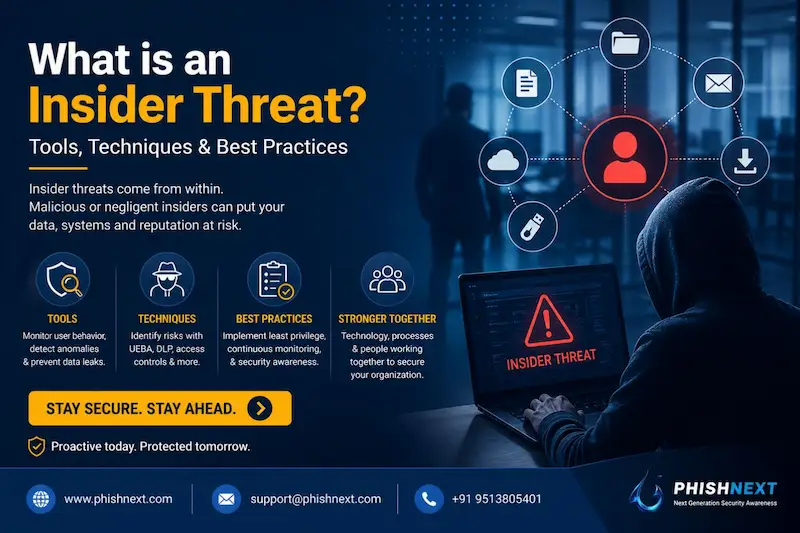
Do you know what is Insider Threat in Cybersecurity? If not, then you are at the right place. Here, we will talk about what Insider Threats are, their effects, and how to prevent them to protect your confidential data.
Moreover, we will introduce you to a reliable phishing simulation platform offered by a reputable VAPT service provider. What are we waiting for? Let’s get straight to the topic!
What is an Insider Threat in Cybersecurity?
In the context of cybersecurity, an insider threat is a security risk that comes from within the targeted organization, usually including contractors, business associates, or current or former workers who have been granted access to internal systems.
These people might purposefully steal data, destroy vital infrastructure, or seriously disrupt operations by taking advantage of their trusted standing. A significant threat vector that gets beyond conventional perimeter defenses is activities like unintentional data leakage or falling victim to phishing assaults by trusted insiders.
Let’s find out what an Insider Threat is in Cybersecurity and how you can prevent it from happening!
Types of Insider Threats (Malicious vs Negligent vs Compromised)
|
S.No. |
Types |
What? |
|
1. |
Malicious |
A trusted person who purposefully uses their permitted access to steal information, disrupt systems, or perpetrate fraud for their own benefit or harm. |
|
2. |
Negligent |
A well-intentioned user who unintentionally exposes security flaws by disclosing passwords or handling private information improperly. |
|
3. |
Compromised |
An insider whose credentials or devices have been hijacked by an external attacker, allowing the adversary to function under the pretense of a trusted institution. |
Common Insider Threat Techniques Used by Attackers
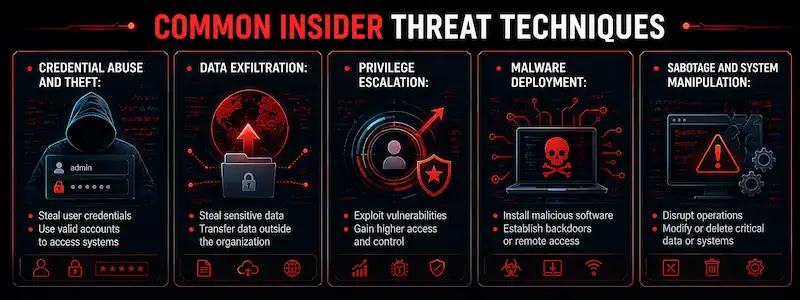 The following are some of the common insider threat techniques used by attackers:
- Credential Abuse and Theft: Attackers utilize weak, stolen, or shared user credentials to enter the network without authorization or to pose as authorized staff members.
- Data Exfiltration: Insiders use allowed access to transfer confidential customer information or intellectual property to unapproved external locations, such as USB devices or personal cloud storage.
- Privilege Escalation: By taking advantage of software flaws or configuration flaws, users can obtain administrative rights that go beyond what is permitted, giving them more power over the system.
- Malware Deployment: Insiders circumvent external perimeter defenses like firewalls by introducing harmful software, like ransomware or spyware, straight into the internal environment.
- Sabotage and System Manipulation: In order to cause operational or financial harm, disgruntled or malevolent insiders purposefully change system configurations, erase important databases, or interfere with services.
Key Indicators and Warning Signs of Insider Threats
The following are key indicators and warning signs of insider threats:
● Unusual Access Patterns: Users may browse data unrelated to their job duties, log into sensitive systems at odd hours, or use unidentified IP addresses.
● Behavioral Red Flags: Notable changes in an employee's temperament, such as increased animosity, demonstrations of unhappiness, or voiced grievances against the firm.
● Unauthorized Data Movement: Significant or dubious data transfers that depart from regular work schedules to personal devices, external cloud accounts, or encrypted messaging services.
● Privilege or Configuration Anomalies: Unexpected requests for additional access rights or attempts to adjust security settings and logs that are not aligned with typical administration activities.
● Neglect of Security Protocols: Frequent disregard for standard security procedures, such as avoiding multi-factor authentication or neglecting to safeguard endpoints, may be a sign of ignorance or willful carelessness.
Real-World Examples of Insider Threat Attacks
|
S.No. |
Examples |
What? |
|
1. |
The Tesla Sabotage (2018) |
Sensitive gigafactory data was transmitted to unauthorized third parties by a disgruntled employee who purposefully altered the manufacturing operating system code. |
|
2. |
The Ubiquiti Data Breach (2021) |
Using their administrative access, an insider gained illegal access to the company's cloud infrastructure, stole confidential information, and tried to extort the business by pretending to be an outside hacker. |
|
3. |
The Twitter "God Mode" Attack (2020) |
By using social engineering to trick internal staff members into giving them access to an internal administration tool, attackers were able to take control of prominent accounts, such as those of Elon Musk and Barack Obama, in order to spread a cryptocurrency fraud. |
Role of AI and Behavioral Analytics in Insider Threat Detection
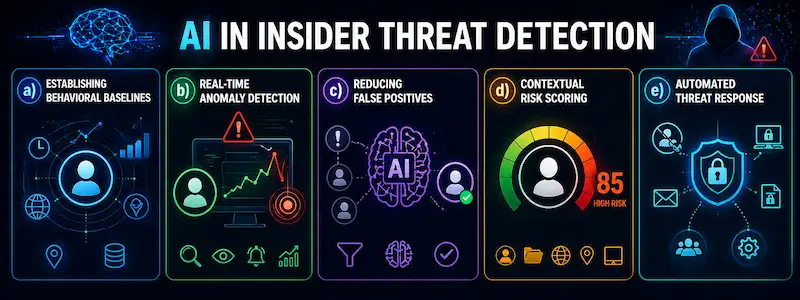
The following are the roles of AI and behavioral analytics in insider threat detection:
a) Establishing Behavioral Baselines: In order to identify the distinct "normal" activity patterns for each user and entity on the network, AI models examine past data.
b) Real-Time Anomaly Detection: Deviations from established standards, including irregular login times or unexpected data access, are immediately flagged by behavioral analytics.
c) Reducing False Positives: More sophisticated machine learning techniques greatly reduce noise for security teams by better differentiating between innocuous user errors and real threats.
d) Contextual Risk Scoring: In order to determine a dynamic risk score that prioritizes investigations according to the seriousness and purpose of suspicious activity, systems combine many signals.
e) Automated Threat Response: In order to eliminate possible threats before serious harm is done, AI can initiate quick defensive measures like locking accounts or limiting file access.
Top Tools for Insider Threat Detection and Monitoring
The following are the top tools for insider threat detection and monitoring:
- ShieldXDR (Craw Security): An all-inclusive extended detection and response system that uses behavioral analytics and artificial intelligence to detect and eliminate sophisticated threats across networks and endpoints.
- Proofpoint Insider Threat Management: A specialized platform that offers contextual evidence to identify and look into any insider threats, as well as deep visibility into user behavior and data interaction.
- Varonis Data Security Platform: An AI-powered data-centric solution that tracks access patterns, automates data classification, and identifies unusual activity involving private company data.
- Exabeam: A security operations platform that produces comprehensive timelines to monitor and correlate suspicious activities over extended periods of time, with a focus on user and entity behavior analytics.
- Code42 Incydr: A targeted insider risk management solution that helps identify and stop data exfiltration by monitoring file transfers and user activity across endpoints and cloud environments.
Insider Threat Risk Assessment and Management Strategies
|
S.No. |
Factors |
What? |
|
1. |
Implement Least Privilege Access |
To reduce the possible impact of a compromised account, strictly restrict user permissions to the particular data and systems required for their responsibilities. |
|
2. |
Adopt User and Entity Behavior Analytics (UEBA) |
Use AI-powered monitoring technologies to set baselines and automatically identify deviations that point to malicious or careless behavior. |
|
3. |
Conduct Regular Security Awareness Training |
Inform staff members on the dangers of unintentional data disclosure, the significance of security hygiene, and how to spot social engineering techniques. |
|
4. |
Establish a Cross-Functional Insider Threat Team |
To guarantee a thorough, impartial approach to looking into and handling suspicious activity, form a cooperative team comprising the HR, legal, and IT/security departments. |
|
5. |
Implement Data Loss Prevention (DLP) Policies |
Use software to keep an eye on, identify, and prevent sensitive data from being moved or exfiltrated across endpoints, networks, and cloud services without authorization. |
Best Practices to Prevent Insider Threats in Organizations
The following are the best practices to prevent insider threats in organizations:
● Enforce Strict Access Controls: Apply the least privilege principle consistently, making sure that workers only have access to the particular resources necessary for their job duties.
● Cultivate a Proactive Security Culture: Encourage an atmosphere where workers may report suspicious activity or security issues without worrying about facing reprisals.
● Mandate Regular Security Training: Organize regular, interesting training sessions to teach employees how to spot phishing attempts and handle private information safely.
● Monitor Critical Data and Systems: To control access to sensitive data and notify teams of unwanted exfiltration efforts, use automated monitoring and data loss prevention (DLP) solutions.
● Streamline Offboarding Processes: When an employee resigns or is fired, make sure that their company accounts, physical badges, and system access are promptly and completely revoked.
Building a Strong Insider Threat Program for Your Organization
In the following ways, you can build a strong insider threat program for your organization:
a) Define Clear Governance and Policy: Create a formal, documented framework that clearly outlines acceptable use guidelines, mandatory compliance requirements, and insider threat roles.
b) Integrate Technological Monitoring: Use all-inclusive tools such as UEBA, DLP, and endpoint monitoring to see user behavior and identify questionable trends.
c) Establish Defined Detection and Response Workflows: Make precise, repeatable incident response playbooks that specify how to investigate, contain, and escalate possible threats.
d) Balance Privacy with Security: Use anonymization techniques and privacy-by-design principles to make sure security monitoring stays ethically visible and legal.
e) Continuously Assess and Improve: Use threat simulations, maturity evaluations, and lessons acquired from previous occurrences to regularly examine program efficacy.
Frequently Asked Questions
About Insider Threat in Cybersecurity
- Which best describes an insider threat?
When someone with authorized access, such as workers or contractors, abuses their rights to purposefully or unintentionally jeopardize data, systems, or operational integrity, it's known as an insider threat.
- What is one example of an insider threat?
A blatant example of a malicious insider threat is when an employee purposefully exfiltrates sensitive intellectual property to a personal cloud storage account for personal benefit.
- What are the three main types of insider threats?
The following are the 3 main types of insider threats:
a) Malicious Insider,
b) Negligent Insider, and
c) Compromised Insider.
- What are some of the best practices for insider threat prevention?
The following are some of the best practices for insider threat prevention:
a) Enforce Strict Access Controls,
b) Cultivate a Proactive Security Culture,
c) Mandate Regular Security Training,
d) Monitor Critical Data and Systems, and
e) Streamline Offboarding Processes.
- What are the 5 categories of insider threat?
The following are the 5 categories of insider threat:
a) Malicious Insider,
b) Negligent Insider,
c) Compromised Insider,
d) Disgruntled Insider, and
e) Third-Party/Vendor Insider.
- What are the 4 types of threats?
The following are the 4 types of threats:
a) Internal (Insider) Threats,
b) External Threats,
c) Structured Threats, and
d) Unstructured Threats.
- What tools and techniques are commonly used for threat intelligence gathering?
The following tools and techniques are commonly used for threat intelligence gathering:
a) Open Source Intelligence (OSINT),
b) Network Traffic and Log Analysis,
c) Dark Web Surveillance,
d) Threat Intelligence Feeds, and
e) Vulnerability Scanning and Asset Discovery.
Conclusion
Now that we have talked about Insider Threat in Cybersecurity, you might want to know how you can protect yourself against insider threats or social engineering. For that, you can go for Craw Security, offering a dedicated phishing simulation platform, “Phish Next,” to IT practitioners.
At this platform, the practitioner will be able to use their skills and confront simulated phishing attacks while defending against them. What are you waiting for? Contact, Now!