What Is Aadhaar Phishing and How Does It Work?
Do you know what Aadhaar Phishing is, and how you can protect yourself against it with ease? If not, then you are at the right place. Here, we will talk about Aadhaar Phishing and prevention techniques in detail.
Moreover, we will introduce you to a reliable phishing simulation platform offered by a reputable VAPT service provider. What are we waiting for? Let’s get straight to the topics
What is Aadhaar Phishing?
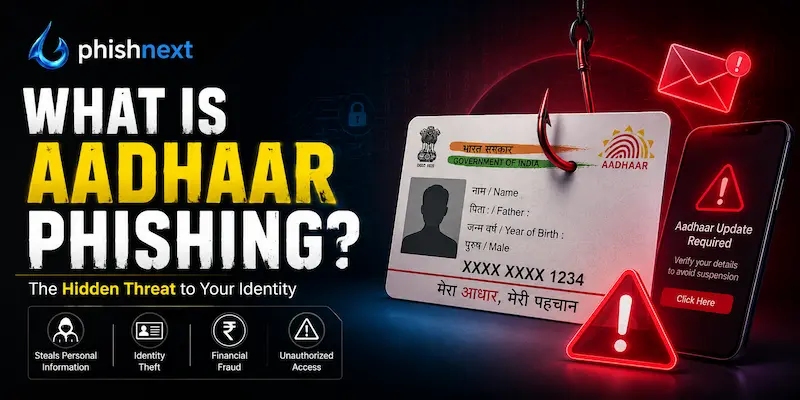
Aadhaar phishing is a dishonest cyberattack in which con artists use phony websites, SMS, or emails to mislead people into divulging their 12-digit Indian unique identity numbers and associated credentials.
Attackers frequently pose as banks, utilities, or government organizations and threaten to suspend the victim's account unless they can prove their identity right away. Once acquired, thieves may use this private information to open bogus bank accounts, carry out illegal financial operations, or steal identities.
Let’s talk about what Aadhaar Phishing is, its targets, its impacts, and prevention techniques for organizations!
Why Aadhaar Data Is a High-Value Target?
|
S.No. |
Factors |
Why? |
|
1. |
Gateway to Identity Theft |
Makes it possible for crooks to obtain loans, create fictitious accounts, and pose as victims on various platforms. |
|
2. |
Direct Access to Financial Systems |
Unauthorized cash withdrawals are made possible via direct connections to bank accounts and the Aadhaar Enabled Payment System (AePS). |
|
3. |
Consolidation of Sensitive Data |
Serves as a single master key that links a person's bank data, phone numbers, tax information, and biometrics. |
|
4. |
Valuable Commodity on the Dark Web |
Commands a high price in cybercrime marketplaces for carrying out extensive credential-stuffing and phishing campaigns. |
|
5. |
Exploitation of Government Subsidies |
Permits hackers to unlawfully transfer welfare payments and direct benefit transfers into fictitious accounts. |
Common Aadhaar Phishing Techniques
The following are some common Aadhaar phishing techniques:
1. Fake Government and Bank Portals: Spoof websites that pose as official portals to fool users into entering their OTPs and login credentials.
2. SMS Phishing (Smishing): Links to fraudulent credential-harvesting websites are included in urgent text messages alleging account suspension or large incentives.
3. Vishing (Voice Phishing): Scammers use high-pressure phone calls to get dynamic verification codes while pretending to be bank executives or authorities.
4. Malicious Subsidies and Welfare Schemes: False social media links that offer free cash assistance from the government in return for registration information.
5. QR Code Scams: Victims unintentionally consent to data sharing by scanning fraudulent QR codes received through chat apps under the pretense of receiving cash.
How Attackers Use Stolen Aadhaar Data?
Attackers use stolen Aadhaar data in the following ways:
● Financial Fraud via AePS: Attackers use the Aadhaar Enabled Payment System to perform illicit biometric cash withdrawals and get around conventional debit cards.
● Mule Account Creation: Unverified bank accounts are opened using stolen identities in order to launder money and channel the proceeds of other cybercrimes.
● Targeted Phishing and Social Engineering: Criminals create incredibly convincing frauds that fool victims into disclosing OTPs by using precise personal information from compromised documents.
● Subsidy and Welfare Theft: Fraudsters illegally redirect government financial aid and direct benefit transfers by connecting stolen information to their own accounts.
● Identity Cloning and Loan Fraud: In order to obtain quick digital loans and buy expensive items, attackers falsify identification documents, leaving victims with the debt.
Warning Signs of an Aadhaar Phishing Attempt
|
S.No. |
Factors |
What? |
|
1. |
Urgent Threats of Account Suspension |
Your bank account, SIM card, or ID status will be immediately terminated if you receive high-pressure alerts. |
|
2. |
Requests for Your One-Time Password (OTP) |
Any unsolicited call or message requesting the dynamic verification code that was sent to your phone. |
|
3. |
Suspicious or Unofficial Website Links |
URLs that are truncated, misspelled, or cloned yet lack valid domains, such as.gov.in. |
|
4. |
Offers tied to Free Rewards or Subsidies |
Unsolicited promises of government assistance, lottery riches, or quick cash upon enrollment. |
|
5. |
Unprofessional Communication Channels |
Requests that sound official are sent over private mobile numbers, personal emails, or informal forums like WhatsApp. |
How to Verify Official Aadhaar Communication?
You can verify official Aadhaar communication in the following ways:
a) Check the Sender Identity: Verify that SMS alerts originate from genuine, registered UIDAI sender IDs and emails originate from verified @uidai.net.in addresses.
b) Verify the Web Domain: Make sure the URL finishes with the official.gov.in domain and always search for the secure https:// protocol.
c) Look for Digital Signatures: A legitimate, cryptographically signed digital signature with a green checkmark should be included in all downloaded electronic letters.
d) Use Official Verification Tools: To verify whether an identity record is authentic and current, use the "Verify an Aadhaar Number" feature directly on the UIDAI website.
e) Cross-Reference with the mAadhaar App: To safely examine, confirm, and validate your profile information and official communication records, use the official mobile application.
Real-World Examples of Aadhaar Phishing
The following are some real-world examples of Aadhaar phishing:
1. The "Digital Arrest" and Misuse Scam: Over video calls, scammers pretend to be law enforcement and demand quick money by stating your ID was used in a crime.
2. Fake Service Upgrades and Mandatory Linking: In order to keep your bank account or SIM card operational, scammers issue phony threat notifications that require you to attach your ID.
3. Spoofed Government Welfare and Subsidy Portals: Under the false pretense of receiving free financial aid, cloned websites entice citizens to provide identifying details.
Role of Organizations in Preventing Aadhaar-Based Fraud
|
S.No. |
Roles |
What? |
|
1. |
Implement Secure Verification and Masking |
To avoid visual data exposure, mask the identity number's initial eight digits during display and verification. |
|
2. |
Deploy Dedicated Data Vaults and Encryption |
To stop unwanted mass database access, keep private identifying documents in secure, encrypted vaults. |
|
3. |
Enforce Strict Role-Based Access Controls (RBAC) |
Limit access to data only to verified employees who are absolutely necessary for permitted business operations. |
|
4. |
Conduct Regular Security Audits and Compliance Checks |
Review system vulnerabilities and access logs on a regular basis to guarantee ongoing compliance with legal requirements. |
|
5. |
Educate Employees and Customers |
Provide ongoing training to assist employees and users in recognizing phishing signs and adhering to safe data handling procedures. |
How PhishNext Helps Simulate and Train Against Aadhaar Phishing?
PhishNext helps simulate and train against Aadhaar phishing in the following ways:
● Localized and Realistic Lure Templates: Offers incredibly realistic, region-specific templates that closely resemble real banking and government warnings.
● Multi-Channel Simulation Delivery: Evaluates an employee's resistance to several attack methods, such as email, SMS (smishing), and WhatsApp.
● Just-In-Time Teachable Moments: Provides consumers with engaging, bite-sized teaching as soon as they engage with a simulated link.
● Granular Behavioral Analytics: Monitors extensive parameters, including data entry and open rates, to pinpoint departments that are at risk.
● Automated, Adaptive Training Paths: Automatically enrolls repeat offenders in security modules that are targeted and increasingly difficult.
Conclusion
Now that we have talked about what Aadhaar Phishing is, you might want to protect yourself against such attempts for better security. For that, you can go for PhishNext, a dedicated phishing attack simulation platform offered by Craw Security.
PhishNext can facilitate users to simulate various types of phishing attacks, and users can learn there how to protect themselves against phishing attacks. What are you waiting for? Contact, Now!
Frequently Asked Questions
About Aadhaar Phishing
1. What makes Aadhaar phishing different from regular phishing attacks?
Because it targets a single master identification credential that directly connects a person's biometrics, bank accounts, subsidies, and official mobile numbers within a single, government-backed ecosystem, Aadhaar phishing is particularly dangerous.
2. Can Aadhaar phishing lead to identity theft?
Yes, Aadhaar phishing directly contributes to identity theft by enabling con artists to create fictitious bank accounts, obtain unapproved loans in your name, and clone your identity.
3. How do scammers usually contact victims for Aadhaar fraud?
Scammers usually contact victims for Aadhaar fraud in the following ways:
a) High-Pressure Phone Calls (Vishing),
b) Deceptive SMS Alerts (Smishing),
c) Malicious WhatsApp and Social Media Messages,
d) Spoofed Phishing Emails, and
e) Impersonation Video Calls ("Digital Arrest").
4. Is it safe to share Aadhaar OTP over a phone call?
No, sharing an Aadhaar OTP over the phone is never safe because banks or legitimate authorities will never request it, and doing so might give hackers instant access to your identity and financial assets.
5. What should I do if I suspect my Aadhaar details are compromised?
You should follow these things if you suspect your Aadhaar details are compromised:
a) Lock Your Biometrics Immediately,
b) Generate and Use a Virtual ID (VID),
c) Check Your Authentication History,
d) Lock your Aadhaar Number Completely, and
e) Report the Incident to Authorities.
6. How can I verify if an Aadhaar update link is genuine?
You can verify if an Aadhaar update link is genuine in the following ways:
a) Verify the Domain Structure,
b) Look for the Secure Protocol (https://),
c) Inspect the Sender ID for Official Communication,
d) Cross-Reference with the Official App, and
e) Watch for Urgent or Threatening Language.
7. Are there official UIDAI channels to confirm Aadhaar requests?
Yes, you can verify Aadhaar requests formally by checking the secure mAadhaar mobile app and going to the main website uidai.gov.in (or the myaadhaar.uidai.gov.in portal).
8. Can businesses be held liable for Aadhaar data leaks?
Yes, companies that fail to preserve people's Aadhaar data may be subject to severe financial fines, legal action, or criminal prosecution under Indian legislation, particularly the Digital Personal Data Protection Act and the Aadhaar Act.
9. How does Aadhaar masking help prevent phishing?
Aadhaar masking helps prevent phishing in the following ways:
a) Conceals the Core Identity Key,
b) Neutralizes Visual Phishing Harvesters,
c) Prevents Exploitation in Social Engineering,
d) Blocks Unauthorized Biometric and Account Access, and
e) Limits the Danger of Corporate Data Breaches.
10. What role does employee training play in preventing Aadhaar-related fraud?
Employee training plays the following roles in preventing Aadhaar-related fraud:
a) Building Phishing and Social Engineering Resilience,
b) Ensuring Compliance with Masking and Redaction Standards,
c) Enforcing Verification Protocols and Eliminating Shadow Workarounds,
d) Establishing Secure Incident Reporting Habits, and
e) Instilling a Culture of Data Minimization.