What Is a Brute Force Attack? How It Works and How to Prevent It?
Do you know how a Brute Force Attack can harm innocent net surfers by stealing their credentials and blackmailing them? If not, then you are at the right place. Here, we will discover how a brute force attack works and victimizes individuals.
Moreover, we will introduce you to a reliable phishing simulation solution offered by a reputable VAPT service provider. What are we waiting for? Let’s get straight to the topic!
What Is a Brute Force Attack?
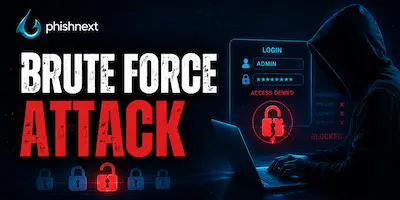
A brute force attack is a cryptographic method based on trial and error, in which cybercriminals utilize automated software to systematically try every possible combination of passwords, encryption keys, or PINs until they find the correct one.
Due to its dependence on raw computing power instead of advanced exploits, hackers utilize it to obtain unauthorized access to accounts, decrypt data, or probe for system weaknesses. Though their concept is simple, these attacks can be very effective against weak credentials, which makes it crucial to have strong defense mechanisms such as rate limiting and multi-factor authentication.
Let’s take a look at what a Brute Force Attack is, its uses, its features, and its benefits for organizations in the IT Industry!
How Does a Brute Force Attack Work?
|
S.No. |
Factors |
How? |
|
1. |
Target Identification and Data Harvesting |
Attackers choose a target and collect publicly available data such as usernames, email addresses, or domain names. |
|
2. |
Deploying Automated Software Tools |
High-speed cracking tools use leaked data or custom wordlists to automate the attack. |
|
3. |
Systematic Trial-and-Error Guessing |
The program submits thousands of combinations of credentials every second without pause until it locates a match. |
|
4. |
Bypassing Simple Security Filters |
To bypass fundamental, non-configured security measures, attackers utilize proxy networks and change IP addresses frequently. |
|
5. |
Exploitation Upon Success |
After a match is found, the hacker obtains unauthorized access to steal data, install malware, or take control of systems. |
Why Do Cybercriminals Use Brute Force Attacks?
Cybercriminals use brute force attacks for the following reasons:
1. High Success Rate Against Weak Credentials: A lot of users continue to rely on weak, easily guessable passwords, which render them vulnerable to automated guessing attacks.
2. Low Technical Barrier to Entry: Tools for cracking that are open-source and easily accessible require minimal coding knowledge to establish and operate.
3. Complete Automation and Scalability: With no need for direct involvement, aggressors are able to initiate round-the-clock campaigns that assess thousands of accounts at the same time worldwide.
4. Monetization via Credential Stuffing: Usernames and passwords that have been successfully cracked can be bundled and sold for substantial profits on the dark web.
5. Gateway to Larger Campaigns: By obtaining initial access to one account, hackers can pivot, deploy ransomware, or exfiltrate sensitive corporate data.
Common Types of Brute Force Attacks
The following are some common types of brute force attacks:
● Simple Brute Force Attack: Attempts to break a password by systematically trying every possible alphanumeric combination, without using any external data or wordlists.
● Dictionary Attack: Iterates through a set list of leaked passwords, phrases, and common words instead of making random guesses.
● Reverse Brute Force Attack: Uses a widely used password (e.g., “Password123”) and checks it with thousands of various usernames to see if there is a match.
● Credential Stuffing: Automatically enters pairs of verified compromised usernames and passwords that have leaked from past breaches into various websites.
● Hybrid Brute Force Attack: Merges dictionary words with arbitrary logic, incorporating numbers, symbols, or alterations in capitalization to base words (such as "Password123!").
Tools and Software Used by Attackers
|
S.No. |
Tools |
What? |
|
1. |
Hydra (THC-Hydra) |
A speedy, multi-protocol network login cracker capable of executing parallel attacks on dozens of protocols such as SSH, FTP, and HTTP. |
|
2. |
John the Ripper |
An open-source password security auditing tool that is highly customizable and mainly used for offline detection of weak Unix and Windows hashes. |
|
3. |
Hashcat |
The world’s fastest password recovery utility, powered by a GPU, that can crack hundreds of hash types using rules and masks. |
|
4. |
Aircrack-ng |
A specialized wireless security software package designed for packet capture and brute-force attacks on WEP and WPA/WPA2-PSK encryption keys. |
|
5. |
Burp Suite (Intruder) |
A web vulnerability scanning tool that includes a robust, customizable payload injector for automating brute-force attacks on login forms of web applications. |
Signs Your System May Be Under a Brute Force Attack
The following are the signs your system may be under a brute force attack:
a) Spike in Failed Login Attempts: Security logs indicate a sudden and substantial increase in failed authentication attempts aimed at one or more accounts.
b) Unusual Login Patterns and Hours: A significant amount of traffic comes from unknown geographic areas or takes place during non-business hours.
c) Degraded System Performance: The automated traffic flood leads to elevated server CPU usage, network congestion, and slow response times.
d) Repetitive, Sequential Username Queries: System logs record bots that target usernames in alphabetical or numerical order or by going through employee directories.
e) Sudden Lockout of Legitimate Users: Due to automated security triggers, several actual employees are simultaneously locked out of their accounts.
Risks and Consequences of Brute Force Attacks
The following are the risks and consequences of brute force attacks:
1. Unauthorized Data Breaches: Attackers achieve complete access to sensitive systems, resulting in the theft of intellectual property, trade secrets, and personal customer information.
2. Severe Financial Losses: Organizations incur huge direct costs stemming from ransom demands, forensic investigations, compliance penalties, and legal settlements.
3. Operational Downtime and Disruption: To contain the breach, it is often necessary to take systems offline, which halts business operations and freezes productivity.
4. Gateway to Advanced Threats: When hackers gain initial access to an account, they can create a foothold, increase their privileges, and spread devastating ransomware throughout the network.
5. Long-Term Reputational Damage: When security is compromised, it can have devastating effects: customer trust is shattered, brand value diminishes, and long-term business alliances may shift to rival companies.
How to Prevent Brute Force Attacks?
|
S.No. |
Factors |
How? |
|
1. |
Enforce Robust Password Policies |
Require the use of long, complex, and unpredictable passphrases that are resistant to automated cracking. |
|
2. |
Deploy Multi-Factor Authentication (MFA) |
Demand a secondary verification step, making compromised passwords ineffective on their own. |
|
3. |
Implement Progressive Rate Limiting and Lockouts |
After several unsuccessful attempts, automatically lock accounts or block IP addresses. |
|
4. |
Integrate Advanced CAPTCHAs |
Require users to resolve behavioral challenges in order to prevent automated bot traffic during login. |
|
5. |
Monitor with IP Whitelisting and Blacklisting |
Limit administrative access to networks that are trusted, and block IP pools that are known to be malicious. |
Best Practices for Creating Strong and Secure Passwords
The following are the best practices for creating strong and secure passwords:
● Prioritize Length Over Complexity: Utilize lengthy passphrases consisting of 12 to 16 characters, since the duration needed for automated cracking increases exponentially with length.
● Incorporate a Diverse Character Mix: Incorporate capital letters, small letters, numerals, and special characters in a mixture to disrupt predictable linguistic patterns.
● Eliminate Predictable Patterns: Steer clear of personal details that can be easily harvested, sequential sequences, and common substitution tricks such as replacing "E" with "3".
● Enforce Strict Password Uniqueness: To isolate and limit the damage from a single breach, never use the same password on different platforms.
● Utilize a Dedicated Password Manager: Create, securely save, and automatically input intricate, random passwords so that human memory is not relied upon.
Future Trends in Password Security and Authentication
The following are the future trends in password security and authentication:
a) The Mainstream Shift to FIDO2 Passkeys: Completely replaces weak passwords with cryptographic key pairs that are device-bound and cannot be phished and that are unlocked using local biometrics.
b) AI-Powered Adaptive Authentication: Assesses real-time risk indicators such as location and device health to adjust or increase login requirements dynamically.
c) Continuous Behavioral Biometrics: Monitors user typing speed and mouse actions passively to immediately identify account takeovers during a session.
d) Universal Phishing-Resistant MFA: Eliminates shareable and interceptable codes, relying solely on end-to-end hardware tokens and cryptographic handshakes.
e) Integrated Lifecycle Identity Verification: Links continuous digital threat scoring with ID proofing verified by the government, from onboarding to system offboarding.
Conclusion: Protect Your Systems from Brute Force Attacks
Now that we have talked about what a Brute Force Attack is, you might want to get a dedicated security solution to evade such attacks in the future. For that, you can go for PhishNext, a dedicated phishing simulation platform offered by Craw Security.
PhishNext can help users to acknowledge various types of phishing attacks to identify the ways to victimize the victims and learn how to evade them. What are you waiting for? Contact, Now!
Frequently Asked Questions
About Brute Force Attack
1. What is a brute force attack in cybersecurity?
A brute force attack is a hacking technique that employs automated tools to exhaustively guess every possible combination of a password or encryption key through trial and error, until the correct one is identified.
2. How does a brute force attack work?
A brute force attack works in the following ways:
a) Target Identification,
b) Tool Configuration,
c) Automated Guessing,
d) Security Evasion, and
e) System Compromise.
3. What are the different types of brute force attacks?
The following are the different types of brute force attacks:
a) Simple Brute Force Attack,
b) Dictionary Attack,
c) Reverse Brute Force Attack,
d) Credential Stuffing, and
e) Hybrid Brute Force Attack.
4. Why are brute force attacks dangerous for businesses?
Brute force attacks are dangerous for businesses for the following reasons:
a) Catastrophic Data Breaches,
b) Crippling Financial Losses,
c) Severe Operational Downtime,
d) Ransomware and Malware Deployment, and
e) Permanent Reputational Damage.
5. How can I detect a brute force attack on my website or network?
You can detect a brute force attack on your website or networks in the following ways:
a) Monitor for Surges in Failed Logins,
b) Track Geographically Impossible Patterns,
c) Audit Unexpected Traffic Volumes,
d) Watch for Sequential or Alphabetical Usernames, and
e) Alert on Simultaneous Account Lockouts.
6. What are the best ways to prevent brute force attacks?
The following are the best ways to prevent brute force attacks:
a) Enforce Robust Password Policies,
b) Deploy Multi-Factor Authentication (MFA),
c) Implement Progressive Rate Limiting and Lockouts,
d) Integrate Advanced CAPTCHAs, and
e) Monitor with IP Whitelisting and Blacklisting.
7. Does multi-factor authentication (MFA) protect against brute force attacks?
Yes, multi-factor authentication (MFA) effectively prevents brute force attacks, as even if an attacker guesses the correct password, they still cannot access the account without the additional physical verification factor.
8. What is the difference between a brute force attack and a dictionary attack?
The main distinction lies in the fact that a brute force attack systematically and randomly tries every conceivable character combination to break a password, while a dictionary attack tests only a prearranged list of frequently used words, phrases, and credentials that have been leaked in the past.
9. Which tools do hackers use to perform brute force attacks?
Hackers use the following tools to perform brute force attacks:
a) Hydra (THC-Hydra),
b) John the Ripper,
c) Hashcat,
d) Aircrack-ng, and
e) Burp Suite (Intruder).
10. Can strong passwords completely prevent brute force attacks?
No, while strong passwords cannot entirely avert the initiation of a brute force attack, they can render success virtually impossible by prolonging the time needed to crack them from mere minutes to trillions of years.