How to Protect Your Business from Phishing Attacks?
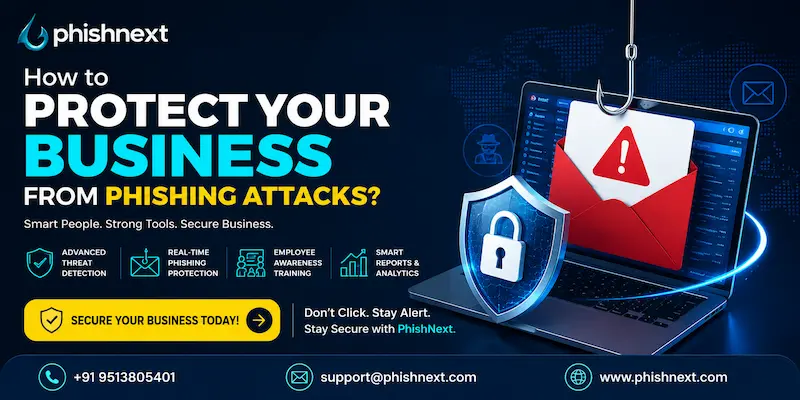
Do you want to learn about how Phishing Attacks work and what impact they cause to terrorize the usual traffic online? If yes, then you are at the right place. Here, we will talk about phishing attacks and prevention techniques in detail.
Moreover, we will introduce you to a reliable phishing simulation solution offered by a reputable VAPT service provider. What are we waiting for? Let’s get started!
What Are Phishing Attacks?
Phishing attacks are fraudulent online schemes in which cybercriminals impersonate reliable sources like banks, coworkers, or medical providers through emails, messages, or websites in order to deceive victims into divulging sensitive information.
These assaults exploit social engineering tactics to coerce victims into disclosing sensitive credentials, downloading harmful attachments, or permitting deceitful monetary transactions. Once compromised, these stolen entry points are often exploited by attackers to install destructive ransomware payloads or extract sensitive corporate data.
Let’s talk about what Phishing Attacks are, their potential aims, terrible impacts and the ways to deal with them!
Common Types of Phishing Attacks That Target Businesses
|
S.No. |
Types |
What? |
|
1. |
Spear Phishing |
Uses well-researched, tailored details to deceive particular employees into disclosing credentials or installing malware. |
|
2. |
Business Email Compromise (BEC) |
Imitates corporate leaders or reliable suppliers to deceive finance teams into permitting illicit financial wire transfers. |
|
3. |
Whaling |
Aims at top-level C-suite executives using customized social engineering methods to appropriate sensitive corporate assets or gain access to substantial funds. |
|
4. |
Smishing and Vishing (SMS & Voice Phishing) |
Exploit misleading text messages and high-pressure phone calls to control corporate employees into circumventing security protocols. |
|
5. |
Clone Phishing |
Copies a valid email that was received before and substitutes the original attachment or link with a harmful variant. |
Top Warning Signs of a Phishing Attempt in the Workplace
The following are the top warning signs of a phishing attempt in the workplace:
1. Urgent, Coercive, or Threatening Language: Requires immediate action, with threats of account suspension or penalties.
2. Mismatched Sender Domains: Shows an address that appears to be close but contains spelling mistakes or the incorrect extension.
3. Suspicious or Generic Hyperlinks: Show a different, unrecognized URL when the mouse hovers over the given link.
4. Unusual Requests for Sensitive Information: Requests for login information, passwords, or financial verification through email.
5. Unexpected Attachments with Strange File Extensions: Includes unsolicited documents with potentially dangerous formats such as .exe, .scr, or .zip.
How Phishing Attacks Impact Business Security and Operations?
Phishing attacks impact business security and operations in the following ways:
● Triggers Catastrophic Ransomware Infiltrations: Acts as the main access point for assailants to implement file-encrypting malware throughout the corporate network.
● Inflicts Severe Financial Losses: Results in direct theft of funds, recovery costs that are financially debilitating, and enormous fines for failing to comply with regulations.
● Compromises Proprietary Corporate Data: Permits unapproved individuals to pilfer trade secrets, strategic business plans, and intellectual property.
● Damages Customer Trust and Brand Reputation: Results in serious and lasting brand damage and customer turnover after sensitive data is publicly revealed.
● Drains IT and Security Resources: Redirects security teams from strategic growth initiatives to handle the tiring tasks of incident triage and forensic cleanups.
Essential Cybersecurity Policies to Prevent Phishing Attacks
|
S.No. |
Policies |
What? |
|
1. |
Mandatory Multi-Factor Authentication (MFA) Policy |
When hardware or app-based tokens are necessary, stolen login credentials become entirely ineffective for phishing perpetrators. |
|
2. |
Email Security and Authentication Standards Policy |
By implementing SPF, DKIM, and DMARC regulations, emails from spoofed external domains are prevented from reaching inboxes. |
|
3. |
Continuous Security Awareness and Phishing Simulation Policy |
By conducting random mock attacks, corporate personnel are trained to recognize and report active email threats. |
|
4. |
Strict Access Control and Privilege Management Policy |
Applying Zero Trust principles stops localized phishing breaches from spreading across network segments. |
|
5. |
Formal Out-of-Band Verification Policy |
By requiring the use of an independent communication channel, fraudulent executive email scams that alter invoices are entirely prevented. |
How do regular phishing simulations improve employee awareness?
Regular phishing simulations improve employee awareness in the following ways:
a) Creates Muscle Memory for Real Threat Identification: Prepares employees to recognize warning signs immediately via ongoing practical experience with changing email scams.
b) Shifts Security from Theoretical to Experiential: Substitutes dull text instructions with practical, real-life simulations that assess vigilance in high-pressure situations.
c) Safely Demonstrates the Consequences of a Click: Provides immediate and constructive feedback within a controlled setting, eliminating the risk of a real network breach.
d) Fosters a Proactive Culture of Instant Reporting: Trains employees to quickly flag dubious messages with the help of built-in alert buttons that require only a single click.
e) Provides Measurable Metrics for Risk Management: Monitors failure rates over time to identify at-risk business units that require additional focused training.
Protect Business Data with Endpoint Security and Zero Trust Security
By integrating endpoint security with a Zero Trust architecture, business data is safeguarded through the continuous verification of the identity and security posture of all users and devices trying to access the network.
This unified strategy implements strict, contextual access controls and isolates compromised endpoints to ensure that even if a device or credential is breached, malicious actors cannot move laterally to access sensitive company assets.
The Role of Threat Intelligence in Preventing Phishing Attacks
|
S.No. |
Roles |
What? |
|
1. |
Expose Phishing Infrastructure Early |
Identifies and marks harmful domains and lookalike servers ahead of time, before harmful emails are dispatched. |
|
2. |
Feeds Real-Time Indicators into Security Tools |
Delivers harmful URLs and IP blocklists directly to firewalls and email gateways without manual intervention. |
|
3. |
Provides Context on Active Threat Actor Tactics |
Analyzes particular enticements and social manipulation strategies employed by organizations that are presently aiming at the sector. |
|
4. |
Monitors the Dark Web for Leaked Corporate Credentials |
Notifies security teams of compromised staff logins for password resets before weaponization. |
|
5. |
Informs Targeted Employee Training Simulations |
Utilizes actual threat blueprints to create pertinent and current phishing assessments for employees. |
Why Does Dark Web Monitoring Help Detect Stolen Business Credentials?
Dark web monitoring helps detect stolen business credentials for the following reasons:
1. Exposes Initial Access Broker Postings: Flags cybercriminals who are actively offering illicit access to corporate network credentials on underground marketplaces.
2. Identifies Compromised Third-Party Vendor Logins: Identifies leaked supply-chain credentials that may enable unauthorized lateral access to the business network.
3. Intercepts Automated Infostealer Malware Logs: Captures login information saved by the browser and collected by malware before its broad dissemination or use as a weapon.
4. Mitigates Credential Stuffing Exploits: Permits teams to mandate resets on reused passwords identified in newly leaked public database dumps.
5. Provides Early Warning Before Active Exploitation: Provides security teams with a vital advance in the race to deactivate compromised accounts before they can be used by attackers to log in.
Best Tools and Solutions to Protect Your Business from Phishing Attacks
The following are the best tools and solutions to protect your business from Phishing Attacks:
● Next-Generation Secure Email Gateways (SEGs): Utilize AI behavior analysis to prevent malicious domains and zero-day payloads from entering the perimeter.
● FIDO2-Compliant Multi-Factor Authentication (MFA): Eliminates the possibility of credential interception by mandating cryptographic verification that is resistant to phishing and based on hardware.
● Security Awareness Training and Phishing Simulations: Carry out ongoing, automated simulated assaults to train personnel to recognize developing social engineering enticements.
● Threat Intelligence and Dark Web Monitoring Platforms: Monitor underground markets to detect leaked company credentials before they can be misused.
● Automated Incident Response and SOAR Playbooks: Carry out instantaneous, machine-speed quarantine procedures to separate suspected mailboxes as soon as a breach happens.
Automated Email Authentication Protocols: SPF, DKIM, and DMARC
|
S.No. |
Protocols |
What? |
|
1. |
SPF |
Enumerates the sending IP addresses that are permitted and have been authorized in DNS records to avert the impersonation of corporate domains by unapproved servers. |
|
2. |
DKIM |
Affixes a cryptographic signature to the headers of emails to confirm that the messages were not modified during transmission. |
|
3. |
DMARC |
Specifies the method by which receiving servers should manage emails that do not pass SPF or DKIM verification, using strict blocking or quarantine directives. |
What is PhishNext?
PhishNext is a platform that utilizes AI to provide phishing simulations and security awareness training, aimed at assessing and bolstering the human aspect of cyber defenses in companies. It pinpoints employee behavioral weaknesses and delivers prompt, data-informed training to avert genuine data breaches by carrying out realistic, adaptive mock assaults grounded in real-time threat intelligence.
Benefits of PhishNext for Organizations
The following are the benefits of PhishNext for organizations:
a) Reduces Real-World Attack Success: Usually reduces the baseline "Phish-prone Percentage" of an organization from about 30% to 5% in the span of a year.
b) Delivers Immediate Just-in-Time Remediation: Offers micro-learning feedback the moment a user makes a mistake, reinforcing practical defense habits.
c) Maps Behavioral Risk and Analytics: Monitors the evolution of click-rate patterns over time to produce detailed risk scores and identify at-risk departments.
d) Simulates Advanced, Region-Specific Threats: Mimics evolving localized attacks, QR-code phishing, and executive fraud using a multilingual template library.
e) Offers Frictionless, Scalable Deployment: Automates the tasks of provisioning, syncing email directories, and assigning training to initiate campaigns in less than a minute.
Conclusion: Build a Strong Business Defense Against Phishing Attacks
Now that we have talked about what Phishing Attacks are, you might want to learn about some ways to evade such attempts to secure yourself. For that, you can go for PhishNext, a dedicated phishing simulation
PhishNext can offer a simulated experience to the users where they can see how various types of phishing attacks work and how they can protect themselves against them. Thus, you can feel safer working online. What are you waiting for? Contact, Now!
Frequently Asked Questions
About Phishing Attacks
1. What is a phishing attack, and how does it target businesses?
Phishing attacks are scams based on social engineering, in which perpetrators impersonate trusted organizations through misleading emails, links, or messages in order to deceive employees into giving up sensitive corporate information, funds, or credentials.
2. How can businesses identify phishing emails before employees click on them?
Businesses can identify phishing emails before employees click on them in the following ways:
a) Enforce Automated Email Authentication (SPF, DKIM, DMARC),
b) Deploy AI-Powered Secure Email Gateways (SEGs),
c) Enable Inbound External Email Banners,
d) Hover Over Hyperlinks to Verify URLs, and
e) Look for Urgent or Coercive Social Engineering Lures.
3. What are the most common types of phishing attacks affecting organizations?
The following are the most common types of phishing attacks affecting organizations:
a) Spear Phishing,
b) Business Email Compromise (BEC),
c) Whaling,
d) Smishing and Vishing (SMS & Voice Phishing), and
e) Clone Phishing.
4. Why is employee cybersecurity awareness training important for phishing prevention?
Employee cybersecurity awareness training important for phishing prevention for the following reasons:
a) Neutralizes the Human Risk Vector,
b) Cultivates Instinctual Threat Recognition,
c) Dramatically Lowers Success Rates,
d) Accelerates Incident Reporting Times, and
e) Reinforces Corporate Security Policies.
5. How does multi-factor authentication (MFA) help protect against phishing attacks?
Multi-factor authentication safeguards against phishing by necessitating a secondary verification step (such as a hardware token or app approval), making stolen passwords ineffective for attackers.
6. What email security tools are most effective in preventing phishing attacks?
The following email security tools are most effective in preventing phishing attacks:
a) AI-Powered Secure Email Gateways (SEGs),
b) API-Driven Behavioral AI Security,
c) Integrated Cloud Email Security (ICES),
d) Automated DMARC Management Tools, and
e) Automated Post-Delivery Remediation (SOAR).
7. How often should businesses conduct phishing simulations for employees?
To foster enduring muscle memory, sustain ongoing vigilance, and adapt to changing threat strategies, companies ought to carry out phishing simulations on a monthly basis.
8. What should a company do immediately after a successful phishing attack?
The firm ought to promptly separate impacted devices, reset all at-risk credentials, and activate incident response playbooks to terminate active attacker sessions.
9. How can threat intelligence help businesses detect and prevent phishing campaigns?
Threat intelligence can help businesses detect and prevent phishing campaigns in the following ways:
a) Identifies Malicious Infrastructure Early,
b) Feeds Real-Time Indicators into Security Tools,
c) Exposes Active Threat Actor Tactics,
d) Scans the Dark Web for Compromised Logins, and
e) Tailors Security Awareness Training.
10. What are the best practices to protect a business from phishing attacks?
The following are the best practices to protect a business from phishing attacks:
a) Enforce Phishing-Resistant MFA (FIDO2),
b) Deploy Cloud-Native, AI-Driven Email Security,
c) Automate Strict Domain Authentication,
d) Conduct Monthly Security Awareness and Simulations,