What are Hyper-Personalized AI Phishing Attacks?
Do you know about what Hyper-Personalized AI Phishing Attacks are, their impacts, and potential victims? If not, then you are at the right place. Here, we will talk about such attacks in detail with their prevention techniques.
Moreover, we will introduce you to a reliable phishing simulation platform offered by a reputable VAPT service provider. What are we waiting for? Let’s get straight to the topic!
How AI Is Transforming Traditional Phishing Scams?
|
S.No. |
Factors |
How? |
|
1. |
Hyper-Personalized Spear Phishing |
AI immediately collects enormous volumes of social media and public data to create highly customized, context-aware lures that target certain people. |
|
2. |
Flawless Language and Tone |
The obvious spelling mistakes, bad syntax, and difficult wording that have traditionally exposed phishing efforts are eliminated by generative language models. |
|
3. |
Automated Scaling of Attacks |
Threat actors employ automation to concurrently launch thousands of highly convincing, specially tailored phishing operations with little manual labor. |
|
4. |
Deepfake and Multi-Channel Exploitation |
In order to carry out extremely dishonest social engineering schemes on phone conversations and video platforms, attackers combine text-based lures with artificial audio and video clones. |
|
5. |
Bypassing Traditional Security Filters |
AI allows phishing emails to evade static, signature-based email security gateways by dynamically changing their text and code in real time. |
What Are Hyper-Personalized AI Phishing Attacks?
Hyper-personalized AI phishing attacks create highly customized lures that imitate a person's particular relationships, projects, and communication style by using generative AI to collect social media and public data.
These automated frauds take advantage of deep personal context to trick people on a large scale by removing conventional warning signs like poor grammar.
Why These Attacks Are More Dangerous Than Traditional Phishing?
These attacks are more dangerous than traditional phishing for the following reasons:
1. Eradication of "Telltale" Red Flags: Grammar errors and inappropriate wording are eliminated by AI, leaving no visible clues for people to notice.
2. Massive Scaling of Deeply Targeted Lures: Individual spear-phishing campaigns that are highly personalized are now automatically deployed against thousands of targets at once.
3. Bypassing Signature-Based Email Filters: Every email has a different attack signature thanks to unique, dynamically generated text that gets past conventional blocklists.
4. Multi-Channel Synchronized Exploitation: In order to establish complete trust, attackers can easily coordinate matching threats across deepfake voice calls, SMS, and email.
5. No Malicious Payloads to Track: Security software has no malicious code to scan because the scams only use text-based social engineering and credential harvesting.
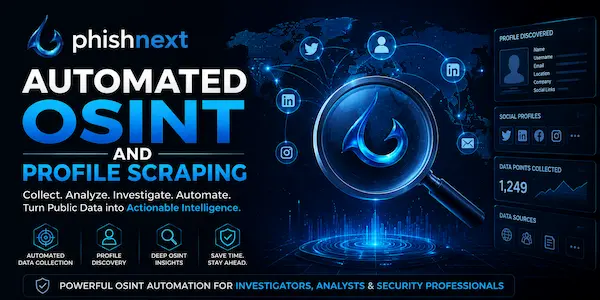
Automated OSINT and Profile Scraping
AI-powered bots and web crawlers are used in automated OSINT and profile scraping to quickly compile social media data, public information, and organizational hierarchies from the internet. Threat actors use this technology as a weapon to quickly create thorough victim profiles and scale highly targeted spear-phishing attacks with little manual labor.
How Hyper-Personalized AI Phishing Attacks Work?
Hyper-personalized AI phishing attacks work in the following ways:
● Automated OSINT Scraping: AI-powered bots quickly compile a thorough digital dossier on the target by scanning social media, news, and public profiles.
● Contextual Lure Generation: Using the scraped data, generative language models create immaculate, extremely particular emails that precisely resemble the tone of a reliable vendor or colleague.
● Continuous Identity Modification: The AI makes sure that no two phishing communications have the same digital signature by dynamically changing the text, sender aliases, and email headers for each recipient.
● Cross-Channel Verification: In order to create layers of credibility that coerce the victim into compliance, attackers synchronize the email with corresponding SMS texts or deepfake voice calls.
● Payload-Free Exploitation: The assaults only use text-based social engineering to fool victims into sending money or disclosing passwords, completely avoiding identifiable malware or links.
Common Types of AI-Powered Phishing Attacks
The following are some common types of AI-powered phishing attacks:
a) AI-Generated Business Email Compromise (BEC): In order to deceive employees into making illicit cash transfers, AI flawlessly imitates executive writing styles.
b) Deepfake Voice and Video Vishing: In order to control employees during live phone or video calls, attackers mimic executive voices or video faces.
c) Dynamic Polymorphic Phishing: Every email message avoids traditional signature detection because algorithms continuously modify the content and code structure.
d) Automated Spear-Phishing via Social Scraping: To simultaneously launch hundreds of highly personalized, targeted lures, bots automatically gather public social profiles.
e) AI-Driven Smishing (SMS Phishing): AI creates time-sensitive, highly localized text messages that take advantage of urgent context to steal mobile device credentials.
Social Engineering via Deepfakes
Using AI-cloned audio or video to flawlessly imitate trusted people, such as family members or business executives, during in-person meetings is known as social engineering using deepfakes.
Through phone calls and video conferences, attackers use these lifelike synthetic media assets to trick victims into giving over sensitive credentials, allowing fraudulent wire transfers, or getting around security measures.
Real-World Examples of Hyper-Personalized AI Phishing
The following are some real-world examples of hyper-personalized AI phishing:
1. The $25 Million Arup Deepfake Video Conference: Fraudsters tricked an employee into making large unauthorized transfers by posing as a CFO and colleagues on a live teleconference using spear-phishing emails and AI-generated video and audio.
2. The Wiz AI-Cloned Executive Voicemail Campaign: Attackers trick internal teams into approving urgent data or wire transfers by using highly accurate 10-second AI voice clones to send convincing business voicemails.
3. The Multi-Channel WPP Exec Impersonation: In an attempt to steal company money, scammers combined a phony WhatsApp profile, publicly available YouTube videos, and artificial intelligence sounds during a Microsoft Teams conference to pose as CEO Mark Read.
Key Warning Signs to Watch For
The following are some key warning signs to watch for:
● High-Pressure Urgency Bypassing Standard Protocols: Requests to circumvent existing verification procedures due to a purported, urgent business crisis.
● Unnatural Audio Cues (Voice Cloning): Unusual background static, robotic language, flat or monotone pace, and no breathing noises.
● Visual Glitches and Distortion (Deepfakes): Unnatural lighting changes, mismatched blinking, blurred jawlines, and glitching when a hand passes over the face.
● Unusual Content and Hyper-Specific Personal Context: Requests that request extremely out-of-character actions while utilizing intimate personal or project details.
● Refusal to Verify via Alternate Channels: Aggressively blocking attempts to use a separate communication route while insisting on remaining on the present call.
How Individuals Can Protect Themselves?
|
S.No. |
Factors |
How? |
|
1. |
Implement Multi-Channel Verification |
Verify any urgent or delicate requests using a different, reliable communication channel. |
|
2. |
Establish Secret Shared Passphrases |
To quickly confirm identities during unforeseen conversations, create distinctive voice passwords with loved ones or coworkers. |
|
3. |
Scan for Synthetic Media Glitches |
During video and phone calls, keep an eye out for robotic vocal cadences, strange lighting, and abnormal blinking. |
|
4. |
Practice Strict Digital Footprint Hygiene |
Limit the amount of data AI may scrape for lures by restricting public personal information on social media. |
|
5. |
Enforce a "Pause and Validate" Mindset |
When dealing with high-pressure requests, especially those that call for departures from accepted security procedures, slow down. |
How Businesses Can Defend Against AI-Driven Phishing?
Businesses can defend against AI-driven phishing in the following ways:
a) Deploy AI-Powered Email Gateways: Utilize cloud APIs to examine communication patterns and identify anomalies that are payload-free and contextually odd.
b) Implement Phishing-Resistant MFA: To completely prevent credential theft and session hijacking, force FIDO2 security keys or device-bound passkeys.
c) Enforce Adaptive Behavioral Analytics: Real-time authentication checks are triggered by dynamically monitoring environmental signals and user interaction patterns.
d) Adopt a Zero Trust Architecture: Limit lateral movement by constantly checking each person, device, and request in case of a breach.
e) Upgrade to Adaptive Security Awareness Training: Replace out-of-date yearly compliance videos with ongoing, behavior-focused simulations that thwart the allure of perfect generative AI.
The Future of AI-Powered Cyber Threats
Future AI-powered cyberthreats are expected to be completely autonomous, self-replicating malware that actively evades sophisticated protection measures by constantly changing its own code.
Real-time deepfakes and predictive behavioral algorithms will be used as weapons in these hyper-targeted attacks to quickly and efficiently conduct highly coordinated, multi-channel corporate intrusions.
Conclusion
Now that we have talked about what Hyper-Personalized AI Phishing Attacks are, you might want to protect yourself against such phishing attacks. For that, you can go for PhishNext, a dedicated phishing attack simulator offered by Craw Security.
PhishNext can help users to train their brains to identify various kinds of phishing attacks and the ways to protect themselves against such attempts. Thus, protection against online phishing attacks will be easy. What are you waiting for? Contact, Now!
Frequently Asked Questions
About Hyper-Personalized AI Phishing Attacks
1. What are hyper-personalized AI phishing attacks?
Hyper-personalized AI phishing assaults automatically create highly customized, context-aware schemes that imitate a person's particular relationships, projects, and communication style by using generative artificial intelligence to harvest public data.
2. How do AI-powered phishing attacks differ from traditional phishing scams?
While AI-powered attacks dynamically collect data to launch hyper-personalized, linguistically perfect frauds at machine speed, traditional phishing relies on static, generic templates that are manually broadcast to the masses.
3. What technologies do cybercriminals use to create hyper-personalized phishing messages?
Cybercriminals use the following technologies to create hyper-personalized phishing messages:
a) Generative Language Models (LLMs),
b) Automated OSINT and Scraping Bots,
c) AI Audio and Video Deepfakes,
d) Polymorphic Code Algorithms, and
e) Predictive Analytics and Data Synthesizers.
4. How do attackers gather personal information for AI-driven phishing campaigns?
Attackers gather personal information for AI-driven phishing campaigns in the following ways:
a) Automated OSINT Web Scraping,
b) Social Media Mining,
c) Exploiting Historical Data Breaches,
d) Public Code Repository Auditing, and
e) Public Schedule and Media Ingestion.
5. Can AI-generated phishing emails bypass spam filters?
Yes, AI-produced phishing emails get past conventional spam filters because they don't contain the known dangerous payloads or banned terms that security software carefully monitors, and their distinct, dynamically created text constantly modifies the message signature.
6. What role do deepfakes play in hyper-personalized phishing attacks?
Deepfakes play the following roles in hyper-personalized phishing attacks:
a) Cloning Executive Voices (Vishing),
b) Fabricating Video Conferences,
c) Creating Multi-Channel Credibility,
d) Bypassing Biometric Security, and
e) Exploiting Emotional Urgency.
7. How can I identify a hyper-personalized phishing attempt?
You can identify a hyper-personalized phishing attempt in the following ways:
a) Look for an Unusual Sense of Crisis,
b) Verify Strange Contextual Requests,
c) Spot Synthetic Audio and Video Anomalies,
d) Check for Communication Multi-Channel Coercion, and
e) Test via an Independent Protocol.
8. Who is most at risk from AI-powered phishing attacks?
The following individuals are at most risk from AI-powered phishing attacks:
a) High-Level Executives and Leadership,
b) Finance and Accounting Personnel,
c) Human Resources and IT Administrators,
d) New or Less-Experienced Employees, and
e) Individuals with a Large Public Digital Footprint.
9. How can businesses protect themselves from hyper-personalized AI phishing threats?
Businesses can protect themselves from hyper-personalized AI phishing threats in the following ways:
a) Enforce Phishing-Resistant MFA,
b) Deploy AI-Driven Communication Defense,
c) Establish Out-of-Band Verification Protocols,
d) Implement Continuous Behavioral Analytics, and
e) Modernize Security Awareness Training.
10. What is the future of AI-driven phishing and cybercrime?
The future of AI-driven cybercrime lies in fully autonomous, self-mutating malware and real-time deepfakes that orchestrate hyper-targeted, multi-channel attacks at machine speed.
Read More: