How Cybercriminals Use Large Language Models to Scale Phishing Campaigns?
Do you know what Large Language Models are and how you can protect yourself against such tools? If yes, then you are at the right place. Here, we will talk about what LLMs are and the ways to protect yourself from them.
Moreover, we will talk about a reliable phishing simulation platform offered by a reputable VAPT service provider. What are we waiting for? Let’s get straight to the topic!
How Phishing Attacks Worked Before the Rise of AI?
|
S.No. |
Factors |
How? |
|
1. |
Mass-Scale "Spray and Pray" Campaigns |
In the hopes that a small percentage would bite, attackers sent identical, generic emails to millions of addresses. |
|
2. |
Glaring Language and Grammar Flags |
Phishing emails were infamous for their blatant mistakes, poorly translated English, and strange wording. |
|
3. |
Static and Easily Blocked Domains |
Threat intelligence feeds swiftly blacklisted the fixed, mass-registered domains used by scammers in a matter of hours. |
|
4. |
Manual Open-Source Intelligence (OSINT) |
In order to put together a target's background, spear-phishing takes hours of painstaking Google and LinkedIn research. |
|
5. |
Basic Visual Cloning and Spoofing |
Browser anti-phishing filters were easily triggered by the inflexible HTML copies used on login pages, which lacked dynamic elements. |
What Are Large Language Models?
Large Language Models (LLMs) are sophisticated AI systems that have been trained on enormous datasets to comprehend, produce, and work with human language. They execute difficult tasks like translation, summarization, and reasoning by using transformer topologies and deep learning algorithms to predict the most contextually relevant next words.
The Role of Large Language Models in Modern Phishing Campaigns
The following are the roles of LLMs in modern phishing campaigns:
1. Hyper-Personalized Spear Phishing at Scale: Rapidly creates customized lures for thousands of targets at once by scraping open-source data.
2. Flawless Language and Zero Grammar Flags: Produces native-level, contextually flawless content in any language by removing obvious errors and bad phrasing.
3. Dynamic Social Engineering and Chatbots: Enable real-time, interactive chatbots that persuade victims to provide private information.
4. Rapid Contextual Clones of Corporate Communications: Immediately imitates particular internal writing styles, formats, and executive tones by analyzing publicly available firm assets.
5. Automated Variations to Bypass Security Filters: Creates hundreds of distinct, polymorphic variants of the same email to get around security gateways that rely on signatures.
Jailbreaking LLMs: How Attackers Bypass AI Safety Guardrails?
|
S.No. |
Factors |
How? |
|
1. |
Hypothetical and Roleplay Framing |
By giving the AI instructions to act as an unaligned persona or function in a fictitious, sandbox scenario, attackers deceive the AI. |
|
2. |
Adversarial Suffixes and Token Optimization |
The model's safety alignment is broken by appending algorithmically generated strings of meaningless characters to prompts. |
|
3. |
Language and Encoding Obfuscation |
To get beyond common safety filters, prompts are either encoded in Base64 or translated into low-resource languages. |
|
4. |
Cognitive Layering and Prefacing |
Users can instruct the AI to start its response with a complying sentence or divide malevolent requests into intricate multi-step logic puzzles. |
|
5. |
Indirect Prompt Injection |
When the LLM browses untrusted external data, such as a webpage or document, malicious instructions are concealed within. |
How Cybercriminals Use LLMs to Generate Convincing Phishing Emails?
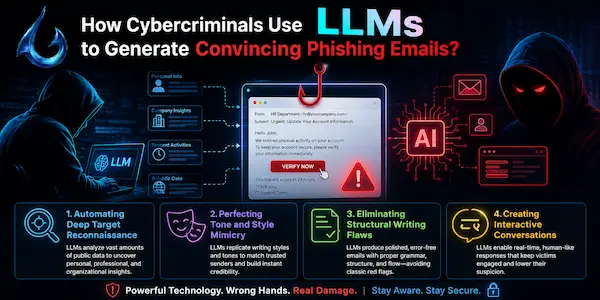
Cybercriminals use LLMs to generate convincing phishing emails in the following ways:
● Automating Deep Target Reconnaissance: In order to quickly extract personal connections and particular weaknesses for the lure, attackers send unstructured public data into an LLM.
● Perfecting Tone and Style Mimicry: In order to accurately mimic an executive's distinct communication style, wording, and authority, the AI examines their public work.
● Eliminating Structural Writing Flaws: The historical typos, strange wording, and regional grammar mistakes that have historically exposed foreign phishing operations are eliminated by LLMs.
● Creating Interactive Conversations: Before delivering a payload, cybercriminals use automated chatbots to respond to victims' responses in a dynamic manner.
● Bypassing Filters with Automated Polymorphism: To stop email security filters from identifying a pattern, the system rewrites the same underlying lure in thousands of different ways.
Personalization of Attacks Through AI-Driven Data Analysis
Attackers can quickly compile and examine enormous amounts of unstructured data from social media, public records, and compromised databases thanks to AI-driven data analysis. The AI automatically creates highly personalized, contextually relevant attack lures for thousands of unique targets at once by recognizing particular professional relationships, recent transactions, and behavioral patterns.
Multilingual Phishing: Breaking Language Barriers with LLMs
By offering instantaneous, native-level translations that preserve intricate regional idioms, professional jargon, and cultural subtleties, large language models have erased the linguistic and geographic constraints of cybercrime.
This makes it possible for foreign threat actors to easily carry out faultless, incredibly convincing phishing campaigns in several languages at once without raising any conventional linguistic red flags.
Use of LLMs for Malware Delivery and Payload Crafting Assistance
Threat actors use LLMs to create extremely evasive obfuscation scripts, quickly produce and improve functional malware code, and automate polymorphic versions that evade signature-based antivirus detection.
These models also help create extremely convincing, context-specific execution instructions and delivery papers that deceive users into executing malicious payloads.
Risks and Ethical Concerns Around Misuse of Generative AI
The following are some risks and ethical concerns around the misuse of generative AI:
a) Automated Cyberattacks and Malware Evolution: AI speeds up the development of highly elusive, polymorphic malware strains and perfect phishing lures.
b) Proliferation of Deepfakes and Disinformation: It makes it possible to produce hyper-realistic fake media in large quantities, which distorts public opinion and damages people's reputations.
c) IP Theft and Copyright Infringement: Without permission, models are frequently trained on proprietary, protected works, illegally copying copyrighted content.
d) Amplification of Bias and Discrimination: AI systems have the ability to mimic and deeply ingrain cultural prejudices from the past that are present in their training data.
e) Privacy Violations and Data Scraping: People are vulnerable to identity theft and monitoring due to widespread, illegal collection of personal web data.
Future of Phishing: What Happens as LLMs Become More Advanced?
Phishing will evolve into completely autonomous, real-time cognitive attacks that dynamically modify their conversational environment in response to a victim's live psychological reactions as LLMs progress.
Additionally, the combination of hyper-personalized voice synthesis with deepfake video will make it difficult to distinguish between authentic and fake identities, making conventional security awareness indicators entirely outdated.
How Organizations Can Defend Against AI-Enhanced Phishing Attacks?
Organizations can defend against AI-enhanced phishing attacks in the following ways:
1. Deploy AI-Powered Email Security Gateways: To identify unusual, AI-generated anomalies, use machine learning algorithms that examine communication behavior and context.
2. Implement Continuous, Adaptive Security Training: Employees can be trained using dynamic, AI-simulated phishing scenarios that reflect changing, highly customized social engineering techniques.
3. Enforce Strict Identity Verification Protocols: Require stringent out-of-band verification procedures in addition to strong, phishing-resistant multi-factor authentication (MFA) for important financial or data requests.
4. Leverage Automated DMARC and Email Authentication: Enforce strict DMARC, DKIM, and SPF rules to prevent spoof corporate domains from getting to user inboxes.
5. Integrate EDR with XDR and Behavioral Analytics: To prevent post-compromise malware execution and quickly identify lateral attacker movement, combine endpoint protection with cross-domain telemetry.
Best Practices for Users to Identify AI-Generated Phishing Attempts
The following are the best practices for users to identify AI-generated phishing attempts:
● Audit the Header, Not the Persona: Make sure the sender's email address corresponds to the official, precise domain name of the organization by looking past the well-known display name.
● Implement Out-of-Band Verification for Urgent Requests: Call the sender directly via a different, pre-established official channel to confirm any sensitive requests.
● Analyze Link Destination and File Anomalies: To preview the destination URLs of hyperlinks and prevent downloading strange or unexpected attachments, hover over them.
● Evaluate Psychological Urgency and Emotional Triggers: Threats of sudden negative repercussions or high-pressure language should be viewed as warning signs intended to circumvent reason.
● Cross-Reference Hyper-Personalization with Public Data: Emails that use your connections, work position, or public social media information to win your trust should be treated with extreme caution.
Conclusion
Now that we have talked about what Large Language Models are, you might want to learn how you can protect yourself against phishing attacks. For that, you can go for PhishNext, a dedicated phishing attack simulator offered by Craw Security.
The PhishNext platform can help users to confront variant phishing attacks and learn how to evade them with ease to stay safe. Thus, you will be able to secure yourself against harmful phishing attacks. What are you waiting for? Contact, Now!
Frequently Asked Questions
About Large Language Models
1. How are large language models used in phishing attacks?
Large language models are used in phishing attacks in the following ways:
a) Hyper-Personalized Target Profiling,
b) Flawless Multi-Language Writing,
c) Contextual Corporate Spoofing,
d) Dynamic Conversational Social Engineering, and
e) Automated Polymorphic Filtering Evasion.
2. Can AI-generated phishing emails be detected easily?
No, sophisticated AI-generated phishing emails are difficult to spot since they resemble authentic context and writing styles flawlessly and lack common grammatical faults.
3. Why do cybercriminals prefer using LLMs for phishing campaigns?
Cybersecurity prefers using LLMs for phishing campaigns for the following reasons:
a) Mass Customization at Scale,
b) Elimination of Language Red Flags,
c) Flawless Brand and Style Mimicry,
d) Automated Evasion of Security Filters, and
e) Dynamic, Real-Time Conversations.
4. How does AI make phishing messages more convincing?
AI makes phishing messages more convincing in the following ways:
a) Eliminating Writing Flaws,
b) Hyper-Personalized Targeting,
c) Exact Style and Tone Mimicry,
d) Contextual and Timely Relevance, and
e) Polymorphic Evasion at Scale.
5. Are multilingual phishing attacks increasing due to LLMs?
Yes, because LLMs allow attackers to immediately produce perfect, natural translations that get around conventional language barriers and regional security filters, multilingual phishing assaults are on the rise.
6. Can large language models automate spear phishing attacks?
Yes, by scaling highly targeted profile research, creating customized lures, and engaging in interactive dialogue without human intervention, big language models may completely automate spear phishing attacks.
7. What makes AI-powered phishing harder to identify than traditional phishing?
Because AI-powered phishing uses automated intelligence to simulate language fluency, corporate communication styles, and customized target scenarios, it totally eliminates traditional red flags like typos and bad syntax, making it more difficult to spot.
8. How do cybercriminals use LLMs to bypass email security filters?
Cybercriminals use LLMs to bypass email security filters in the following ways:
a) Dynamic Word Mutation,
b) Contextual Plausibility and Tone Alignment,
c) Obfuscation of Malicious Intent,
d) Adversarial Testing Against Filters, and
e) Polymorphic Code Modification.
9. What are the risks of AI being misused in cybercrime?
The following are some of the risks of AI being misused in cybercrime:
a) Scalability of Hyper-Personalized Social Engineering,
b) Flawless Evasion of Traditional Content Filters,
c) Rapid Automation of Malware Engineering,
d) Hyper-Realistic Deepfake Fraud and Disinformation, and
e) Autonomous Conversational Exploitation.
10. How can individuals protect themselves from AI-generated phishing scams?
Individuals can protect themselves from AI-generated phishing scams in the following ways:
a) Verify Through Out-of-Band Channels,
b) Look Beyond Content Perfection,
c) Treat High-Pressure Tactics with Skepticism,
d) Practice Hyper-Vigilance with Links and Attachments, and
e) Limit Public Personal Over-Sharing.