What Is a Whaling Attack? The Executive Phishing Threat
Do you know what a Whaling Attack is, its impacts, and how you can prevent such attacks with ease? If not, then you are at the right place. Here, we will talk about how whaling attacks work and how you can secure yourself against such attacks in detail.
Moreover, we will introduce you to a reliable phishing attack simulating platform offered by a reputed VAPT service provider. What are we waiting for? Let’s get straight to the topic!
What Is a Whaling Attack and Why Is It Called “Whaling”?
The goal of a whaling attack, a highly focused type of spear-phishing, is to trick prominent executives like CEOs or CFOs into approving large wire transfers or disclosing private company information.
The term "whaling" is a playful extension of the fishing metaphor used in cybersecurity, where "spear-phishing" targets a single person, "phishing" casts a wide net for regular users, and "whaling" is only used for the largest, most valuable targets (the "whales") within an organization.
Let’s take a look at what Whaling Attack is, its features, impacts, and prevention for organizations!
How Whaling Attacks Differ from Traditional Phishing and Spear Phishing?
|
S.No. |
Topics |
Factors |
What? |
|
1. |
Whaling vs. Traditional Phishing |
Target Profile Focus |
While whaling targets a tiny group of high-level board members and C-suite executives, traditional phishing employs a shotgun strategy that simultaneously targets millions of random individuals. |
|
Lure Customization and Sophistication |
While whaling relies on highly customized legal, financial, or executive communication styles that necessitate extensive pre-attack study, traditional phishing uses generic templates (such as phony package delivery links). |
||
|
2. |
Whaling vs. Spear Phishing |
Organizational Hierarchy Level |
While whaling only targets the highest level of executive leadership, spear phishing targets specific mid-level employees, system administrators, or human resources professionals within a business. |
|
Primary Exploitation Objective |
While whaling avoids technological procedures to deceive the victim into performing instantaneous cash wire transfers or disclosing valuable company secrets, spear phishing typically looks for generic network credentials or malware installation. |
Why Executives and Senior Leaders Are Prime Targets for Cybercriminals?
Executives and senior leaders are prime targets for cybercriminals for the following reasons:
1. Access to Highest Financial Authorities: They have the sole corporate authority to directly authorize significant financial transactions, including wire transfers.
2. Possession of High-Value Strategic Assets: They have unfettered access to intellectual property, mergers, acquisitions, and trade secrets.
3. Public and Visible Digital Footprints: Their social media feeds, press releases, and speaking engagements offer simple templates for tailored assaults.
4. Authority and Urgency Exploitation: It is possible to fabricate their identities in order to scare lower-level workers into disobeying safety regulations.
5. A Vulnerable "Gatekeeper" Dynamic: Executive communications administrative assistants may unintentionally fall victim to sophisticated social engineering scams.
How Cybercriminals Plan and Execute a Whaling Attack?
Cybercriminals plan and execute a whaling attack in the following ways:
● Target Scouting and Digital Reconnaissance: Attackers gather personal and professional habits via scraping social media, corporate filings, and CEO biographies.
● Infrastructure Mimicry and Domain Spoofing: To deceive victims, they buy domain names that resemble the target company's website.
● Exploiting the Executive's Inner Circle: To weaken the executive's defenses, scammers pose as reliable third parties, such as suppliers or attorneys.
● Drafting High-Context, Urgency-Driven Bait: They fabricate delicate, urgent communications about important business matters to compel a quick reaction.
● Executing Unauthorized Financial or Data Extraction: Once trust is built, they take advantage of the executive's power to steal passwords or initiate wire transactions.
Common Whaling Lures and Business Email Compromise (BEC)
|
S.No. |
Factors |
What? |
|
1. |
The Critical, Time-Sensitive Executive Order |
A fictitious CEO gives a worker instructions to finish an urgent, covert purchase wire transfer. |
|
2. |
The Fake Supplier Invoice Swindle |
In order to divert upcoming corporate payments to a fictitious bank account, scammers pose as legitimate vendors. |
|
3. |
The Fabricated Legal Subpoena |
Under the pretense of an urgent lawsuit, impostor legal threats deceive executives into clicking on dangerous links. |
|
4. |
The Urgent HR or Employee Data Harvest |
Attackers pose as leaders and ask for payroll information or employee tax forms in order to steal identities. |
|
5. |
The Out-of-Office "Executive in Distress" Scenario |
A fake email states that an executive wants gift cards or fast transfers since they are stuck in a meeting. |
The Cost of a Successful Whaling Breach
The average cost of a successful whaling breach is $4.67 million, and significant corporate incidents can easily result in direct financial losses of tens of millions. Unauthorized wire transfers cause firms to suffer terrible long-term consequences, such as serious reputational harm, falling stock values, legal obligations, and the possible dismissal of senior C-suite executives, in addition to the immediate financial loss.
How Advanced Email Security Solutions Detect and Block Whaling Attempts?
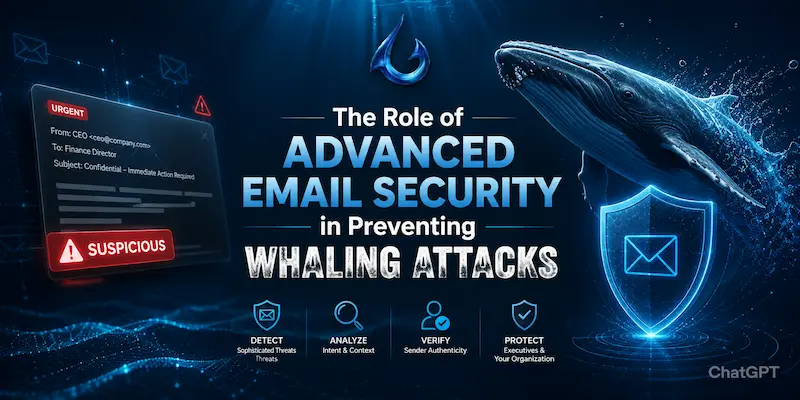
Advanced email security solutions detect and block whaling attempts in the following ways:
a) Behavioral AI and Baseline Anomaly Detection: Systems keep an eye on standard business communication practices to identify unexpected sender times, places, or devices.
b) Natural Language Processing (NLP) Content Analysis: Text is scanned by algorithms for financial terms, high-pressure language, and conversational patterns that are indicative of executive fraud.
c) Identity and Display Name Deception Filters: Emails when external senders change their display names to match internal executive identities are blocked by security systems.
d) Robust Email Authentication Protocols: In order to reject unverified domains, modern security configurations strictly follow SPF, DKIM, and DMARC restrictions.
e) Dynamic Link Sandboxing and Real-Time URL Inspection: To find hidden, harmful code, inbound URLs are opened in secure, isolated virtual environments.
Essential Cybersecurity Measures to Prevent Whaling Attacks
|
S.No. |
Factors |
What? |
|
1. |
Mandatory Multi-Factor Authentication (MFA) |
Even if an attacker steals executive credentials, they are prevented by enforcing cryptographic hardware keys or app-based MFA. |
|
2. |
Strict Process Controls for Financial Transactions |
Unauthorized, single-signature wire transfers are prevented by requiring verbal secondary sign-offs and multi-person permissions. |
|
3. |
Continuous Executive-Focused Security Simulation |
Active skepticism is developed through the use of realistic, highly customized social engineering simulations in leadership team training. |
|
4. |
Advanced Domain and Brand Protection |
Attackers are prevented from creating plausible replica websites by proactively registering lookalike domains and keeping an eye on external registrations. |
|
5. |
Internal Email Tagging and Banners |
Display-name impersonation of internal executives is prevented by clearly labeling all incoming external emails. |
Best Practices for Executives to Protect Sensitive Business Information
The following are the best practices for executives to protect sensitive business information:
1. Secure Personal and Professional Communications: Don't use unapproved messaging applications or personal emails; instead, limit business conversations to company-encrypted channels.
2. Practice Strict Digital Asset Minimization: Restrict the public disclosure of family information, travel plans, and personal habits on social media.
3. Implement Rigorous Device and Network Isolation: Never use unmanaged personal devices for work purposes, and steer clear of public Wi-Fi without a VPN.
4. Adopt Hardware-Based Security Authentication: To get rid of password-only vulnerabilities, secure all personal and business accounts using physical security keys.
5. Maintain Independent Out-of-Band Verification Habits: Any unexpected or urgent request for money or data should always be orally confirmed via a different, known phone number.
The Role of Employee Awareness Training in Preventing Executive Phishing
The following are the roles of employee awareness training in preventing executive phishing:
● Cultivating a Culture of "Healthy Skepticism": Gives employees the freedom to challenge leadership's sudden, high-pressure requests without worrying about facing professional reprisals.
● Mastering "Out-of-Band" Verification Protocols: Teaches staff members to use a backup, pre-established route, such as a phone call or text, to double-check urgent demands.
● Spotting Linguistic and Behavioral Red Flags: Teaches teams to recognize minor changes in an executive's speech, odd ways of greeting people, or undue eagerness.
● Reducing the "Time-to-Report" Window: Increases the pace at which staff members report questionable messages, allowing IT teams to identify risks before a breach happens.
● Securing the Executive's Gatekeepers: Equips executive support employees and administrative assistants with the specific capabilities required to avoid sophisticated social engineering pitfalls.
Building a Strong Defense Against Executive-Level Cyber Threats
|
S.No. |
Factors |
What? |
|
1. |
Enforce Strict Dual-Authorization Financial Controls |
Make it mandatory for two separate, executive-level electronic signatures to be obtained before any high-value money transfers are released. |
|
2. |
Implement Cryptographic Identity Verification |
To verify the authentic sender of confidential business messages, mandate the usage of end-to-end encrypted messaging keys. |
|
3. |
Deploy Advanced Anti-Impersonation Email Defense |
Instantaneously detect external emails that resemble the display names of inside executives by using artificial intelligence security filters. |
|
4. |
Conduct Tailored Executive and Assistant Simulations |
Conduct extremely realistic spear-phishing exercises that are tailored to the actual C-suite office process. |
|
5. |
Establish a Blameless Culture of Rapid Reporting |
By removing the risk of fines for inadvertent clicks, you may encourage staff members to report questionable messages right away. |
What to Do If Your Organization Becomes a Victim of a Whaling Attack?
You should do the following things if your organization becomes a victim of a whaling attack:
a) Initiate Financial Kill-Switches, and Bank Recalls: To stop transfers and start a formal wire recall, get in touch with your bank's fraud department right away.
b) Isolate Compromised Accounts and Revoke Sessions: Lock out compromised executive accounts, reset passwords, and forcefully end all ongoing user sessions.
c) Deploy Digital Forensics to Map Intrusion Scope: To monitor the attacker's footprint and determine whether other networks were compromised, start an internal investigation.
d) Activate Legal Counsel and Notify Cyber Insurance: To ensure regulatory compliance and secure coverage, immediately notify your legal team and insurance provider.
e) Preserve Evidence and File Law Enforcement Reports: After saving all email headers and logs, submit a formal cybercrime report to authorities such as the FBI's IC3.
Conclusion: Staying One Step Ahead of Whaling Attackers
Now that we have talked about what a Whaling Attack is, you might want to learn how to protect yourself against such attacks with ease. For that, you can go for PhishNext, a dedicated phishing attack simulation platform offered by Craw Security.
PhishNext can help users to confront various types of phishing attacks, and you will be able to learn how to fight against such attacks with ease. Thus, you will be able to prevent such attacks in the future. What are you waiting for? Contact, Now!
Frequently Asked Questions
About Whaling Attacks
1. What is a whaling attack?
A whaling assault is a highly focused type of spear-phishing that poses as senior leadership to deceive prominent executives into approving large financial transfers or disclosing confidential company information.
2. What is the difference between phishing and whaling?
Whaling is a hyper-targeted attack that targets only high-profile, high-value business executives, whereas phishing casts a broad, generic net to fool random, everyday users.
3. What is an example of whaling?
Whaling is the practice of an attacker posing as the CEO of a firm in order to deceive the CFO into sending millions of dollars to a fictitious bank account for a "secret, urgent acquisition."
4. What are the 4 types of attacks?
The following are the 4 types of attacks:
a) Active Attacks,
b) Passive Attacks,
c) Inside Attacks, and
d) Outside Attacks.
5. What are the 4 P's of phishing?
The following are the 4 Ps of phishing:
a) Pretend,
b) Problem,
c) Pressure, and
d) Pay.
6. What are the 7 signs of phishing?
The following are the 7 signs of phishing:
a) Urgent or Threatening Language,
b) Mismatched Sender Addresses,
c) Suspicious Links and Hyperlinks,
d) Generic Greetings and Vague Content,
e) Unusual Requests for Personal or Financial Info,
f) Spelling, Grammar, and Formatting Flaws, and
g) Unexpected or Vague Attachments.
7. What are the four types of phishing whaling?
The following are the 4 types of phishing whaling:
a) Executive Impersonation (CEO Fraud),
b) Vendor/Supplier Invoice Swindle (Vendor Email Compromise),
c) Legal and Regulatory Subpoena Threats, and
d) Smishing and Vishing Blends (Multi-Channel Whaling).
8. Where do 90% of all cyber incidents begin?
Phishing emails, which take advantage of human error to breach network perimeters, are the starting point of 90% of all cyber incidents.
9. Is whaling illegal in India?
Yes, both definitions of the term are banned in India: cyber whaling is a serious crime that is prosecuted under the Information Technology (IT) Act and the Bharatiya Nyaya Sanhita (BNS), while maritime whaling is expressly forbidden under the Wildlife (Protection) Act.
10. Which countries still allow whaling?
The following countries still allow whaling:
a) Japan,
b) Norway,
c) Iceland,
d) Denmark (Faroe Islands and Greenland), and
e) The United States & Russia.