Synthetic Identity Fraud Explained: The Fastest-Growing Financial Crime
Do you know what Synthetic Identity Fraud is, and how it can put you in risky situations? If not, then you are at the right place. Here, we will talk about how Synthetic Identity works to lure victims into cybercriminal’s trap.
Moreover, we will learn how you can evade such attacks with ease while getting trained with a dedicated phishing simulation platform. What are we waiting for? Let’s get straight to the topic!
What Is Synthetic Identity Fraud?
Synthetic identity fraud is a complex financial crime in which criminals establish completely new, "Frankenstein" identities by combining actual data, such as stolen Social Security numbers, with made-up information.

Over time, these identities are exploited to create false credit profiles, which enable crooks to get beyond security checks and eventually carry out "bust-out" operations against companies and lenders.
These illegal personas become extremely tough for current fraud detection technologies to recognize and mark as unauthorized because they combine real and fake data points. Let’s take a look at what Synthetic Identity Fraud is and how it can affect organizational operations!
Key Differences Between Synthetic Identity Fraud and Traditional Identity Theft
|
S.No. |
Topics |
Factors |
What? |
|
1. |
Synthetic Identity Fraud |
Target |
No single person; rather, thieves employ a "Frankenstein" technique to create a new identity by fusing real information (such as a child's unused SSN) with fictitious data. |
|
Methodology |
Before abruptly carrying out a high-value "bust-out" scam, fraudsters "nurture" these fake identities for months or years, developing credibility and credit ratings. |
||
|
Detection |
Incredibly challenging to identify since there is no "victim" keeping an eye on a credit record and the persona seems to financial institutions to be a real, changing client. |
||
|
2. |
Traditional Identity Theft |
Target |
A particular, living, and frequently creditworthy person whose current financial footprint is assumed. |
|
Methodology |
Unauthorized access to personal identifiers (SSNs, passwords, and accounts) allows the fraudster to pose as the victim and either open new accounts in their name or drain existing funds. |
||
|
Detection |
When the victim notices illegal charges, unusual account activity, or receives a bank alert reporting credit irregularities, they are typically promptly informed. |
How Synthetic Identity Fraud Works Step-by-Step?
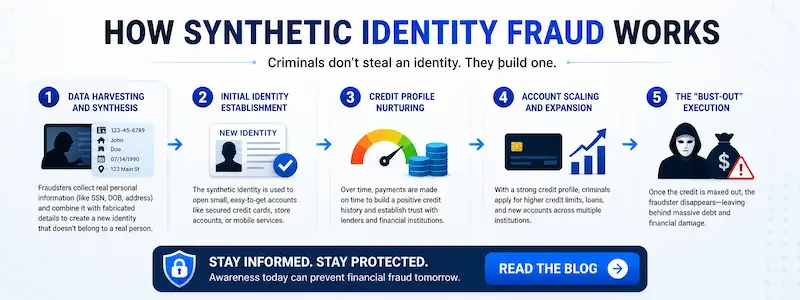
In the following ways, Synthetic Identity Fraud Works:
- Data Harvesting and Synthesis: Fraudsters create a new, untraceable identity by combining stolen, real-world data, such as SSNs, with fictitious personal information.
- Initial Identity Establishment: To establish an initial, authentic-looking footprint, the synthetic identity is registered with financial institutions and credit bureaus.
- Credit Profile Nurturing: In order to gain the trust of lenders, criminals progressively raise their credit score by making timely, modest repayments.
- Account Scaling and Expansion: Once established, the fraudster simultaneously requests larger credit limits at several retail and banking establishments.
- The "Bust-Out" Execution: The institution suffers irreversible damages when the offender maxes out all available credit lines across several accounts and then disappears.
Why Synthetic Identity Fraud Is the Fastest-Growing Financial Crime?
For the following reasons, synthetic identity fraud is the fastest-growing financial crime:
● Industrialization via Generative AI: Criminals can scale operations with little manual labor thanks to sophisticated AI systems that automate the production of realistic synthetic profiles and false documents.
● The "Victimless" Nature: There is no actual person to report suspicious behavior or contest false credit queries because the identity is created rather than taken from an active user.
● Exploitation of SSN Randomization: By using the Social Security Administration's randomized assignment mechanism, criminals can evade age-based validation checks and present fake identities as real adults.
● Digital-First Onboarding Gaps: Synthetic identities can slip past digital security levels undetected because quick, automated remote verification procedures frequently fail to cross-reference various data points.
● "Bust-Out" Credibility Tactics: Synthetic identities successfully "age" their credit files by imitating consistent, prosperous financial conduct over months or years, tricking computerized risk-assessment models prior to the actual fraud.
Common Techniques Used by Fraudsters
|
S.No. |
Factors |
What? |
|
1. |
Credit Piggybacking |
In order to quickly inherit a favorable credit history, fraudsters create a fictitious identity as an "authorized user" on a well-established, high-score credit account. |
|
2. |
SSN Harvesting (Children and Vulnerable Targets) |
Unused Social Security numbers belonging to children or the deceased are given priority by criminals since they are less likely to be checked for credit activity. |
|
3. |
Generative AI Persona Creation |
In order to validate the phony identity during digital onboarding, AI algorithms create convincing images, deepfake movies, and fake utility bills. |
|
4. |
Automated Application "Velocity" Attacks |
In order to obtain funds before systems can cross-reference the data, bot networks quickly submit thousands of credit applications to several lenders. |
|
5. |
Telemetry and Device Spoofing |
Fraudsters alter IP addresses, GPS locations, and device fingerprints to make a single location or computer appear to be numerous, authentic clients. |
Industries Most Targeted by Synthetic Identity Fraud
The following industries are the most targeted by synthetic identity fraud:
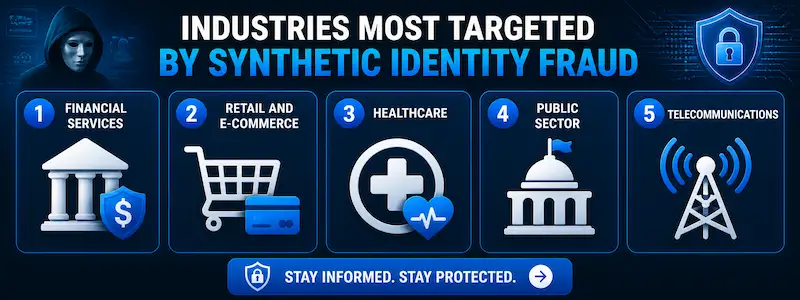
a) Financial Services: Since synthetic identities are especially designed to open fraudulent credit cards, personal loans, and vehicle loans in order to maximize "bust-out" earnings, banks and lenders are the main targets.
b) Retail and E-commerce: Businesses in this industry are taken advantage of by "buy now, pay later" (BNPL) schemes and fraudulent online purchases, in which high-value items are received using fictitious profiles without any intention of payment.
c) Healthcare: Fraudsters steal money from providers and government programs by using fictitious identities to set up shell corporations or pretend to be patients in order to submit costly, fraudulent medical insurance claims.
d) Public Sector: Criminals use fictitious identities to target government institutions and fraudulently claim housing subsidies, social security payments, and unemployment benefits, taking resources away from those in need.
e) Telecommunications: When fraudsters use fictitious identities to register contract accounts, telecom companies are often affected. This allows fraudsters to obtain costly, outdated cellphones or cellular service plans that are never paid for.
Warning Signs and Red Flags to Watch For
The following are some warning signs and red flags to watch for:
- Inconsistent Data Connections: Mismatched data, such as a physical location connected to a commercial mail drop or a name that does not match the SSN provided.
- "Thin" or Recently Issued Digital Footprint: The absence of a long-term online history, including missing work records, utility bill history, or social media presence.
- Suspicious Application Velocity: An abnormally quick increase in credit applications from the same IP address, device, or individual.
- Shared Attributes Across Identities: A phone number, email address, or physical mailing address are examples of data points that are shared by several accounts.
- Behavioral Anomalies During Onboarding: Unusual interactions, including high-speed data entry or efforts to avoid identity verification stages that a legitimate consumer would ordinarily complete.
How Businesses Can Detect and Prevent Synthetic Identity Fraud?
|
S.No. |
Factors |
How? |
|
1. |
Multi-Layered Identity Verification |
Need several independent data sources, such as real-time document verification and government database searches, to confirm an applicant's identification. |
|
2. |
Behavioral Biometrics and Telemetry |
To differentiate human behavior from automated bot activity, examine distinctive user interactions such as keystroke dynamics, mouse motions, and device metadata. |
|
3. |
Real-Time Link Analysis |
Discover hidden connections between seemingly unrelated apps that exchange phone numbers, addresses, or device fingerprints by using graph-based technologies. |
|
4. |
Continuous Risk Monitoring |
Instead of only monitoring accounts upon onboarding, keep an eye on them during their whole lifecycle to spot any unusual changes in spending or transaction trends. |
|
5. |
Predictive AI and Machine Learning |
Use sophisticated models that automatically identify high-risk applications by identifying subtle, obscure features linked to well-known strategies for synthetic identity fraud. |
Future Trends: AI, Automation, and the Evolution of Fraud Detection
Static rule-based fraud detection systems will give way to autonomous, self-learning AI that can instantly identify abnormal patterns throughout vast networks. The defense will depend more and more on "adversarial machine learning" as automation grows in order to foresee and thwart emerging AI-driven attack vectors before they can be used.
Frequently Asked Questions
About Synthetic Identity Fraud
- What Is Synthetic Identity Fraud?
A financial crime known as "synthetic identity fraud" occurs when thieves establish completely new, "Frankenstein" personas by combining genuine stolen data with fake information. These personas are then used to generate bogus credit profiles and ultimately carry out high-value "bust-out" operations.
- What is an example of a synthetic identity fraud?
A typical example is when a fraudster opens a "blank" credit file using a child's unused Social Security number along with a fictitious name and address. They then cultivate the credit file over a number of years by making small, consistent payments until they eventually max out several high-limit credit lines and disappear.
- Is identity theft the fastest-growing crime?
Although identity theft is a widespread and expanding issue in America, financial regulators and industry professionals explicitly point to synthetic identity fraud as the fastest-growing kind of financial crime because of its capacity to scale through AI-driven automation.
- What is the fastest-growing type of fraud?
Because synthetic identity fraud can take advantage of AI-driven automation and exploit weaknesses in digital-first onboarding systems, it is widely acknowledged by financial authorities and industry professionals as the fastest-growing sort of financial crime.
- What is a common characteristic of synthetic identity fraud?
The following are some common characteristics of synthetic identity fraud:
a) Use of "Frankenstein" Data,
b) Lack of a Verifiable Victim,
c) The "Nurturing" Phase,
d) High-Volume Automation, and
e) Exploitation of Digital Onboarding.
- What is a synthetic identity?
A synthetic identity is a made-up persona that is constructed by fusing fictitious data with actual, frequently stolen personal information, including a Social Security number, to create a new, nonexistent person.
- What is the key indicator of synthetic identity fraud?
The following are the key indicators of synthetic identity fraud:
a) SSN and Name Mismatch,
b) Non-Standard Address History,
c) Thin or "Artificial" Credit File,
d) Shared Identity Attributes, and
e) Rapid Velocity of Credit Applications.
- What is identity synthesis?
Identity synthesis is the harmful process of creating a false, nonexistent persona by fusing real personal information, like a stolen Social Security number, with fake data.
Conclusion
Now that we have talked about what Synthetic Identity Fraud is, you might want to get a dedicated solution for that. For that, you can go for Phish Next, a dedicated phishing simulation platform offered by Craw Security.
On this platform, the user can experience real-time phishing attacks that can be harmful to individuals and organizations. With time, they will be able to evade such phishing attacks with ease. What are you waiting for? Contact, Now!