Push Bombing Attack Prevention Checklist for IT Teams
Do you know what Push Bombing Attack is and how it can threaten your working environment’s work safety? If not, then you are at the right place. Here, we will talk about what Push Bombing is in detail and offer you dedicated solutions.
Moreover, we will introduce you to a reliable phishing simulation platform offered by a reputable VAPT service provider. What are we waiting for? Let’s get straight to the topic!
What Is a Push Bombing Attack?
When a malicious actor frequently triggers Multi-Factor Authentication (MFA) notifications on a target's mobile device, it's referred to as a Push Bombing attack or MFA Fatigue. In order to get unauthorized access to the victim's account, the attacker aims to overload the victim with constant alerts until they unintentionally or out of annoyance approve the request.
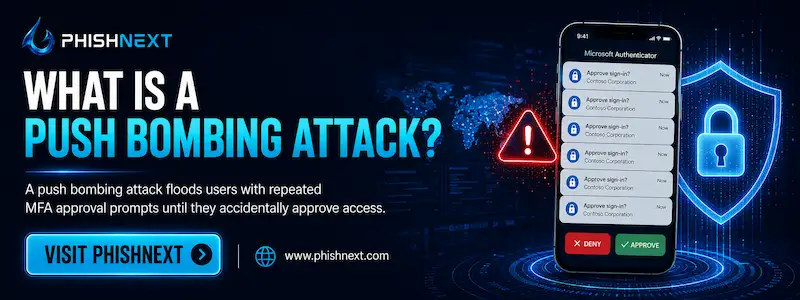
By taking advantage of human psychology rather than technological flaws, this social engineering technique successfully gets beyond strong security mechanisms. Let’s talk about what Push Bombing Attack is and how it can impact your working environment’s security!
Why MFA Fatigue Attacks Are Increasing?
|
S.No. |
Factors |
Why? |
|
1. |
Weaponization of Notification Overload |
Attackers take advantage of the "always-on" mentality of today, when people are trained to dismiss notifications fast in order to stay productive. |
|
2. |
Low Barrier to Entry for Attackers |
Once they obtain a stolen password, threat actors can use automated scripts to initiate thousands of requests every hour with no technical expertise. |
|
3. |
Exploitation of Human Psychology |
An unintentional or irritated "Approve" tap is more likely when targets are bombarded during "vulnerable" times, such as late at night or during hectic meetings. |
|
4. |
Rise of AI-Driven Persistence |
To time "bombing" sessions for maximum psychological impact, AI bots now consider a user's time zone and activity habits. |
|
5. |
Shift from Technical to Human Bypasses |
Hackers switch to the "human API," viewing users as the weakest link in the security chain, as software becomes more difficult to exploit. |
Key Risks for IT Teams and Organizations
The following are some key risks for IT teams and organizations:
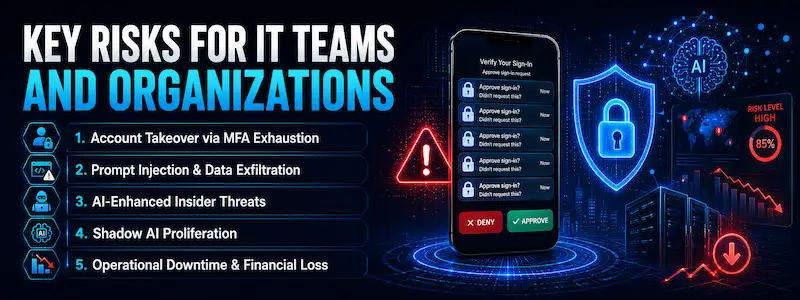
- Account Takeover via MFA Exhaustion: Uses push bombing to circumvent security measures and obtain complete administrative access by taking advantage of human annoyance.
- Prompt Injection & Data Exfiltration: Using harmful inputs to manipulate LLMs to reveal client information, proprietary source code, or internal system secrets.
- AI-Enhanced Insider Threats: Workers in high-speed business networks are employing AI tools to automate data theft or mask illicit activities.
- Shadow AI Proliferation: Staff members' careless usage of third-party AI technologies has resulted in significant company data leakage into public training sets.
- Operational Downtime & Financial Loss: AI-driven breaches or compromised credentials can lead to severe regulatory fines and critical system breakdowns.
Early Warning Signs of a Push Bombing Attack
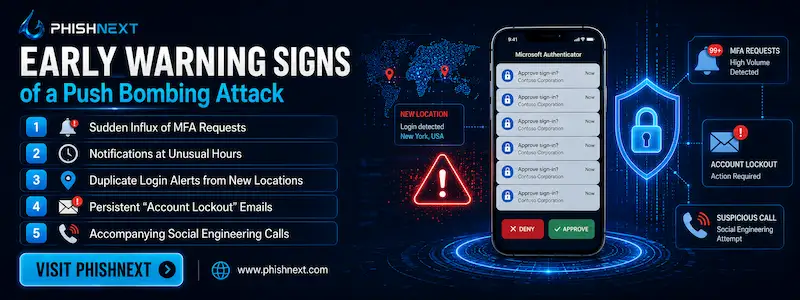 The following are some early warning signs of a push bombing attack:
● Sudden Influx of MFA Requests: Getting several unwanted push notifications in a few minutes while not actively attempting to log in.
● Notifications at Unusual Hours: Receiving authentication notifications while your devices are idle in the middle of the night or outside of regular business hours.
● Duplicate Login Alerts from New Locations: Seeing requests coming from unknown places, nations, or IP addresses that don't correspond to where you are right now.
● Persistent "Account Lockout" Emails: Getting multiple automated alerts informing you that your account has been locked as a result of too many unsuccessful login attempts.
● Accompanying Social Engineering Calls: Receiving a call or text from someone posing as "IT Support" requesting that you authorize a notice to "fix a system error."
Essential Push Bombing Attack Prevention Checklist
|
S.No. |
Checklist |
What? |
|
1. |
Enable Number Matching |
In order to verify their physical presence, users should be required to enter a code that appears on the login screen into their MFA app. |
|
2. |
Limit Authentication Retries |
Establish a limit on how many MFA prompts can be sent in a brief period of time before the account is momentarily locked. |
|
3. |
Implement Adaptive Authentication |
To automatically stop suspicious login attempts, use risk-based signals (such as odd IP addresses or locales). |
|
4. |
User Awareness Training |
Teach staff members to "Deny" and report any push messages that they did not originate. |
Advanced Security Measures to Strengthen MFA
The following are some advanced security measures to strengthen MFA:
a) FIDO2 / Hardware Security Keys: Switch high-risk users to physical keys that are resistant to phishing and push bombing, such as YubiKeys.
b) Certificate-Based Authentication: To guarantee that only controlled, reliable hardware can try to log in, use device-specific certificates.
Incident Response Plan for Push Bombing Attacks
Following is the incident response plan for push bombing attacks:
- Decline and Report Immediately: If your MFA provider has a "Report Fraud" button, use it to notify security staff and tap "Deny" on any unwanted requests.
- Trigger an Immediate Password Reset: Assume that your primary credentials have been compromised. To prevent the attacker from generating more prompts, change your password using a secure device.
- Enable "MFA Lock" or Contact IT: Inform the security operations center (SOC) of your company so that your account can be temporarily suspended or your identity records can be monitored more closely.
- Revoke Active Sessions: Choose "Sign out of all devices" after logging into your account security settings to remove any prospective intruders who could have already obtained access.
- Switch to Number Matching: If at all possible, change your MFA settings from "Simple Push" to "Number Matching," which eliminates blind approvals by requiring you to enter a code into your app from the login screen.
Conclusion
Now that we have talked about what a Push Bombing Attack is, you might want to get a dedicated solution for that. For that, you can go for Phish Next, a dedicated phishing simulation platform offered by Craw Security.
One of the reasons for becoming a victim of such attacks is that you can’t identify which message is a spam/ scam. Thus, this platform trains the users to confront various phishing attacks and get smarter to evade them in time. What are you waiting for? Contact, Now!
Frequently Asked Questions
About Push Bombing Attack
- What Is a Push Bombing?
In a cyberattack known as "push bombing," a hacker bombards a user's smartphone with several MFA push notifications in the hopes that the victim will finally hit "Approve" either by accident or out of sheer annoyance.
- What is a pushing attack?
A pushing assault, sometimes known as push bombing, is a social engineering technique in which attackers bombard a user with numerous MFA alerts in an attempt to fool them into unintentionally or irrationally providing unauthorized access.
- What are the 4 phases of an attack?
The following are the 4 phases of an attack:
a) Reconnaissance,
b) Weaponization and Delivery,
c) Exploitation and Installation, and
d) Actions on Objectives.
- What are the 4 types of threats?
The following are the 4 types of threats:
a) Cybercrime,
b) State-Sponsored Threats,
c) Insider Threats, and
d) Hacktivism.
- What do hackers hate the most?
Because Zero Trust design replaces "trusted" perimeters with constant, unrelenting verification, hackers detest it more than anything else. This ensures that even with a stolen password, they have nowhere to go.
- What is the difference between push and TOTP?
The main distinction is that TOTP (Time-based One-Time Password) is a client-generated, six-digit code that changes every thirty seconds and doesn't require an internet connection, while Push is a server-initiated "Approve/Deny" notice sent to a device.
- How does pushing attack work?
The Pushing attack works in the following ways:
a) Credential Harvesting,
b) Automated Request Triggering,
c) Psychological Pressure,
d) The "Accidental" Approval, and
e) Session Establishment.
- What are the types of attacks?
The following are some types of attacks:
a) Social Engineering Attacks,
b) Malware Attacks,
c) Web-Based and Injection Attacks,
d) Denial-of-Service (DoS/DDoS) Attacks, and
e) Man-in-the-Middle (MitM) Attacks.
- What does pushing mean in slang?
In colloquial language, "pushing" (more especially, "pushing P") means performing honorably, maintaining optimism, and "keeping it player" by making prosperous, elegant life decisions.
- What are the 13 damage types?
The following are the 13 damage types:
a) Acid,
b) Bludgeoning,
c) Cold,
d) Fire,
e) Force,
f) Lightning,
g) Necrotic,
h) Piercing,
i) Poison,
j) Psychic,
k) Radiant,
l) Slashing, and
m) Thunder.
- What to do if someone pushes you?
You can do the following tasks if someone pushes you:
a) Establish Immediate Safety,
b) Do Not Reciprocate,
c) Assess and Secure,
d) Document the Incident, and
Report to Proper Channels.