OAuth Consent Phishing: Why It’s Rising & How Awareness Programs Stop It?
Do you know what OAuth Consent Phishing is and how it can affect your working environment’s security measures? If not, then you are at the right place. Here, we will talk about OAuth Consent Phishing in detail, with solutions to deal with it.
Moreover, we will introduce you to a reliable phishing simulation platform offered by a reputable VAPT service provider. What are we waiting for? Let’s get straight to the topic!
What is OAuth phishing?
OAuth phishing is a sophisticated assault in which hackers utilize genuine "Login with Google" or "Sign in with Microsoft" prompts to fool users into allowing a malicious application access to their accounts.
The attacker obtains a permanent OAuth token that circumvents multi-factor authentication (MFA) and grants continuous access to files, emails, and personal information rather than stealing passwords.
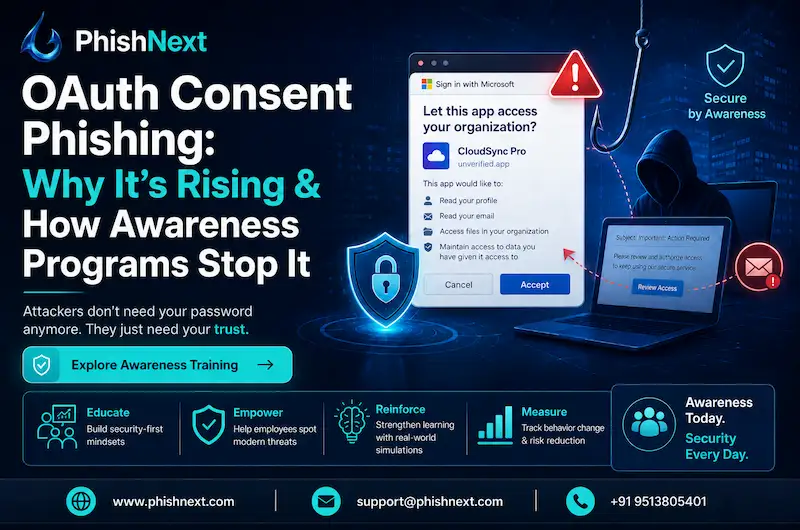
Because it takes advantage of consumers' faith in official third-party authorization protocols and doesn't require the victim to submit any credentials, this strategy is very effective. Let’s take a look at what OAuth Consent Phishing is!
How Does OAuth Consent Phishing Work?
|
S.No. |
Factors |
How? |
|
1. |
Malicious App Creation |
In order to appear trustworthy, attackers register a phony application with a reputable source like Google or Microsoft. |
|
2. |
The Lure |
In order to "verify" or "authorize" a service, victims are sent a phishing email or link that takes them to an actual OAuth login site. |
|
3. |
Permission Request |
A typical consent screen is shown to the user, requesting broad permissions like reading emails and viewing files. |
|
4. |
Token Issuance |
After the user selects "Accept," the provider creates an OAuth access token and transmits it straight to the server of the attacker. |
|
5. |
Persistent Access |
The attacker circumvents multi-factor authentication and passwords by using the secret token to gain perpetual access to the victim's data. |
Device Code Phishing: a Variant of OAuth Abuse
Device code phishing is a contemporary attack in which hackers deceive a user into entering a code on a genuine verification page in order to take advantage of the "Device Authorization Grant" procedure designed for smart TVs or IoT devices.
The attacker's secondary device is automatically given a full access token to the victim's account after the victim authorizes the code on their laptop or mobile device, circumventing MFA without the requirement for a phony login page.
Common OAuth and Device Code Phishing Scenarios
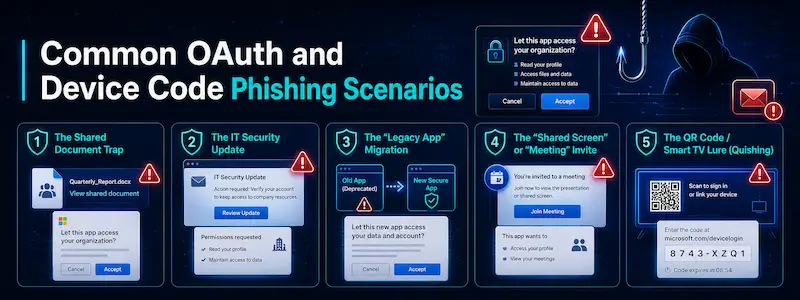
The following are some common OAuth and Device Code Phishing Scenarios:
- The "Shared Document" Trap: Attackers transmit a phony OneDrive or Google Drive link that demands "permissions" from the app in order to access a private file.
- The IT Security Update: In order to comply with corporate rules, a phony IT email asks users to approve a "Security Scanner" software.
- The "Legacy App" Migration: In order to sync their old inbox with a new system, users are asked to provide access to a "Legacy Mail Connector".
- The "Shared Screen" or "Meeting" Invite: Before joining the call, a phony Zoom or Teams invite requests authorization to "sync calendar events" with your account.
- The QR Code / Smart TV Lure (Quishing): Users are tricked into inputting a device code to "activate" a streaming service or Wi-Fi via a physical or digital QR code.
Why is OAuth Phishing Dangerous?
|
S.No. |
Factors |
Why? |
|
1. |
Bypasses Multi-Factor Authentication (MFA) |
The secondary security layer is totally evaded because the user gives a genuine token via a lawful login process. |
|
2. |
No Password Required |
Traditional password resets and complexity constraints are unsuccessful because attackers concentrate on stealing authorization tokens rather than credentials. |
|
3. |
Persistent Unattended Access |
Hackers can stay in the system without having to re-authenticate thanks to OAuth tokens, which can have extended validity periods or be automatically renewed. |
|
4. |
Legitimate Infrastructure Hijacking |
Because the assault takes place on the official platform's domain (such as microsoft.com), it is very impossible for users or simple URL filters to identify a danger. |
|
5. |
Silent Data Exfiltration |
Once approved, the malicious program can surreptitiously scan contacts, emails, and cloud data in the background without the user's knowledge. |
Defending Against OAuth Phishing
In the following ways, you can defend yourself against OAuth Phishing:
● Implement Application Consent Policies: Set up your environment such that users cannot grant permissions to third-party apps without the consent of the IT administrator.
● Enforce "Verified Publisher" Status: Limit consumers' ability to approve apps that don't have a "Verified" logo from reputable companies like Google or Microsoft.
● Regularly Audit App Permissions: Review the list of third-party programs that have access to your environment on a regular basis, and remove permissions for any tools that aren't being used or seem questionable.
● Use Conditional Access Policies: Create rules that prevent authorization requests from high-risk IP addresses, unmanaged devices, and untrusted places.
● Specific User Education: Employees should be trained to understand that authentic login screens should never request extensive rights, such as "Read all mail" for basic activities.
Security Awareness & Training: The Human Firewall
By teaching staff members to identify the subtle psychological triggers and technical red flags of contemporary OAuth and device code attacks, Security Awareness & Training turns them into a "Human Firewall."
This proactive layer of defense makes sure that users have the critical thinking abilities to stop, confirm the source, and report suspicious permission requests before allowing access to sensitive data, even in the event that technical filters fail.
Conclusion
Now that we have talked about what OAuth Consent Phishing is, you might want to protect yourself against such scheming attempts. For that, you can go for Phish Next, a dedicated phishing simulation platform provided by Craw Security.
Moreover, by practicing on this platform, users will be able to confront various phishing simulations, and they will be able to evade such attempts in the future with ease. What are you waiting for? Contact, Now!