MFA Fatigue Attacks Are Rising: Are You the Next Target?
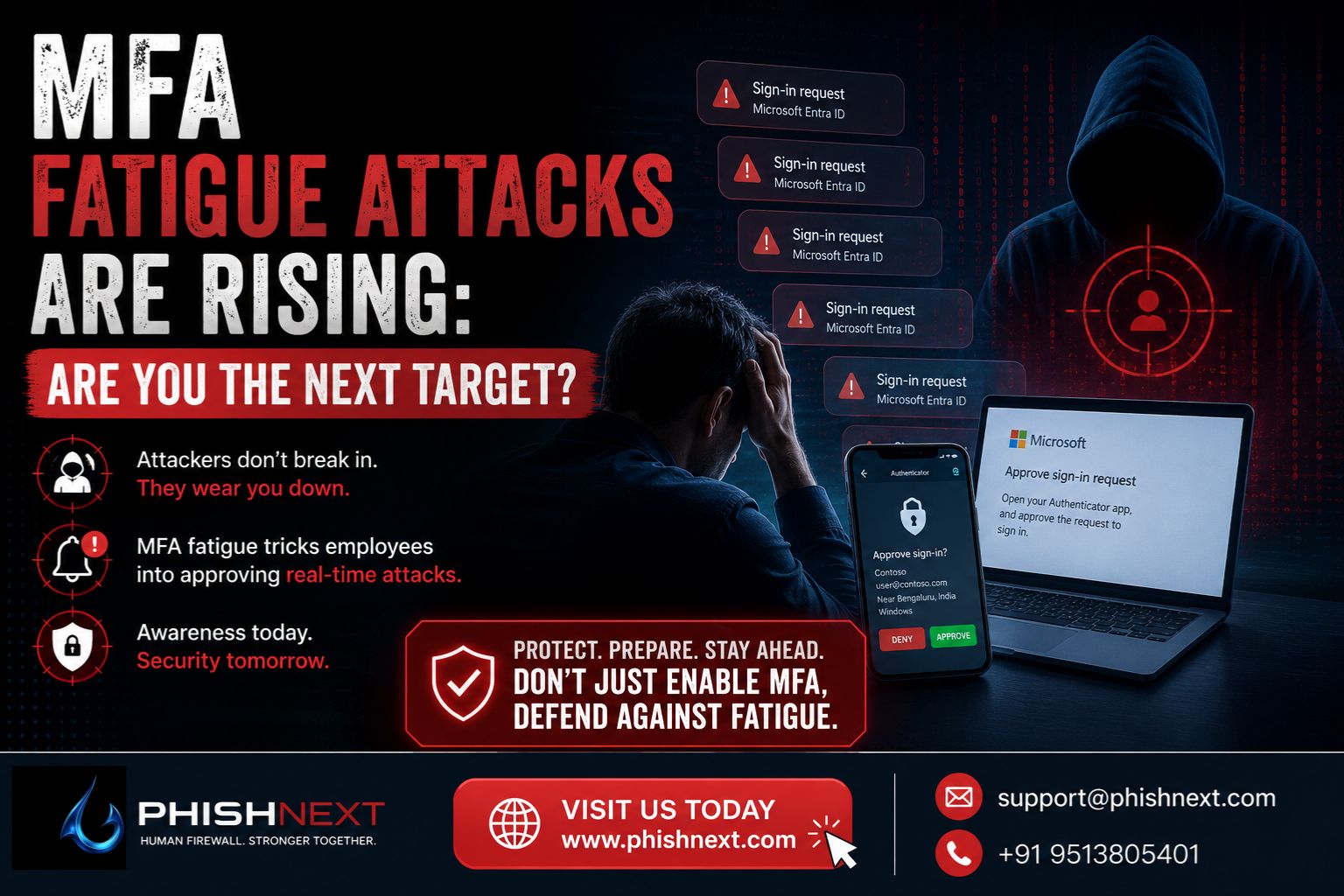 Do you know what MFA Fatigue Attacks are, and how you can protect yourself against such vicious attacks? If not, then you are at the right place. Here, we will talk about the MFA Fatigue Attacks in detail and will find the best ways to evade them.
Moreover, we will introduce you to a reliable phishing simulation platform offered by a reputable VAPT service provider. What are we waiting for? Let’s get straight to the topic!
What Are MFA Fatigue Attacks?
MFA fatigue attacks, sometimes referred to as "push bombing," happen when a cybercriminal steals a victim's primary password and then continually sends multi-factor authentication requests to their device.
In the hopes that the victim may finally hit "Approve" out of annoyance, perplexity, or to put an end to the incessant buzzing, the attacker intends to bombard the user with a deluge of alerts. The attacker successfully circumvents security procedures by psychological persuasion rather than a technical exploit, once the user hits agree, giving them complete access to the account.
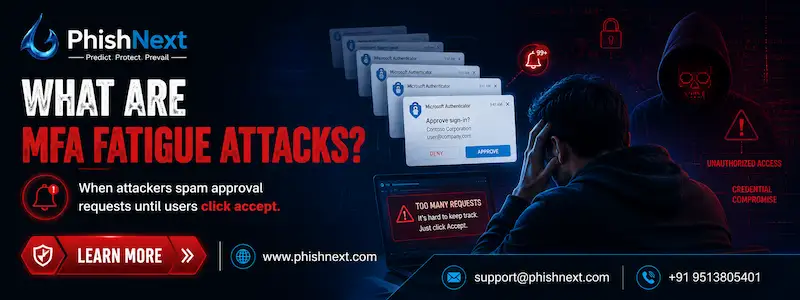
Let’s take a look at what MFA Fatigue Attacks are, their impacts, and the ways you can prevent such events!
Why MFA Fatigue Attacks Are Rising?
|
S.No. |
Factors |
Why? |
|
1. |
Exploitation of Notification Overload |
By taking advantage of "alert fatigue," attackers wager that a preoccupied user will automatically press "Approve" in order to clear a cluttered lock screen. |
|
2. |
Low Technical Barrier to Entry |
Once they have a set of compromised credentials, even inexperienced attackers may initiate hundreds of push requests using automated scripts and phishing kits. |
|
3. |
Prevalence of "Tap-to-Approve" MFA |
Convenient, one-tap mobile notifications have become the norm in the sector, which has inadvertently made it simpler to unknowingly provide illegal access. |
|
4. |
AI-Timed Attack Windows |
In order to launch "push bombs" in the early morning or late at night, when users are most likely to be sleepy or impatient, modern attackers use artificial intelligence (AI) to study victim activity patterns. |
|
5. |
Lack of Context in Prompts |
The user is unable to discern between their own login and an attacker's attempt since standard MFA requests frequently fail to display the login location or device type. |
The Psychology of "Human-in-the-Loop" Vulnerabilities
Because people are frequently the weakest link in a digital security chain, "human-in-the-loop" vulnerabilities take advantage of this by using cognitive biases like trust, urgency, or exhaustion to get around technical defenses.
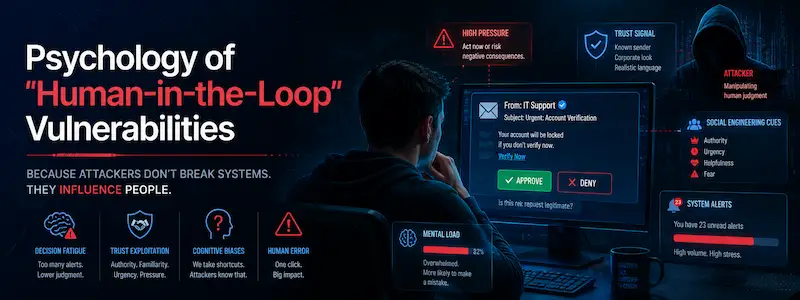
Attackers can effectively turn a security asset into a point of entry by tricking users into making poor decisions, like accepting a fraudulent push message, by manipulating psychological triggers.
How Cybercriminals Exploit Push Notification Fatigue?
In the following ways, cybercriminals exploit push notification fatigue:
- High-Frequency Bombardment: Causing visitors to click "Approve" to end the cacophony of dozens of consecutive requests.
- Strategic Timing: Launching attacks in the early morning or late at night, when users are more likely to make mistakes due to sleepiness.
- Social Engineering Follow-up: Pretending to be IT support to "help" the user stop the barrage of notifications by sending a phony text or phone call.
- Exploiting Cognitive Friction: Relying on people's inclination to take the easiest route when confronted with persistent, bothersome disruptions.
- Session Hijacking: They can avoid MFA for subsequent logins by using the authorized push to quickly collect a session cookie.
Common Signs You May Be Under an MFA Fatigue Attack
|
S.No. |
Signs |
What? |
|
1. |
Unsolicited Push Notifications |
Getting requests for login approval on your phone even though you're not actively attempting to log in. |
|
2. |
Rapid-Fire Bombardment |
In a matter of seconds or minutes, a rapid, high-frequency wave of notifications appears one after the other. |
|
3. |
Persistent Requests Over Time |
An attacker is waiting for you to get sidetracked if you receive notifications that pause for an hour before starting up again. |
|
4. |
Discrepancies in Location or Device |
MFA prompts that indicate an attempt to log in from a foreign nation or an unexpected device type (for example, Linux when using a Mac). |
|
5. |
Accompanying "Support" Messages |
Getting an email or text message from "Technical Support" requesting your permission to "fix a sync error" or "update security." |
Adversary-in-the-Middle (AiTM) Techniques
The following are some AiTM Techniques:
● Reverse Proxy Relay: In order to show the victim the actual Microsoft or Google page while recording every keystroke, attackers host a server that transparently transmits actual login activity.
● Session Token Theft: The attacker can completely avoid further password and MFA prompts by intercepting the authenticated session cookie once the victim has finished the MFA.
● MFA Bypass: The attacker deceives the service into thinking the login is authentic by sending the user the actual MFA challenge and recording the outcome.
● QR Code (Quishing) Lures: Phishers force victims to open the proxy site on less secure mobile browsers by using malicious QR codes to get around email link scanners.
● Cloaking and CAPTCHAs: Kits employ CAPTCHAs to compel human interaction and "cloaking" to conceal the phishing content from security bots, ensuring the link remains open for a longer period of time.
Real-World Examples of MFA Fatigue Attacks
The following are some real-world examples of MFA Fatigue Attacks:
a) Uber (2022): After almost an hour of bombarding a contractor with push notifications, a hacker from the Lapsus$ group contacted them via WhatsApp, posing as IT assistance. When the weary employee eventually pushed "Approve," the attacker gained access to Slack and Uber's internal servers.
b) MGM Resorts (2023): To launch a major ransomware attack that shut down hotel operations, casino machines, and booking systems and caused losses of over $100 million, attackers combined MFA fatigue with social engineering aimed at the company's support desk.
c) Microsoft (2022): After users became weary of frequent "push bombs," the Lapsus$ gang leveraged MFA fatigue to breach high-privilege accounts, enabling them to steal and leak source code for important projects like Bing and Cortana.
Who Is Most at Risk of MFA Fatigue Attacks?
|
S.No. |
Individuals |
Why? |
|
1. |
Privileged IT Administrators |
Targeted due to their extensive access to databases, cloud infrastructure control panels, and server backends. |
|
2. |
Employees in High-Stress Sectors |
Because they are more likely to reflexively clear notifications in high-pressure settings, personnel in the healthcare or finance industries are targeted. |
|
3. |
Remote and Hybrid Workers |
Unusual login prompts may appear to be common sync issues because these individuals frequently work across various devices and time zones. |
|
4. |
Executives and Senior Leadership |
High-value targets for "whaling" attacks because they have access to financial authorization and confidential corporate strategy. |
|
5. |
Organizations Using "Legacy" Push MFA |
Businesses that use straightforward "Approve/Deny" prompts without location context or number matching are the most vulnerable. |
Why Traditional MFA Is No Longer Enough?
For the following reasons, Traditional MFA is no longer enough:
- Susceptibility to Proxy Attacks: One-time passwords (OTP) are rendered obsolete by Adversary-in-the-Middle (AiTM) kits, which can readily intercept and relay codes or sessions in real-time.
- Weaponization of Fatigue: Simple "Approve/Deny" push notifications depend on human willpower, which attackers methodically undermine by inundating users with notifications.
- Credential Stuffing Speed: Millions of compromised credentials can be tested by automated botnets, which can initiate MFA requests more quickly than security professionals can identify the anomaly.
- Lack of Contextual Intelligence: The majority of conventional prompts don't give the user important information like the requester's IP address, device kind, or location.
- SS7 and SIM Swapping: SMS-based MFA is still extremely susceptible to fraudulent SIM transfers that completely avoid the user's phone and telecom-level interceptions.
How to Prevent MFA Fatigue Attacks?
In the following ways, you can prevent MFA Fatigue Attacks:
● Implement Number Matching: Makes it impossible for users to unintentionally approve a request by requiring them to enter a specific code displayed on the login screen into their MFA app.
● Enforce Context-Aware Prompts: Helps consumers identify fraudulent efforts by explicitly displaying the requester's IP address, location, and browser type in the message.
● Set Rate Limiting on MFA Requests: Automatically freezes an account or sends out a security alert if a certain number of consecutive push requests are made in a short period of time.
● Enable Risk-Based Authentication: Uses artificial intelligence (AI) to automatically deny or escalate MFA challenges if the login attempt comes from an unidentified device or a questionable location.
● Mandate Phishing-Resistant Hardware: Switches high-value users to physical security keys (such as FIDO2/YubiKeys) that need to be touched in person and cannot be activated remotely by an attacker.
Final Thoughts: Are You the Next Target?
Anyone utilizing classic push-based MFA is still vulnerable to fatigue-driven exploitation in a time when attackers use human psychology and perseverance as weapons. A single moment of distraction defines your susceptibility more than technical expertise; switching to phishing-resistant authentication is a must rather than an option.
Conclusion
Now that we have talked about what MFA Fatigue Attacks are, you might want to get a dedicated solution to evade such situations. For that, you can go for “Phish Next,” a dedicated phishing simulation platform offered by Craw Security.
This platform offers the opportunity to experience real-life phishing attacks, and with time, the users will be able to evade such attacks with ease. What are you waiting for? Contact, Now!
Frequently Asked Questions
About MFA Fatigue Attacks
- What are MFA fatigue attacks known as?
The most popular terms for MFA fatigue attacks are "Push Bombing" and "MFA Spamming."
- Is MFA fatigue a tactic?
Yes, MFA fatigue is a smart social engineering technique that allows attackers to get around security by overpowering a user's mental barriers.
- Do 90% of cyberattacks start with phishing?
Although recent research from 2026 indicates that up to 80–95% of breaches are caused by phishing, industry reports such as IBM's place it closer to 16% as the key first vector, emphasizing that although phishing is a major component of most attacks, it is one of several crucial entry points.
- What is a fatigue attack?
A fatigue attack is a social engineering tactic in which an attacker overwhelms a user with security alerts or prompts in order to take advantage of their annoyance and trick them into allowing unauthorized access.
- What are the 4 types of MFA?
The following are the 4 types of MFA:
a) Knowledge Factors (Something You Know),
b) Possession Factors (Something You Have),
c) Inherent Factors (Something You Are), and
d) Location/ Context Factors (Somewhere You Are).
- What is an MFA solution?
An MFA solution is a security technique that, before allowing access to an account, requires users to supply two or more unique verification elements, like a fingerprint and a password, to verify their identity.
- What is the MFA in security?
Before gaining access to a system, users must authenticate themselves using at least two distinct kinds of credentials, usually something they know, possess, or are, according to MFA (Multi-Factor Authentication), a layered security framework.
- Which is better, MFA or SSO?
While SSO is better for user ease and centralized management, and MFA is "better" for sheer security, they work best when together.
- Which is better, SSO or MFA?
SSO and MFA are allies rather than rivals; SSO streamlines the login process by utilizing a single set of credentials, while MFA offers the crucial security layer that keeps those credentials safe.