How Data Protection Training Helps Prevent Data Breaches?
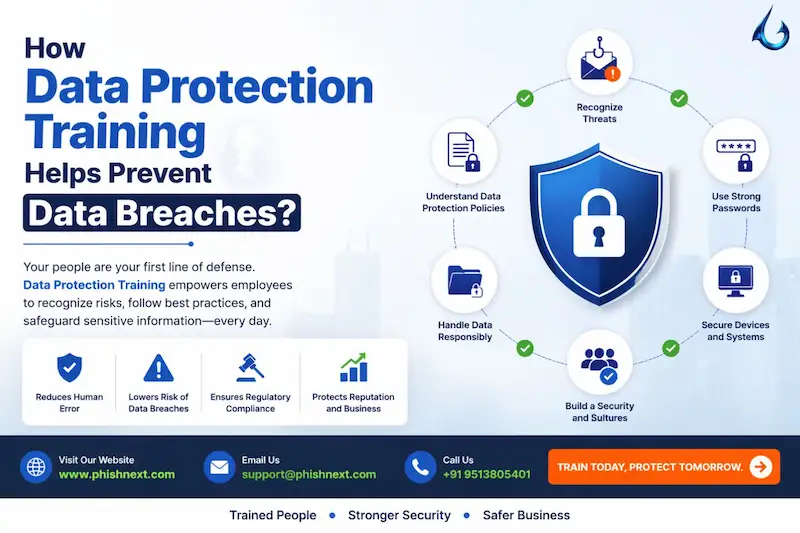
Do you know what Data Protection Training is and how it helps practitioners to grow their knowledge & skills to fight against online threats? If not, then you are at the right place. Here, we will talk about Data Protection Training in detail.
Moreover, we will introduce you to a reliable phishing simulation platform offered by a reputable VAPT service provider. What are we waiting for? Let’s get started!
Why Data Breaches Are Increasing Worldwide?
|
S.No. |
Factors |
Why? |
|
1. |
AI-Enhanced Social Engineering |
Attackers can automate incredibly convincing, error-free phishing and deepfake attacks on a large scale thanks to generative AI. |
|
2. |
The "Human Element" Gap |
Even with improved technologies, human factors like social engineering, stolen passwords, or basic errors still account for 68% of breaches. |
|
3. |
Sprawling Supply Chain Interconnectivity |
A single weak connection can expose thousands of linked organizations in the massive networks of third-party providers that modern enterprises rely on. |
|
4. |
Cloud Misconfigurations & Rapid Digitization |
The haste to move to the cloud frequently results in "shadow IT" and inadequately secured databases that expose private information. |
|
5. |
Ransomware-as-a-Service (RaaS) |
The barrier to entry for high-stakes digital extortion has significantly decreased as a result of specialized hackers renting out sophisticated malware toolkits to inexperienced attackers. |
The Role of Human Error in Data Breaches
The following are the roles of human error in data breaches:
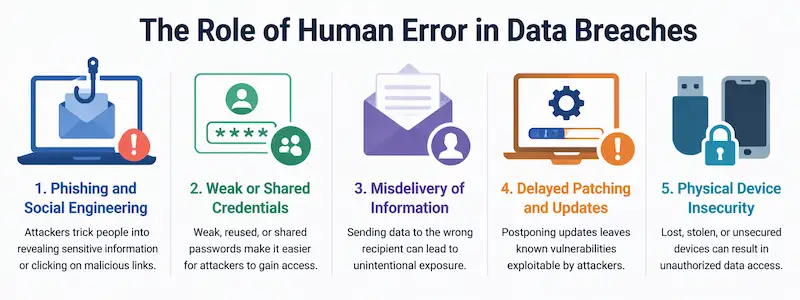
- Phishing and Social Engineering: Workers frequently become victims of misleading emails or messages, unintentionally divulging login information or clicking on links that contain malware.
- Weak or Shared Credentials: Attackers can obtain access using straightforward "credential stuffing" attacks by using passwords that are simple to figure out or by using the same password on several platforms.
- Misdelivery of Information: Thousands of records can be instantaneously exposed by a simple error, like transferring a private database to a public cloud bucket or CCing the incorrect recipient on a sensitive email.
- Delayed Patching and Updates: Systems are vulnerable to exploits that have already been patched by developers when people disregard software update notifications or neglect to patch known vulnerabilities.
- Physical Device Insecurity: Data theft can occur easily when laptops are left open in public areas, unencrypted USB drives are lost, or physical papers are disposed of without being shredded.
Social Engineering and Phishing Tactics
Through lying and manipulation, social engineering takes advantage of human psychology to obtain illegal access to systems or sensitive data. Phishing, the most prevalent type, efficiently gets over even the most sophisticated technical firewalls by tricking staff members into disclosing credentials or installing malware through phony emails or texts.
What Is Data Protection Training?
Data protection training is an organized educational program created to educate staff members about the technical safeguards, corporate rules, and regulatory requirements required to handle sensitive information safely.
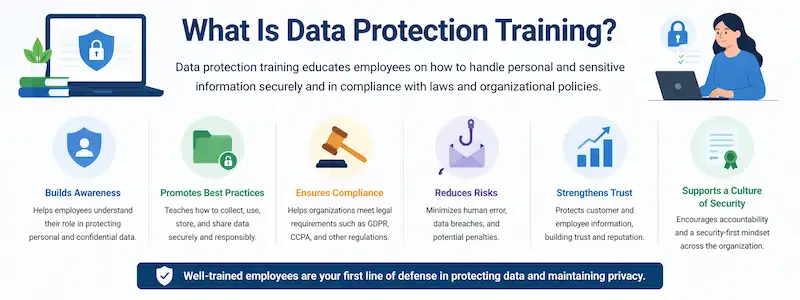
By teaching employees how to recognize possible dangers, manage data throughout its lifecycle, and react correctly to security breaches, it goes beyond basic knowledge. This training guarantees that every employee of an organization is aware of their unique role in upholding data privacy and regulatory compliance by cultivating a "security-first" culture.
How Data Protection Training Reduces Security Risks?
In the following ways, data protection training reduces security risks:
● Heightened Threat Recognition: Before clicking on harmful sites, staff members are trained to recognize subtle signs of social engineering and phishing.
● Reduced Negligent Mishandling: Employees learn safe file-sharing procedures to avoid unintentional data breaches via email or public cloud storage.
● Strengthened Password Hygiene: To counteract credential-based assaults, training mandates the use of multi-factor authentication and complicated, one-of-a-kind passwords.
● Minimized "Shadow IT" Usage: Knowledgeable employees stick to secure software that has been approved by the organization and are aware of the dangers of utilizing unapproved third-party apps.
● Faster Incident Response: An attacker's "dwell time" is greatly decreased when staff are ready to report unusual activity right away.
Key Components of Effective Data Protection Training
The following are some of the components of effective data protection training:
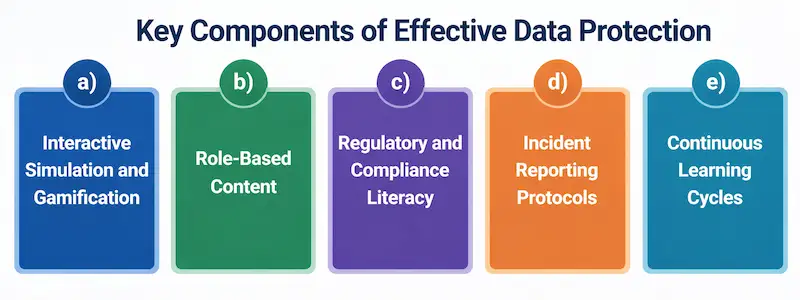
a) Interactive Simulation and Gamification: Security ideas are made memorable, and real-world reactions are tested by including employees in competitive scenarios and fake phishing tests.
b) Role-Based Content: Customizing modules for departments like IT, HR, or finance guarantees that workers are aware of the particular data dangers connected to their daily responsibilities.
c) Regulatory and Compliance Literacy: Staff members are better able to comprehend the legal "why" behind security procedures when legislation like the DPDP Act and GDPR is explained in an understandable and straightforward manner.
d) Incident Reporting Protocols: Potential breaches are prevented before they worsen by establishing a transparent, "no-blame" procedure for reporting errors or suspicious conduct.
e) Continuous Learning Cycles: In the face of changing cyberthreats, switching from yearly "one-off" sessions to regular, bite-sized updates keeps data protection at the forefront.
Best Practices for Implementing Training Programs
|
S.No. |
Practices |
What? |
|
1. |
Executive Buy-in and Leadership Modeling |
Leaders who actively participate in and support training to establish an organizational standard are the first to establish a security culture. |
|
2. |
Frequent, Bite-Sized "Micro-learning" |
Compared to lengthy, yearly seminars, delivering 5-minute courses on a weekly basis guarantees greater retention and puts security at the forefront. |
|
3. |
Data-Driven Customization |
Utilize the findings of internal audits and phishing simulations to pinpoint specific knowledge gaps and design training to fill them. |
|
4. |
Multi-Channel Delivery |
To reach employees where they are most likely to interact, use a combination of videos, emails, Slack notifications, and physical posters. |
|
5. |
Positive Reinforcement and Recognition |
To foster a culture of pride rather than fear, give rewards to staff members who report questionable emails or finish courses ahead of schedule. |
Role-based Training Modules
Role-based training modules provide customized security training that is adapted to the particular software tools and data types utilized by various departments, including engineering, finance, and human resources.
This focused strategy guarantees that staff members learn the exact procedures needed to safeguard the special assets they deal with on a daily basis, rather than being overloaded with unrelated knowledge.
Creating an Incident Reporting Culture
Transparency is valued above punishment in an incident reporting culture, which encourages staff members to report possible errors or suspicious conduct right away without worrying about facing consequences.
Organizations may identify and mitigate threats early on by eliminating the stigma associated with mistakes, making every employee an active sensor for the security team.
Compliance and Legal Advantages of Data Protection Training
|
S.No. |
Factors |
How? |
|
1. |
Demonstrating "Duty of Care" |
Keeping thorough training logs gives authorities concrete evidence that the company has taken appropriate action to stop data misuse. |
|
2. |
Mitigation of Regulatory Fines |
Evidence of a strong training program can be a major "mitigating factor" used to lessen the severity of financial penalties under the DPDP Act and GDPR. |
|
3. |
Meeting Contractual Obligations |
Regular employee training is now required by the majority of enterprise-level service agreements and cyber insurance policies as a requirement for partnership or coverage. |
|
4. |
Support for Statutory Audits |
Internal and external auditors can identify uniform, compliant data-handling procedures in every department thanks to standardized training modules. |
|
5. |
Protection Against Vicarious Liability |
Even though a fiduciary is usually accountable for mistakes, demonstrating that an employee directly violated thorough instructions might strengthen the legal argument. |
Return on Investment (ROI) of Security Awareness
By significantly lowering the frequency and financial effect of successful cyberattacks, investing in security awareness yields a strong return on investment, frequently saving millions in potential breach remediation expenses.
A proactive "human firewall" is one of the most economical components of a contemporary security strategy since it reduces risk, decreases operational downtime, and lowers cyber insurance rates.
Future Trends in Data Protection and Cybersecurity Training
Future developments will concentrate on hyper-personalization, employing AI-powered systems to pinpoint each employee's knowledge gaps and provide tailored "just-in-time" training according to their unique risk behavior.
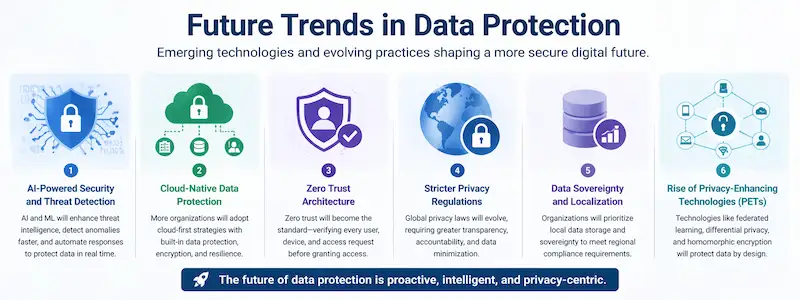
Alongside the incorporation of automated "nudge" learning into regular procedures, we are witnessing a shift toward immersive technologies such as VR/AR simulations that mimic high-pressure breach scenarios.
Frequently Asked Questions
About Data Protection Training
- How can training help to protect the security of data?
In the following ways, training can help to protect the security of data:
a) Creates a "Human Firewall",
b) Reduces Accidental Leaks,
c) Enforces Access Control Hygiene,
d) Ensures Compliance with Privacy Laws, and
e) Accelerates Threat Detection.
- What is the most effective way to prevent data breaches?
Implementing a multi-layered "defense-in-depth" strategy that combines strong technical measures (like encryption and MFA) with an ongoing culture of staff security awareness is the most effective way to stop data breaches.
- What are the 5 key responsibilities of a DPO?
The following are the 5 key responsibilities of a DPO:
a) Regulatory Liaison,
b) Grievance Redressal,
c) Internal Compliance Oversight,
d) Strategic Advisory, and
e) Incident Accountability.
- What are the 7 golden rules of data protection?
The following are the 7 golden rules of data protection:
a) Lawfulness, Fairness, and Transparency,
b) Purpose Limitation,
c) Data Minimization,
d) Accuracy,
e) Storage Limitation,
f) Integrity and Confidentiality (Security), and
g) Accountability.
- How can security awareness training reduce the risk of a data breach?
In the following ways, security awareness training can reduce the risk of a data breach:
a) Identifies Social Engineering,
b) Reduces Accidental Data Exposure,
c) Strengthens Credential Security,
d) Limits "Shadow IT" Risks, and
e) Shortens Incident Response Time.
- What are the four types of security training?
The following are the four types of securities training:
a) General Security Awareness Training,
b) Role-Based Security Training,
c) Technical Security Training, and
d) Compliance and Regulatory Training.
- What are the 5 C's in security?
The following are the 5 Cs in security:
a) Change,
b) Compliance,
c) Cost,
d) Continuity, and
e) Culture.
- What are some of the benefits of conducting security awareness training?
The following are some of the benefits of conducting security awareness training:
a) Significant Reduction in Successful Phishing,
b) Establishment of a "Human Firewall",
c) Improved Regulatory Compliance and Legal Standing,
d) Enhanced Incident Response Times, and
E) Protection of Brand Reputation and Trust.
Conclusion
Now that we have talked about what Data Protection Training is and how such training is helpful, you might want to learn more about how data breaches happen and in what ways. If we talk about Phishing, you can get in contact with Craw Security, offering a dedicated phishing simulation platform, “Phish Next.”
This platform will help practitioners to train in a way that will confront real-life phishing attacks and learn how to evade them in time. After several practice sessions, practitioners will be able to predict if a scenario imitates a phishing attack or not. What are you waiting for? Contact, Now!