AI-Based Social Engineering Attacks In 2026
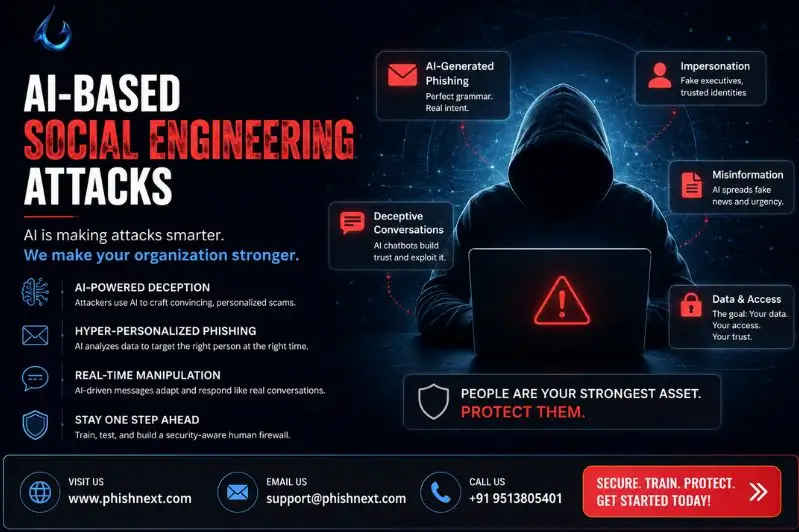
Do you know how vicious AI-Based Social Engineering Attacks can be for normal internet users? If not, then you are at the right place. Here, we will talk about the ways they phish the victims and steal their data.
Moreover, we will introduce you to a reliable phishing simulation platform offered by a reputable VAPT service provider. What are we waiting for? Let’s get straight to the topic!
What are AI-Based Social Engineering Attacks?
AI-based social engineering attacks automate the production of highly convincing, customized bait that trick victims into disclosing private information by utilizing machine learning and generative AI.
In contrast to conventional techniques, these attacks use deepfakes and natural language processing to massively imitate the voice, appearance, or writing style of reliable people. AI enables hackers to execute sophisticated, tailored campaigns that are much more difficult for conventional security filters to detect by eliminating human error and language obstacles.
Let’s take a look at what AI-Based Social Engineering Attacks are and how they are used to victimize victims!
How AI Enhances Traditional Social Engineering?
|
S.No. |
Factors |
How? |
|
1. |
Elimination of "Red Flags" |
AI eliminates the "clunky" mistakes that usually reveal phishing attempts by fixing language, spelling, and cultural quirks. |
|
2. |
Hyper-Personalization at Scale |
In order to concurrently create thousands of distinct, targeted messages, algorithms examine public profiles. |
|
3. |
Deepfake Audio and Video Impersonation |
To avoid visual and aural verification, generative models imitate the voices and faces of reliable individuals. |
|
4. |
Automated Reconnaissance |
In order to create comprehensive psychological profiles of possible victims, AI bots quickly scrape social media and compromised databases. |
|
5. |
Real-Time Adaptive Chatbots |
In order to establish trust and influence targets in real time, advanced LLMs converse naturally and fluidly. |
Key Techniques Used in AI-Based Social Engineering Attacks
The following are the key techniques used in AI-based Social Engineering Attacks:
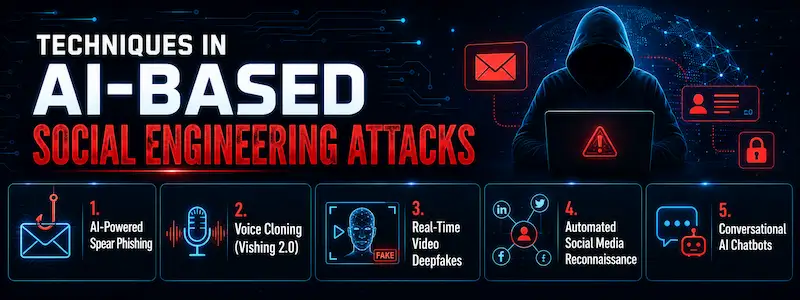
- AI-Powered Spear Phishing: AI creates context-aware, error-free emails that imitate a particular sender's tone in order to trick valuable targets.
- Voice Cloning (Vishing 2.0): Attackers may accurately mimic a person's voice for phony urgent phone calls using only a few seconds of audio.
- Real-Time Video Deepfakes: During live video conferences, hackers can pose as executives or coworkers thanks to synthetic media filters.
- Automated Social Media Reconnaissance: In order to find personal connections and interests for more persuasive bait, bots quickly scan public profiles.
- Conversational AI Chatbots: To establish rapport and gather sensitive data without arousing suspicion, large language models converse for extended periods of time.
The dangers of AI-generated deepfakes
The following are some dangers of AI-generated deepfakes:
● Financial Fraud at Scale: Criminals can use deepfakes to pose as executives during live video calls in order to approve large, fraudulent wire transactions.
● Erosion of Digital Trust: The public finds it challenging to discern between real evidence and AI-generated fabrications due to the pervasiveness of synthetic media.
● Industrialized Identity Theft: AI can circumvent contemporary multi-factor authentication methods by replicating an individual's biometric information, such as voice and facial traits.
● Political and Social Manipulation: It is possible to disseminate false information, provoke civil disturbance, or sway election results with convincing phony recordings of world leaders.
● Personal and Professional Defamation: Fake audio recordings and non-consensual synthetic images can be used to blackmail people or damage their reputations for nefarious purposes.
Automated Reconnaissance and Large-Scale Personalization
In order to create comprehensive psychological profiles of thousands of people at once, AI bots quickly gather enormous volumes of personal data from social media and open databases.
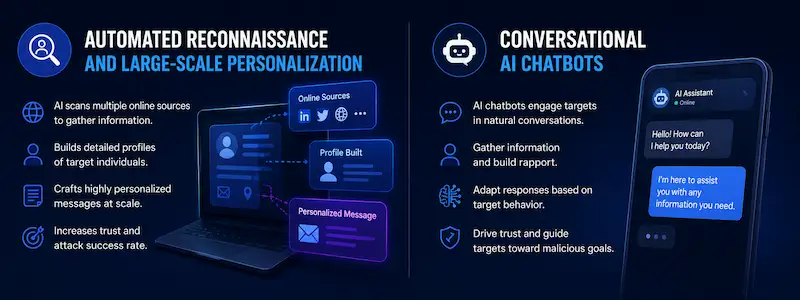
This makes large-scale manipulation seem like a personal, one-on-one conversation by enabling attackers to automatically provide hyper-personalized communications that reflect a victim's interests and writing style.
Real-World Examples and Case Studies
The following are the real-world examples and case studies:
a) The $25 Million Video Conference Heist (2024): In a historic case, a finance employee at the global company Arup in Hong Kong was duped into sending $25 million after participating in a video conversation in which the "CFO" and all other participants were actually deepfakes created by artificial intelligence.
The employee's initial misgivings were dispelled by seeing and hearing familiar "colleagues" during the live call, which ultimately resulted in the large-scale fraudulent transfer.
b) Slovakian Election Misinformation (2023): A sophisticated AI-generated audio tape supposedly showing a prominent contender discussing vote-rigging surfaced just days before the national election.
This instance demonstrated the ability of Vishing 2.0 to sway public opinion and democratic outcomes because the video became viral so fast that fact-checkers were unable to refute it before voters cast their ballots.
c) The UK Energy Company Voice Clone (2019): The CEO of a UK-based energy company received a call from someone who sounded just like his boss, the CEO of the German parent company, in one of the first known AI social engineering attempts.
The CEO was persuaded to send €220,000 to a "Hungarian supplier" in less than an hour after the AI-cloned voice convincingly imitated the boss's German accent and tone.
Psychological Triggers in the AI Era
The following are some psychological triggers in the AI Era:
- Heightened Sense of Authority: AI-generated deepfakes of government officials or high-level executives take advantage of people's propensity to blindly obey commands from perceived leaders.
- Manufactured Urgency and Panic: By simulating "emergency" calls from family members or superiors, voice cloning elicits an emotional "fight-or-flight" reaction that avoids rational analysis.
- The Illusion of Familiarity: AI generates a false sense of connection and safety by imitating the precise jargon, slang, and "inside jokes" found in a victim's previous social media posts.
- Exploitation of Cognitive Overload: AI is used by attackers to initiate "multi-channel" attacks, sending calls, SMS, and emails at the same time to overwhelm a victim's ability to make decisions until they make a mistake.
- Social Proof and Peer Pressure: AI bots have the ability to build whole networks of fictitious "friends" or "colleagues" that support a false link, giving the impression that the victim is the only one who is not taking part.
Detection and Mitigation Strategies
|
S.No. |
Factors |
What? |
|
1. |
Multimodal AI Detection Frameworks |
Putting in place specific security systems that flag synthetic content in real time by concurrently analyzing audio frequencies, metadata, and face discrepancies. |
|
2. |
Mandatory Out-of-Band (OOB) Verification |
Requiring staff members to verify high-value or urgent requests via a second, separate channel of communication, like a physical hardware key or a pre-verified phone number. |
|
3. |
Behavioral Anomaly Detection |
Identifying minute variations from a user's usual communication patterns, typing speed, or login locations using AI-driven security monitoring. |
|
4. |
Zero Trust Architecture (ZTA) |
Enforcing a rigorous "never trust, always verify" policy that mandates constant verification for all digital interactions, regardless of the sender's apparent authenticity. |
|
5. |
Advanced "Live-Fire" AI Simulations |
To develop "digital muscle memory" and enhance the ability to identify complex psychological triggers, employees are trained through realistic, AI-generated phishing and vishing exercises. |
The Role of AI in Defense
The following are the roles of AI in Defense:
● Predictive Threat Intelligence: To predict and stop new social engineering initiatives before they get to the target's mailbox, AI algorithms examine patterns in global data.
● Real-Time Deepfake Analysis: Defensive AI looks for "blood-flow" patterns or pixel irregularities in audio and video streams that indicate artificial manipulation but are not perceptible to the human eye.
● Automated Incident Response: As soon as a high-risk social engineering interaction is identified, intelligent algorithms immediately isolate compromised accounts and remove access permissions.
● Natural Language Understanding (NLU) for Phishing: Instead of only looking for harmful links, advanced NLU filters examine the mood and intent of messages to spot subtle psychological manipulation techniques.
● AI-Enhanced Biometric Security: To make sure a user is a genuine person and not a bot, defensive systems employ "liveness detection" and behavioral biometrics like typing rhythm and mouse movements.
Conclusion
Now that we have talked about what AI-Based Social Engineering Attacks are, you might want to protect yourself against such vicious attacks. For that, you can go for Phish Next, a dedicated phishing simulation platform offered by Craw Security.
Moreover, it will train the students with the latest & trending phishing simulation attacks to give them real-time experience. Such simulations train the brain to detect any suspicious text or mail to identify the trap within. What are you waiting for? Contact, Now!